

Business leaders today confront the challenge of deciphering complex customer behavior and optimizing marketing performance across fragmented digital landscapes. A meticulously planned GA4 event tracking strategy is no longer optional, it’s essential for generating actionable insights that directly drive revenue and foster sustainable growth. This article will articulate the strategic imperative of advanced GA4 data collection, demonstrating how to leverage it for superior SEO, Conversion Rate Optimization (CRO), and Paid Media outcomes. Readers will gain a robust methodological understanding for effective implementation, learn to identify and circumvent common pitfalls, and ultimately unlock maximum return on investment from their digital marketing efforts.
Why GA4 Event Tracking Matters Now
In today’s fiercely competitive digital environment, business leaders are grappling with escalating Customer Acquisition Costs (CAC) and a persistent lack of clarity on what truly drives conversions and sustains customer loyalty. The shift to Google Analytics 4 (GA4) represents both a significant challenge and an unparalleled opportunity to transcend superficial metrics, moving beyond mere page views to truly understand user intent and behavior. This landscape of unclear customer journeys and potentially wasted marketing spend demands a more sophisticated approach. Strategic GA4 event tracking emerges as the definitive solution, offering granular insight into user engagement and enabling data-driven decisions that directly impact your bottom line.
Traditional analytics platforms often provided a fragmented view, making it challenging to attribute value accurately or understand nuanced user interactions. GA4, with its event-driven data model, fundamentally changes this, offering a unified perspective on how users engage with your brand across websites and mobile apps. For business leaders, this translates directly to key financial metrics. Precise GA4 event tracking illuminates the true pathways to conversion, allowing you to identify what truly resonates with your audience. This insight is crucial for reducing CACs by optimizing spend towards high-performing channels and campaigns. Furthermore, understanding deep user engagement and preferences, cultivated through robust GA4 data, enables personalized experiences that enhance Customer Lifetime Value (CLV). By illuminating conversion pathways and optimizing resource allocation across SEO, CRO, and Paid Media efforts, a comprehensive GA4 measurement plan significantly improves Marketing ROI. In an era where every marketing dollar must deliver measurable impact, the strategic deployment of GA4 event tracking is paramount for informed decision-making and profitable growth.
Our Methodology for Granular GA4 Measurement
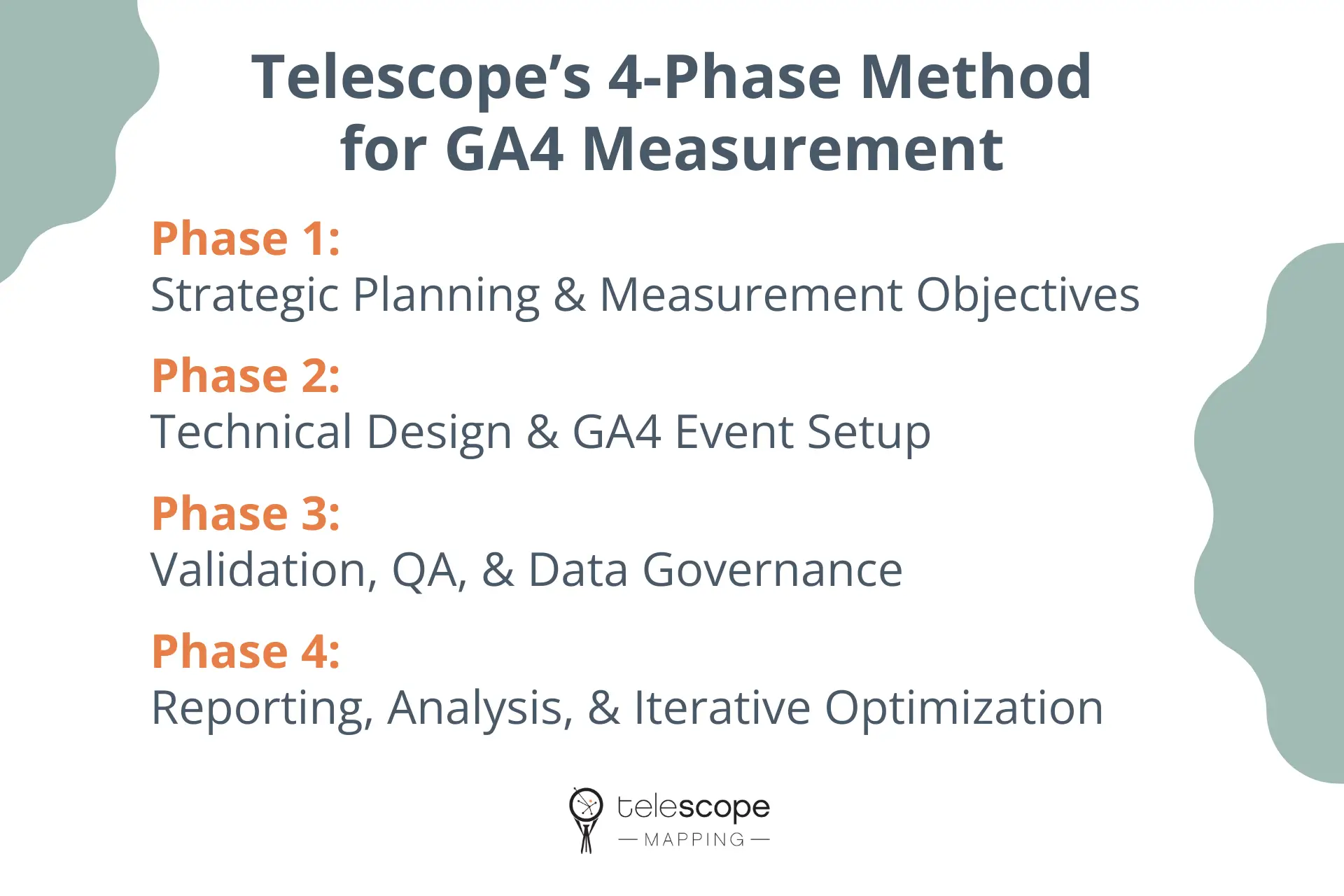
Our consultancy’s proven, structured approach to developing a comprehensive GA4 event tracking plan is designed to unlock truly actionable insights, moving your business beyond basic data collection to strategic intelligence. We break down our methodology into four clear, logical phases, ensuring a robust marketing analytics setup.
Phase 1: Strategic Planning & Measurement Objectives
This foundational phase defines the ‘what’ to track and ‘why.’ We begin by aligning GA4 event tracking with your overarching business objectives and key performance indicators (KPIs) for SEO, CRO, and Paid Media. This involves meticulously mapping your end-to-end customer journey, identifying every critical user interaction, micro-conversion, and macro-conversion point that influences revenue. For a B2B SaaS company, this might include whitepaper downloads, demo requests, or specific feature engagement. For an eCommerce brand, it could range from product views and additions to cart to checkout steps and wish list additions. This strategic groundwork forms the basis of your GA4 measurement plan, ensuring every tracked event serves a specific analytical purpose.
Phase 2: Technical Design & GA4 Event Setup
With objectives clearly defined, we then move into technical architecture. This phase involves architecting the data layer on your website or application to ensure it can accurately pass all necessary information. We then specify custom events, parameters, and user properties tailored to your business needs, going beyond GA4’s enhanced measurement to capture unique, high-value interactions. Leveraging Google Tag Manager (GTM) is central to this phase, enabling efficient, flexible, and scalable implementation of all tag manager events. This ensures robust GA4 conversion tracking across all touchpoints, from identifying content engagement relevant for SEO optimization, to capturing critical checkout steps for CRO improvements, and precisely tracking ad interactions to refine Paid Media strategies.
Phase 3: Validation, QA, & Data Governance
Data without accuracy is misleading. This phase is dedicated to implementing rigorous testing protocols to ensure data accuracy, consistency, and completeness. We conduct thorough quality assurance (QA) checks, debugging the implementation, and cross-referencing collected data with your defined business goals. This involves verifying that custom events fire correctly, parameters are populated accurately, and conversions are being recorded as expected within GA4. Furthermore, we establish ongoing data governance procedures and documentation, ensuring data integrity is maintained over time.
Phase 4: Reporting, Analysis, & Iterative Optimization
Our final phase transforms raw data into strategic intelligence. We develop custom reports and explorations within GA4, tailoring dashboards to highlight key insights for various stakeholders across your organization. Where beneficial, we integrate GA4 data with other marketing platforms, CRM systems, or data visualization tools for a holistic view of performance.
Crucially, we establish a continuous feedback loop. Insights derived from this analysis, like identifying high-performing content for SEO optimization, friction points in conversion funnels for CRO, or effective ad creatives for Paid Media, fuel a cycle of continuous optimization. This ensures that your GA4 event tracking strategy constantly evolves to drive maximum growth.
 Common Pitfalls in GA4 Event Tracking
Implementing GA4 event tracking without a strategic, structured framework can lead to significant data gaps, skewed insights, and ultimately, misinformed business decisions. Recognizing these common pitfalls is the first step toward building a truly effective marketing analytics setup.
Absent Comprehensive Measurement Plan
Many businesses simply enable “enhanced measurement” or track a random assortment of GA4 event setup points without a clear strategic roadmap. This often results in a deluge of data that provides little actionable insight, akin to having many puzzle pieces but no picture to guide their assembly. The absence of a clear GA4 measurement plan linked directly to business objectives leads to data noise rather than clarity.
Before any technical implementation, you must undertake a thorough exercise of customer journey mapping. Define specific, measurable KPIs for each of your SEO, CRO, and Paid Media initiatives. Understand what user actions genuinely contribute to your business goals. This upfront planning ensures every event you track is purposeful and contributes to a coherent narrative of user behavior.
Overlooking Custom Event Needs
Businesses frequently miss the opportunity to track unique, high-value interactions specific to their particular business model or industry. While GA4 offers many out-of-the-box events, critical actions such as a B2B demo request, a specific product configuration step in an eCommerce solution, or deep engagement with an interactive tool are often proprietary and require bespoke tracking. Failing to capture these means missing crucial GA4 conversion tracking data.
The correction for this is to conduct a detailed audit of all critical user actions and micro-conversions on your digital properties. Actively identify those unique interactions that signify user intent or progression through your sales funnel. Then, design custom events and associated parameters via GTM to precisely capture these nuanced behaviors, providing a richer, more relevant data set.
Inadequate Data Layer Implementation
A poorly structured, incomplete, or entirely missing data layer is a pervasive issue that severely hinders accurate and scalable event collection. Without a robust data layer, GTM struggles to extract consistent and correct information from your website, leading to unreliable data and frustrating debugging efforts. This compromises the integrity of your GA4 event tracking.
To avoid this, prioritize the development and consistent implementation of a well-defined data layer strategy. This involves working with your development team to ensure that all necessary information (such as product IDs, user IDs, transaction values, or content categories) is consistently pushed to the data layer. A solid data layer empowers GTM to reliably pass precise information to GA4, ensuring robust GA4 conversion tracking.
Frequently Asked Questions
How does a robust GA4 event tracking plan directly impact our marketing ROI?
By providing granular insights into precise user behavior, a well-implemented GA4 event tracking plan enables more accurate attribution, helping you understand which channels and campaigns are truly driving value. It identifies high-performing segments and content, reveals friction points in your user journeys, and uncovers opportunities for optimization. This allows for more intelligent budget allocation, reduced wasted spend, and higher conversion rates across SEO, CRO, and Paid Media, directly boosting your overall marketing ROI.
What’s the difference between “enhanced measurement” events and custom events in GA4, and which should we prioritize?
Enhanced measurement events (e.g., scrolls, outbound clicks, file downloads) offer a convenient baseline of activity that GA4 automatically collects. However, custom events are tailored specifically to your unique business objectives, tracking actions critical to your conversion funnel, such as “lead_form_submit,” “product_config_complete,” or “view_pricing_page.” While enhanced measurement provides a helpful foundation, prioritizing custom events via strategic event setup is crucial. These events capture the specific, high-value conversion actions unique to your customer journey, making them indispensable for precise conversion tracking and actionable insights.
How can we ensure the accuracy and reliability of our GA4 event data?
Data accuracy and reliability are paramount. They hinge on several key factors: beginning with a meticulously designed GA4 measurement plan that aligns with business objectives, followed by precise GA4 event setup through GTM. Continuous validation is non-negotiable. This involves regular QA processes, leveraging GA4’s DebugView and GTM’s preview mode to verify event firing and parameter capture. Furthermore, establishing ongoing data governance procedures, including documentation and periodic audits, is essential to maintain data integrity and trustworthiness over the long term.
Can GA4 event tracking truly optimize both our SEO and Paid Media efforts simultaneously?
Absolutely. A unified GA4 event tracking plan provides a holistic, user-centric view of the customer journey, breaking down traditional channel silos. This allows you to observe how organic searches (SEO) contribute to specific conversions and how interactions with paid advertisements (Paid Media) influence subsequent engagement. This integrated perspective informs cross-channel strategy, enabling more effective audience targeting, content optimization for organic visibility, and improved ad creative testing and attribution modeling. By understanding the interplay between channels, you can maximize performance across both SEO and Paid Media, driving overall business growth.
Conclusion & Next Steps
A sophisticated GA4 event tracking plan is far more than a technical implementation, it’s a strategic investment that empowers your business with unparalleled clarity into customer behavior. By adhering to a methodical framework, encompassing meticulous planning, precise GA4 event setup, rigorous validation, and a commitment to iterative optimization, you can transform raw data into actionable intelligence. Discover how our strategic approach to GA4 event tracking and comprehensive marketing analytics setup can unlock new revenue streams for your business by scheduling a complimentary strategy session with one of our experts today.