Getting a visitor to your site is only half the job. What happens in the following few seconds determines whether that visit turns into anything at all. A high bounce rate is usually a sign that visitors aren’t finding what they expected, or aren’t being given a clear reason to stick around.
The good news is that bounce rate is one of the more fixable metrics in digital marketing, once you understand what’s actually driving it. This article breaks down how to reduce bounce rate, covering what it really measures, a practical framework for reduction, and the tactics that turn a fleeting visit into genuine engagement your business can actually build on.
What Is Bounce Rate?
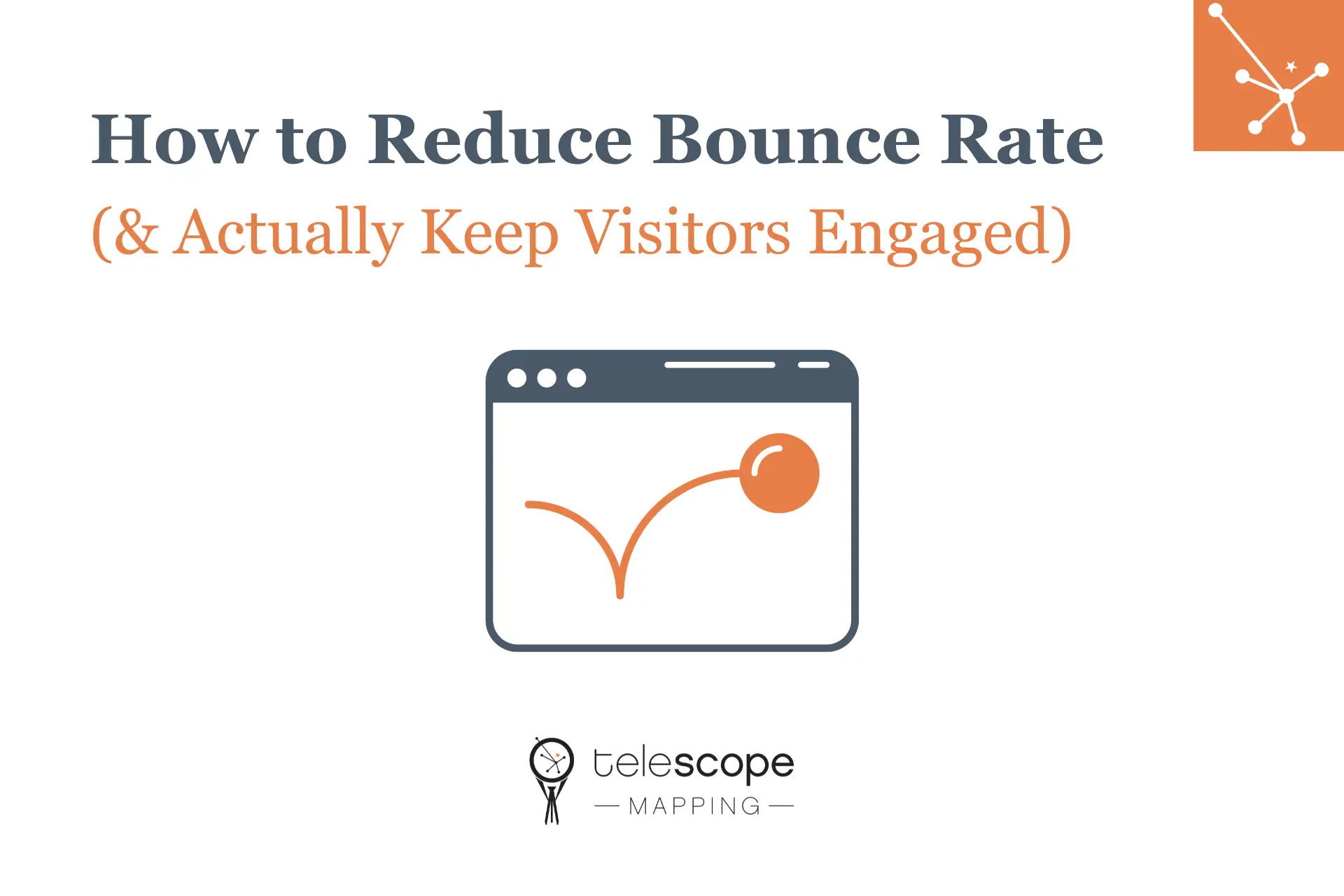
Bounce rate is the percentage of single-page sessions on your site— visits where someone lands on a page and leaves without clicking anything else. It’s a simple metric, but it’s also one of the clearest early signals of whether your site is actually doing its job. A high bounce rate doesn’t just mean fewer conversions today, it actually means the marketing spend that brought that visitor to your site didn’t get a fair chance to pay off.
It’s worth setting expectations here, too: there’s no universal “good” bounce rate to chase. Industry benchmarks exist (commonly cited ranges are roughly 26-40% for eCommerce and 41-55% for content-heavy sites), but the right number depends heavily on your industry, traffic source, and page type. A blog post will naturally see a higher bounce rate than a product page, and that’s not a problem to solve. The real goal isn’t hitting a specific number, it’s steadily reducing bounce rate in a way that reflects genuinely better engagement over time, rather than treating a single industry average as the finish line.
Why This Deserves Real Attention
Every visitor who bounces represents a real cost. Whatever brought them to your site, whether it be paid ads, content, SEO strategies, etc., was an investment– a bounce means that investment didn’t get the chance to convert. A high bounce rate effectively inflates your customer acquisition cost, because you’re paying for traffic that never gets the opportunity to become a lead. It also has a compounding effect on your business pipeline: fewer engaged visitors means fewer marketing-qualified leads, fewer sales-qualified leads, and ultimately fewer closed deals, since each stage of the funnel depends on visitors making it past that first page.
That being said, there’s also an upside worth noting, too: bounce rate is one of the more responsive metrics to improve. That means small, well-targeted changes to a page’s clarity, speed, or messaging often produces a measurable shift in engagement relatively quickly, which makes it a genuinely satisfying area to invest in compared to slower-moving metrics like domain authority. A persistently high bounce rate can also affect how search engines perceive your content’s relevance, so improving engagement tends to support your SEO performance at the same time: one effort, two wins.
How to Reduce Bounce Rate and Build Real Engagement
Knowing how to reduce bounce rate well isn’t about a single quick fix. It’s a cycle of understanding why visitors leave, designing better experiences, testing what actually works, and continuing to refine over time. Skipping straight to design changes without first understanding the real cause tends to produce guesses rather than genuine improvement. Telescope Mapping generally works through this in four phases, each paired with the mistake most likely to undercut it.
Diagnosing Why Visitors Are Leaving
Real improvement starts with understanding, not guessing. This means digging into analytics, heatmaps, session recordings, and sometimes direct user surveys to understand not just which pages have high bounce rates, but why. What were visitors expecting when they landed, and did the page deliver it? Segmenting by new versus returning visitors, organic versus paid traffic, and desktop versus mobile often reveals that a single “high bounce rate” number is actually several distinct problems in disguise (and each have a different fix).
The main mistake to avoid? Overlooking a mismatch between what brought someone to the page and what the page actually delivers. If an ad promises one thing and the landing page delivers something else, visitors leave immediately, no matter how well-designed that page is. Keeping ad copy, keywords, and landing page content genuinely aligned prevents this entirely avoidable category of bounce, and it’s often the single highest-leverage fix available since it costs nothing beyond a closer review of existing campaigns and their corresponding landing pages.
Designing a Stronger Visitor Experience
With real diagnostic insight in hand, the next step is refining the elements that most directly shape a first impression: a value proposition that’s immediately clear above the fold, headlines that match what the visitor was actually searching for, intuitive navigation and calls-to-action that make the next step obvious. Every change here should trace back to a specific insight from the diagnostic phase (not a general design preference), since design decisions grounded in real user behavior consistently outperform ones based on internal taste.
The mistake to avoid here is leaving visitors without a clear value proposition or an obvious next step. If someone can’t tell “what’s in it for them” within a few seconds, or doesn’t know what to do next, they’ll leave rather than explore. A clear, benefit-driven headline paired with one obvious call-to-action solves this more reliably than a page full of options competing for attention.
Testing and Personalizing What Actually Works
Insight only becomes value once it’s validated. A/B or multivariate testing lets you confirm whether a change genuinely improves engagement rather than just seeming like a good idea. Each test result should inform the next one, building a compounding body of evidence about what your specific audience responds to. Personalization builds on this: using what you know about a visitor’s segment or behavior to show more relevant content or offers makes each visit feel tailored rather than generic, which meaningfully increases the odds someone sticks around.
Treating every visitor and every page the same way, with no adjustment for context is the mistake that should be avoided here. A first-time visitor from a cold search and a returning customer from an email campaign have very different needs, and pages that ignore that difference miss real opportunities to keep someone engaged– essentially serving a one-size-fits-all experience to a genuinely diverse audience.
Monitoring Performance and Adapting Over Time
Reducing bounce rate isn’t a one-time project, it’s an ongoing practice. Tracking metrics beyond bounce rate itself, like average session duration, pages per session, scroll depth, and engagement with specific elements, gives a fuller picture of what’s actually working. This ongoing view lets you adapt as user behavior and the competitive landscape shift, rather than optimizing once and assuming the job is done.
A page that performs well today can quietly decay as expectations and competitors evolve. The businesses that hold their gains are the ones that keep watching and adjusting, treating engagement the way they’d treat any other metric that matters to the bottom line.
This is often where businesses find themselves stretched thin: not because any one phase is complicated, but because doing all four well, consistently, alongside everything else a marketing team juggles, takes real dedicated time and a level of ongoing attention that’s hard to sustain internally. Telescope Mapping works directly with clients through exactly this cycle, from initial diagnostics through ongoing testing and refinement, turning bounce rate from a recurring frustration into a metric that steadily improves.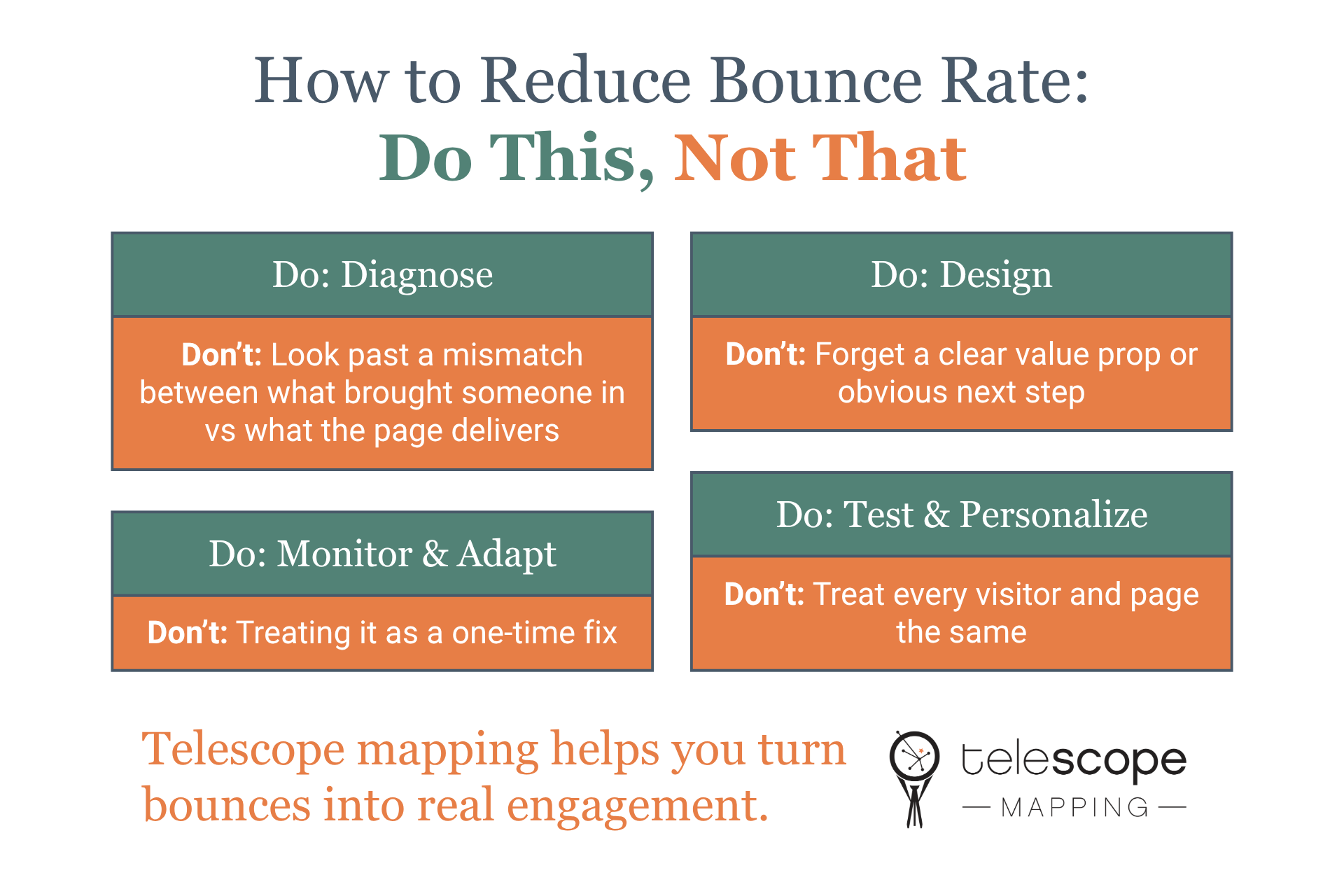
A Few More Tactics Worth Trying
Beyond the core framework, a handful of specific, lower-lift tactics tend to make a real difference: improving page load speed (even a one-second delay measurably increases bounce likelihood), tightening mobile responsiveness so the experience feels genuinely built for phones (rather than shrunk down from desktop), and using contextual engagement prompts, like a well-timed exit-intent offer, an unobtrusive chatbot, or a relevant related-content suggestion, to give a visitor on the verge of leaving one more reason to stay. None of these replace the framework above, but they’re often the fastest wins available while deeper diagnostic work is underway. They tend to benefit every page on the site rather than just the one being actively optimized.
How to Reduce Bounce Rate: Frequently Asked Questions
What’s actually considered a “good” bounce rate?
It depends heavily on industry, page type, and traffic source– there’s no single universal target. A content-heavy blog will typically run higher than a product or checkout page, and that’s to be expected rather than flagged. The more useful goal is steady, page-specific improvement over time rather than chasing an industry benchmark number that may not even apply to your particular page.
How quickly can bounce rate improvements show results?
Some changes, like fixing a slow-loading page or clarifying a confusing headline, can show a measurable shift within weeks. More substantial gains (especially those coming from testing and personalization), tend to build over a few months as insights compound and get validated through real data rather than assumption.
Is a high bounce rate always a bad sign?
Not necessarily. Some pages, like a blog post that fully answers a reader’s question or a contact page someone visits just to find a phone number, are expected to have a higher bounce rate simply because the visitor got what they needed in one visit. Context matters more than the raw number, and treating every high-bounce page as a problem to fix can waste effort on pages that are actually working exactly as intended. It’s essentially pulling attention away from the pages that genuinely need it.
Do I need a large volume of traffic to run meaningful tests?
It helps, but it’s not a strict requirement. Lower-traffic pages can still benefit from qualitative insights like session recordings and heatmaps, even if formal A/B testing takes longer to reach statistical significance. Prioritizing your highest-traffic pages for formal testing while using qualitative methods elsewhere is a practical way to make progress regardless of scale.
Your Bounce Rate, Going Forward
Understanding how to reduce bounce rate is ultimately about respecting the effort it took to earn a visitor’s attention in the first place, and making sure that effort has a real chance to pay off. A systematic, data-driven approach (diagnosing the real cause, designing thoughtfully, testing rigorously, and staying engaged over time), turns bounce rate from a source of frustration into one of the more reliably-improvable metrics in your marketing stack. The gains tend to compound as each round of testing sharpens your understanding of what your audience actually responds to.
If you’re ready to turn more of your traffic into real engagement, that’s exactly the kind of work Telescope Mapping does alongside clients every day. Schedule a complimentary strategy session with one of our experts today to see where your site’s biggest opportunities are hiding.