

The choice between hiring an SEO team and outsourcing SEO services represents a pivotal strategic decision for any business leader committed to sustainable digital growth. In an increasingly competitive online landscape, where organic visibility directly translates to market share and revenue potential, correctly resourcing your SEO efforts is paramount. This article serves as a strategic guide, outlining a robust framework for evaluating your options, understanding the critical implications of each model, and ultimately empowering you to make a decision that aligns perfectly with your overarching business objectives.
Why SEO Staffing Decisions Matter Now
For business leaders, how to staff SEO is a fundamental strategic choice impacting digital growth. The contemporary search landscape is an intricate ecosystem, constantly reshaped by algorithm updates, shifting user behaviors, and an explosion of digital content. A reactive or fragmented approach to SEO is simply unsustainable.
Consider its direct impact on key financial metrics. A well-executed SEO strategy significantly reduces Customer Acquisition Cost (CAC) by driving organic, inbound leads, enhancing Customer Lifetime Value (CLV) through brand authority and trust. Robust organic visibility also expands market share, positioning your business as an authoritative solution.
Macro trends underscore this urgency. Intensifying digital competition, rapid changes in search algorithms, and the demand for integrated, data-driven marketing efforts mean SEO insights must be woven into broader strategic initiatives. The wrong resourcing model leads to stagnation and missed opportunities, and the right one unlocks substantial, sustainable revenue growth.
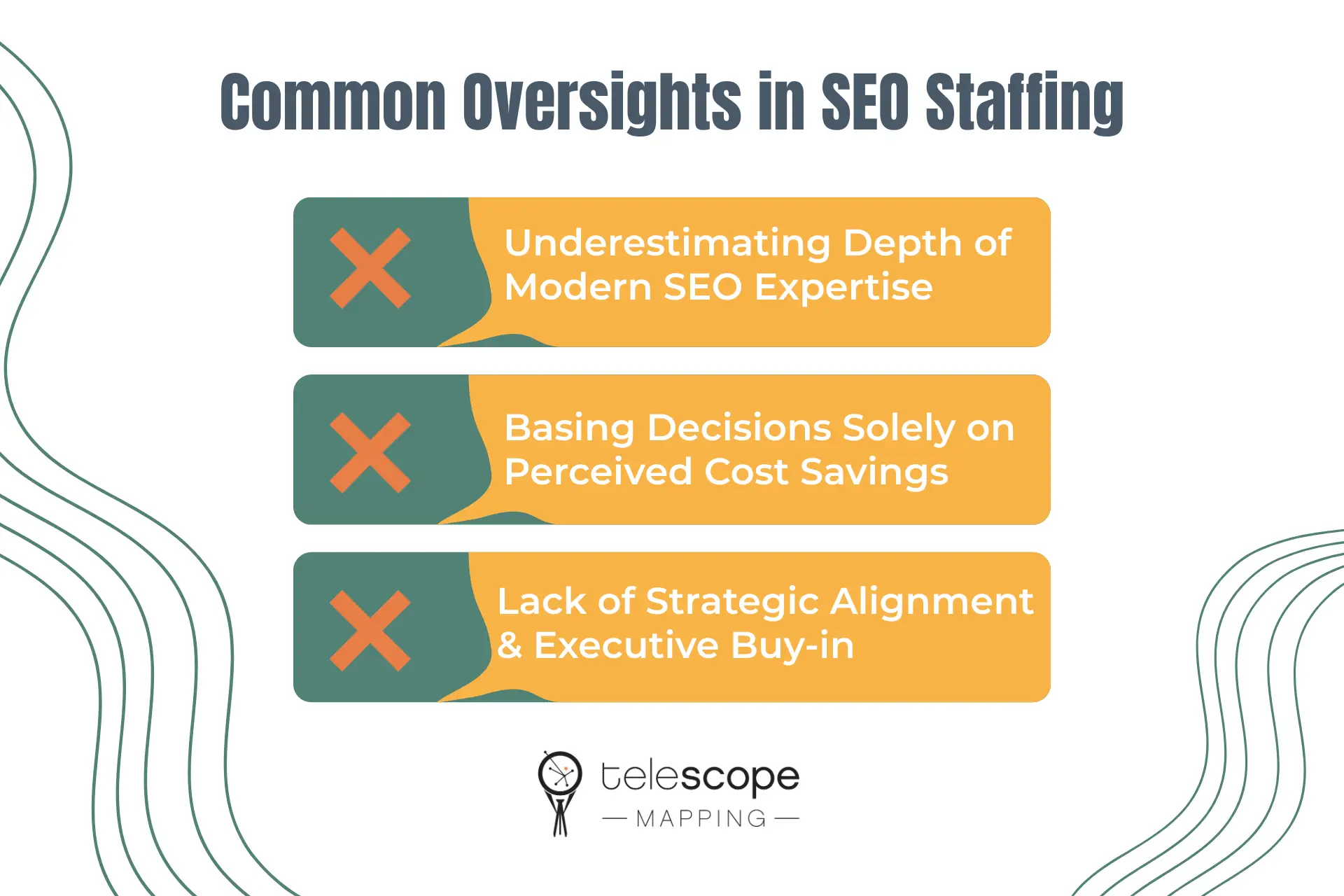
Common Oversights in SEO Staffing
Even with the best intentions, businesses frequently stumble when attempting to implement their SEO staffing strategy. Recognizing these common pitfalls and understanding the correct strategic approach is vital to unlocking your full organic potential.
Pitfall 1: Underestimating Depth of Modern SEO Expertise
Many business leaders view SEO as a singular skill set, often conflating it solely with basic on-page optimization, underestimating its true complexity. Modern SEO encompasses technical SEO (site architecture, crawlability, mobile-friendliness), sophisticated content strategy, local SEO, international SEO, advanced analytics, user experience (UX) signals, link earning, and much more.
Businesses that underestimate this complexity often hire a generalist who quickly becomes overwhelmed or struggles to keep pace with all necessary disciplines. This leads to subpar performance, missed opportunities, and a fragmented strategy. The internal SEO team structure ends up under-resourced and unprepared. To avoid this, acknowledge that truly effective SEO requires a diverse array of specialized skills. If pursuing an in-house model, plan for a team with varied expertise or budget for extensive training and external support. If opting for an agency, ensure their team demonstrates comprehensive capabilities across all relevant SEO domains.
Pitfall 2: Basing Decisions Solely on Perceived Cost Savings
Another common oversight is making the in-house SEO vs agency decision primarily on the perceived upfront cost of in-house SEO (salaries) being lower than an agency retainer. This narrow view often ignores critical factors like recruitment time, advanced SEO tool costs, the opportunity cost of slower execution, and an agency’s collective experience from multiple industries.
False economies lead to stagnated growth. A “cheaper” internal resource might lack the experience to navigate complex technical issues or capitalize on emerging trends, ultimately costing the business far more in lost organic traffic and revenue. Instead, adopt an ROI-driven investment strategy. Evaluate the long-term value and scalability each model offers. Consider not just the expenditure, but the potential revenue generated, the speed of execution, the breadth of expertise, and the overall strategic impact. A higher agency fee often translates to a faster, more effective strategy due to specialized knowledge and economies of scale in tool access and training.
Pitfall 3: Lack of Strategic Alignment & Executive Buy-in
Too often, SEO is treated as a siloed marketing tactic, delegated to junior staff without proper integration into broader business objectives or sufficient executive sponsorship. The consequence is disconnected efforts, poor prioritization, and difficulty securing necessary resources. And, without executive buy-in, SEO initiatives struggle to gain traction, limiting cross-functional collaboration and leaving revenue potential untapped.
The correct approach is to elevate SEO to its rightful place as a strategic business growth driver. Ensure that SEO goals are intrinsically linked to overall business objectives and have strong leadership sponsorship. This involves regular reporting to executives, demonstrating ROI, and fostering cross-departmental collaboration to leverage SEO insights across sales, content creation, and product development.
 Our Methodology for Optimal SEO Resourcing
Making an informed decision about your SEO resourcing requires a structured approach, moving beyond simplistic cost comparisons to a comprehensive evaluation of strategic fit and long-term value. Our methodology guides you through a four-phase framework designed to ensure your SEO investment yields maximum impact.
Phase 1: Strategic Objective & Gap Analysis
The foundation of any effective resourcing decision lies in clarity. What are your specific, measurable business goals for SEO? Are you aiming for increased organic traffic, higher conversion rates for specific keywords, local market dominance, or enhanced brand authority?
Once objectives are clear, a thorough assessment of your existing internal digital marketing capabilities is essential. This involves identifying current skill sets within your team, evaluating existing SEO tools and technologies, and honestly pinpointing skill gaps or resource deficits that would hinder achieving your defined SEO objectives.
Phase 2: Resource & Cost-Benefit Assessment
This phase delves into the financial and operational implications of each model. When considering the cost of in-house SEO, you must factor in more than salaries. It includes recruitment, benefits, training, the procurement and maintenance of advanced SEO tools (which can be substantial), and management overhead. Compare this against agency retainers, which typically bundle expertise, tools, and project management into a single fee. Beyond direct costs, evaluate opportunity costs, such as the time taken to build and manage an internal team versus the speed to market an agency can offer. A comprehensive in-house SEO vs agency financial analysis requires a long-term perspective on ROI rather than a short-term focus on upfront expenditure.
Phase 3: Operational Model Selection & Integration
This is where the strategic choice crystallizes. Each model presents distinct advantages and disadvantages regarding depth of specialization, scalability, cultural fit, and strategic control.
In-House SEO offers deep proprietary knowledge of your products, services, and internal processes. It fosters seamless integration with other internal teams and provides direct strategic control. However, building an expert SEO team structure can be challenging due to the scarcity of multi-skilled professionals, and scaling expertise for specialized areas like international SEO or technical audits can be slow and expensive.
An SEO agency provides immediate access to diverse, specialized expertise across various SEO disciplines, offering scalability and flexibility. Agencies bring external perspectives, best practices from working with multiple clients, and often possess cutting-edge tools. They can accelerate time-to-market for complex campaigns and offer a breadth of experience that is difficult for a single internal team to replicate. The consideration often shifts to finding the right agency partner for your specific needs, rather than solely a binary choice.
Phase 4: Performance Measurement & Optimization
Regardless of the chosen model, establishing robust Key Performance Indicators (KPIs) and a clear reporting structure is paramount. Define what success looks like from the outset and implement comprehensive tracking mechanisms. This allows for continuous performance monitoring, enabling data-driven adjustments and accountability. Regular optimization cycles are crucial for adapting to market shifts, guaranteeing sustained strategic value from your SEO investment.
Frequently Asked Questions
When is an in-house SEO team definitively the better choice for my business?
An in-house SEO team is often the superior choice when your business has a deeply proprietary product or service requiring highly specialized, internal knowledge that is difficult for an external agency to replicate quickly. This model thrives with significant, ongoing content creation, a strong digital infrastructure demanding constant internal oversight, and a long-term commitment to developing internal expertise. It fosters seamless integration with product, development, and sales teams, allowing real-time strategic alignment and deep cultural fit.
How should I evaluate an SEO agency effectively to ensure a strong partnership?
To ensure a strong partnership, evaluate an SEO agency based on several key criteria beyond just their service offerings. Look for a proven track record with demonstrable case studies from similar industries or business models. Demand transparent reporting that clearly links SEO activities to tangible business outcomes and ROI, not just vanity metrics. Assess their strategic alignment, ensuring they genuinely understand your business objectives and market challenges. Prioritize agencies with specialized expertise in areas critical to your growth, such as technical SEO, international SEO, or specific content niches. Finally, consider cultural fit and communication style for a collaborative and productive working relationship.
Beyond the staffing model, what are the key factors for ensuring strong ROI from my SEO investment?
Irrespective of whether you choose an in-house team or an agency, several critical factors underpin strong SEO ROI. First, establish clear, measurable KPIs directly tied to business outcomes, such as qualified lead generation, revenue from organic search, or market share growth. Second, implement robust tracking and analytics for accurate performance attribution and improvement identification. Third, commit to continuous optimization, understanding that SEO is an ongoing process requiring regular adjustments and strategic pivots. Fourth, ensure strong executive buy-in and integrate SEO insights across all sales and marketing functions to maximize its impact and leverage its intelligence.
Conclusion & Next Steps
The decision regarding your SEO resourcing model is a strategic inflection point, carrying profound implications for your business’s online visibility, lead generation, and overall revenue growth. Whether you opt for the deep integration of an in-house team or the specialized agility of an agency, the goal remains consistent: to build a robust, future-proof SEO strategy that positions your business for enduring success. To discover how Telescope Mapping’s strategic approach to SEO resourcing can unlock new revenue streams for your business, schedule a complimentary strategy session with one of our experts today.