

A cannabis SEO pitch can sound very convincing: a polished deck, logos from other brands, and a promise to put your dispensary on the first page of Google within 90 days. The harder part is knowing which agencies can deliver that in a heavily regulated industry and which are just guessing. This guide covers what to look for in a cannabis SEO agency before you sign: the experience to verify, the questions to ask, the red flags to watch for, and the contract terms that protect you if the fit isn’t right.
Why Cannabis SEO Calls for a Specialist
Most major advertising platforms restrict or prohibit cannabis ads, so search engine optimization (SEO) is one of the few dependable ways for cannabis businesses to reach people who are already looking– and that raises the stakes on who handles it. Rules on what you can say, show, and promote differ by jurisdiction and change often.
In the US, for example, state rules often require a license number on advertising, age verification on websites, and a minimum share of adult viewers for digital ads, while most bar health claims and anything that appeals to minors, and a few require regulator approval before marketing runs. An agency that treats a dispensary like any other local business can publish content that creates legal and reputational problems, not just weak rankings. A good cannabis SEO agency has to get two things right at once: visibility and compliance.
Six Things to Look for in a Cannabis SEO Partner
Six qualities separate a cannabis SEO agency that can handle the industry nuances well from those that only say they can. An agency doesn’t have to be perfect on all six, but gaps in experience and compliance are the riskiest to overlook, so give those two the most weight.
1. Verifiable Cannabis Experience.
Ask for case studies with real outcomes, and speak with at least one current or former cannabis client. Ideally, that client is similar to your business. The common mistake is accepting a long client list at face value without asking what the agency actually did for each one.
2. A Compliance Process, Not Just a Promise.
Anyone can say they understand the rules. Ask who reviews content before it goes live, how the agency tracks rule changes in each place you operate, and what happens when a page needs correcting. A strong agency can describe these steps concretely, and it will say plainly that its work doesn’t replace your own legal advice.
3. A Cannabis-Aware Keyword and Content Strategy.
People search for cannabis products, strains, and local stores in patterns of their own, and content has to educate and inform without crossing promotion or health-claim lines. Look for an agency that can show how it plans topics, handles sensitive terms, and writes in a way that earns trust without overpromising.
4. A Real Local SEO Plan.
For dispensaries, much of the opportunity sits in map results and “near me” searches. Ask how the agency manages your Google Business Profile listings, keeps your name, address, and hours consistent across directories, and builds location pages that are genuinely different from one another.
5. Reporting Tied to Business Results.
Rankings and traffic are a starting point, but the numbers that matter are calls, direction requests, menu views, online orders, and leads. Ask to see a sample report. If it’s mostly a list of keyword positions, you’ll have trouble telling whether the work is paying off.
6. Honest Expectations.
SEO takes months, and no one controls what Google does. An agency that gives a realistic timeline, explains what could slow progress, and declines to guarantee rankings is easier to trust than one promising speed.
Match the Cannabis SEO Agency to Your Type of Business
Cannabis businesses don’t all need the same thing from SEO, so the right questions depend on what you run:
- Dispensaries and retail chains depend on local visibility.
- Look for a track record with map results, location pages, and keeping details consistent across many listings.
- Cultivators and licensed producers often gain more from brand authority and educational content than from local rankings.
- Ask how the agency builds trust with content that informs without making prohibited claims.
- Product brands and edibles makers need to be found when people research products and where to buy them.
- Ask how the agency handles product pages, retailer listings, and the rules about how products can be shown online in your area.
- Ancillary and B2B companies, such as packaging suppliers or software providers, sell to other businesses.
- They’re better served by an agency with B2B search experience than one focused on local retail.
The criteria above are easiest to test live. These questions, and what a strong answer includes, give you a quick way to compare agencies side by side.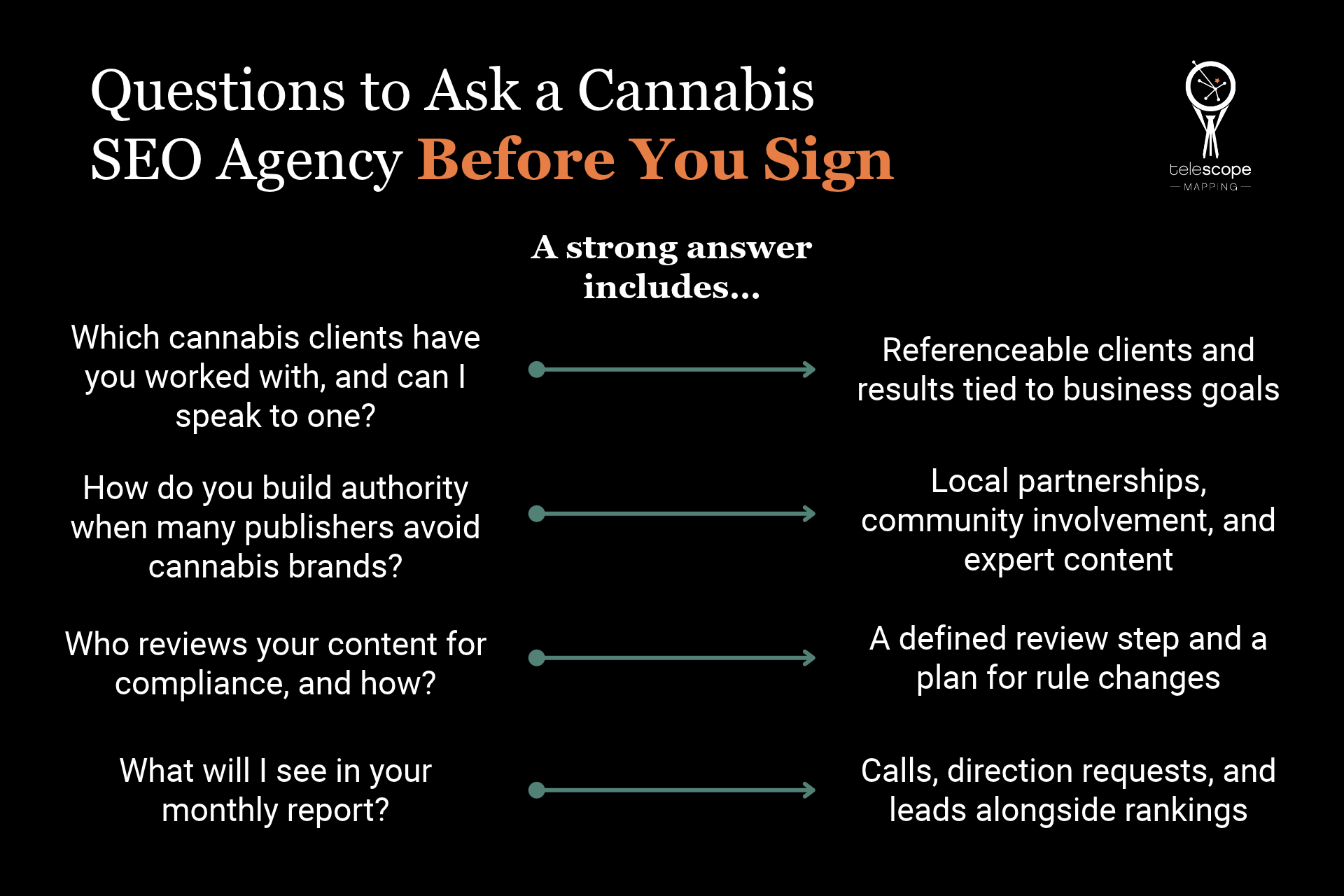
What a Good First 90 Days Looks Like
A clear start is one of the best signs of a well-run agency, so ask to see the plan. A strong first 90 days usually moves through three stages:
- Month one: audit and baseline.
- The agency reviews your site’s technical health, local listings, existing content, and compliance exposure, then records a starting point for rankings, traffic, calls, and leads.
- Month two: priority fixes and planning.
- The most important problems get fixed first, such as slow pages, inconsistent listings, or content that needs correcting, and you receive a content plan built around real customer questions.
- Month three: publishing and first reporting.
- New and updated pages start going live, and your first report compares results against that baseline in plain language.
Meaningful results take longer than 90 days, but you should see clear progress on the work itself, and you should always know what happens next.
Red Flags to Walk Away From
Some warning signs show up in the sales process itself:
- Guaranteed rankings or deadlines.
- As mentioned, no one can promise a number-one position or a date.
- Shortcuts around the rules.
- Anything involving hidden content or “working around” platform or legal limits puts your business at risk.
- Bought links or fake reviews.
- Both break search engine guidelines and can lead to penalties, and fake reviews may also breach consumer protection rules.
- Secrecy about tactics.
- If an agency won’t explain what it’s doing and why, you can’t judge whether it’s safe.
- A one-size-fits-all package.
- Scope and pricing that ignore your number of locations, competition, or product type point to a template, not a strategy.
- Pressure to sign quickly.
- An offer that expires this week leaves no time to review the terms properly.
Contract and Pricing Terms to Check
Even a strong pitch deserves a careful look at the paperwork. Before you sign, check these:
- Term length and exit terms.
- Look at how long the commitment runs, how much notice you need to leave, and whether you’re locked in if results stall.
- Ownership.
- You should own your content, website, analytics, and business listings, with accounts set up in your name rather than the agency’s.
- What’s included.
- Spell out how many pages or posts per month, how many locations, what link and local work is covered, and how often you’ll get reports. Vague phrases like “ongoing optimization” make proposals hard to compare.
- Pricing model.
- Monthly retainers are common, while project-based pricing can suit a defined need. Compare scope, not just price, because the lowest quote often covers the least.
- Responsibility for changes.
- Ask who handles it if content must be changed or removed for compliance reasons.
How Telescope Mapping Can Help
Choosing a cannabis SEO agency is a big commitment, and a second set of eyes helps. Telescope Mapping works with businesses on dispensary SEO strategy and can review a proposal against this checklist, talk through whether you need a cannabis specialist or a broader growth partner, or build a plan around what you want to achieve. If you’re comparing agencies right now, we can help you pressure-test what you’re being told.
Cannabis SEO Agency FAQs
Do I need a cannabis specialist, or can a general agency work?
A general agency can handle the technical fundamentals, but cannabis adds compliance, content limits, and local retail dynamics that many haven’t seen. A specialist is usually the safer default.
How long does cannabis SEO take to work?
Technical fixes can show results within weeks, while meaningful gains in rankings and traffic usually build over several months. Your market’s competition and your starting point both affect the timeline.
What if we operate in more than one state (or province)?
Rules differ by location, so ask how the agency handles each market: separate compliance checks, location-specific pages and listings, and reporting for each location. Multi-market experience is a real advantage, and Telescope Mapping has it.
Choosing a Dispensary SEO Partner You Can Trust
The right cannabis SEO agency combines proven experience, a working compliance process, local expertise, and reporting you can read. You don’t need to be an SEO expert to spot it, you just need the right questions, a willingness to check references, and a close read of the contract before you sign. An agency that welcomes that scrutiny is usually one worth hiring.
If you’d like help comparing options or sizing up a proposal you’ve already received, Telescope Mapping can walk through it with you. Schedule a complimentary strategy session with one of our experts today to talk through what you need and what to ask for.