

In today’s demanding digital economy, business leaders in B2B and high-growth eCommerce sectors face the relentless challenge of achieving sustainable organic growth and converting digital visibility into tangible revenue. This article unpacks why a sophisticated keyword strategy is no longer a peripheral SEO task, but a strategic imperative that underpins all digital marketing success. It outlines a proven methodology designed to move your business beyond basic SEO tactics, enabling you to build and execute a high-impact keyword strategy. Readers will gain a comprehensive understanding of how to craft an approach that ensures content resonates deeply with target audiences, drives qualified traffic, and ultimately accelerates core business objectives.
Why a Holistic Keyword Strategy Matters Now
In the fiercely competitive digital landscape, many businesses grapple with escalating customer acquisition costs and a stagnant organic sales pipeline. Despite significant investments in content creation, a common frustration arises: these efforts often yield insufficient return on investment, failing to capture the attention of ideal customers or convert interest into tangible outcomes.
This persistent challenge frequently stems from a fundamental oversight: the absence of a truly calculated keyword strategy. Let’s explore how to transform your online presence from a potential cost center into a powerful revenue engine, crafting a keyword strategy that doesn’t just chase fleeting rankings, but actively drives engagement, cultivates leads, and ultimately accelerates sales for your business.
Keyword Strategy: Drive Traffic & Revenue
In an era where the buyer journey is predominantly digital, a robust keyword strategy serves as the foundational architect of your online visibility, authority, and credibility. This isn’t about chasing fleeting trends, it’s about cementing your position in the market.
A strategic keyword approach moves your focus beyond vanity metrics, zeroing in on keywords that attract high-intent leads. This precision targeting significantly improves conversion rates, ensuring your marketing spend directly contributes to revenue growth and a measurable increase in overall return on investment (ROI).
Furthermore, by consistently attracting the right audience organically through strategically chosen keywords, your business builds a stronger foundation for long-term customer relationships. High-quality organic traffic often translates into more engaged, loyal customers, significantly impacting their customer lifetime value and fostering repeat business.
Consistently appearing for key industry terms and solving critical customer problems through your content establishes your business as a go-to resource. This builds invaluable trust, differentiates your brand from competitors, and positions your business as an undeniable thought leader within your niche, thereby enhancing your market authority.
Lastly, reducing your reliance on costly paid advertising channels, a powerful keyword strategy builds an evergreen asset: organic search visibility. This ensures a consistent, high-quality stream of inbound traffic that grows over time, fostering sustainable, predictable growth for your business. Ultimately, this underscores that a strategic keyword approach extends far beyond simple SEO tactics. It’s about fundamentally aligning your digital presence with your overarching business goals, market demand, and the precise needs of your target audience.
Our Methodology for Building a High-Impact Keyword Strategy
Building an effective keyword strategy demands a structured, multi-phase approach that seamlessly integrates your business objectives with profound insights into search intent. Our proven methodology breaks down this complexity into clear, actionable steps, ensuring your SEO keyword planning efforts consistently translate into tangible, measurable results for your business.
Phase 1: Comprehensive Business & Audience Alignment
Every high-performing keyword strategy begins with deep alignment between your business objectives and your target audience. This phase focuses on defining your ideal customer profile in detail, including their pain points, motivations, and progression through the buyer journey.
A frequent strategic failure occurs when keyword efforts are disconnected from core business goals. When SEO operates in isolation, it may generate traffic, but not meaningful outcomes such as qualified leads or revenue growth. By anchoring keyword selection in your value proposition and commercial objectives, this phase ensures that every targeted query serves a defined purpose within your growth strategy.
Phase 2: Deep-Dive Keyword Research & Competitive Analysis
This phase moves beyond surface-level research into a comprehensive keyword research strategy grounded in search intent and competitive positioning. It incorporates a full spectrum of keyword types, from high-level short-tail terms to long-tail and conversational queries that reflect increasingly specific user needs.
One of the most common pitfalls for businesses at this stage is an overemphasis on high-volume keywords. While these terms may appear attractive, they often attract broad, low-intent traffic that fails to convert. Similarly, neglecting long-tail and conversational search queries limits your ability to capture high-intent prospects who are closer to a purchasing decision.
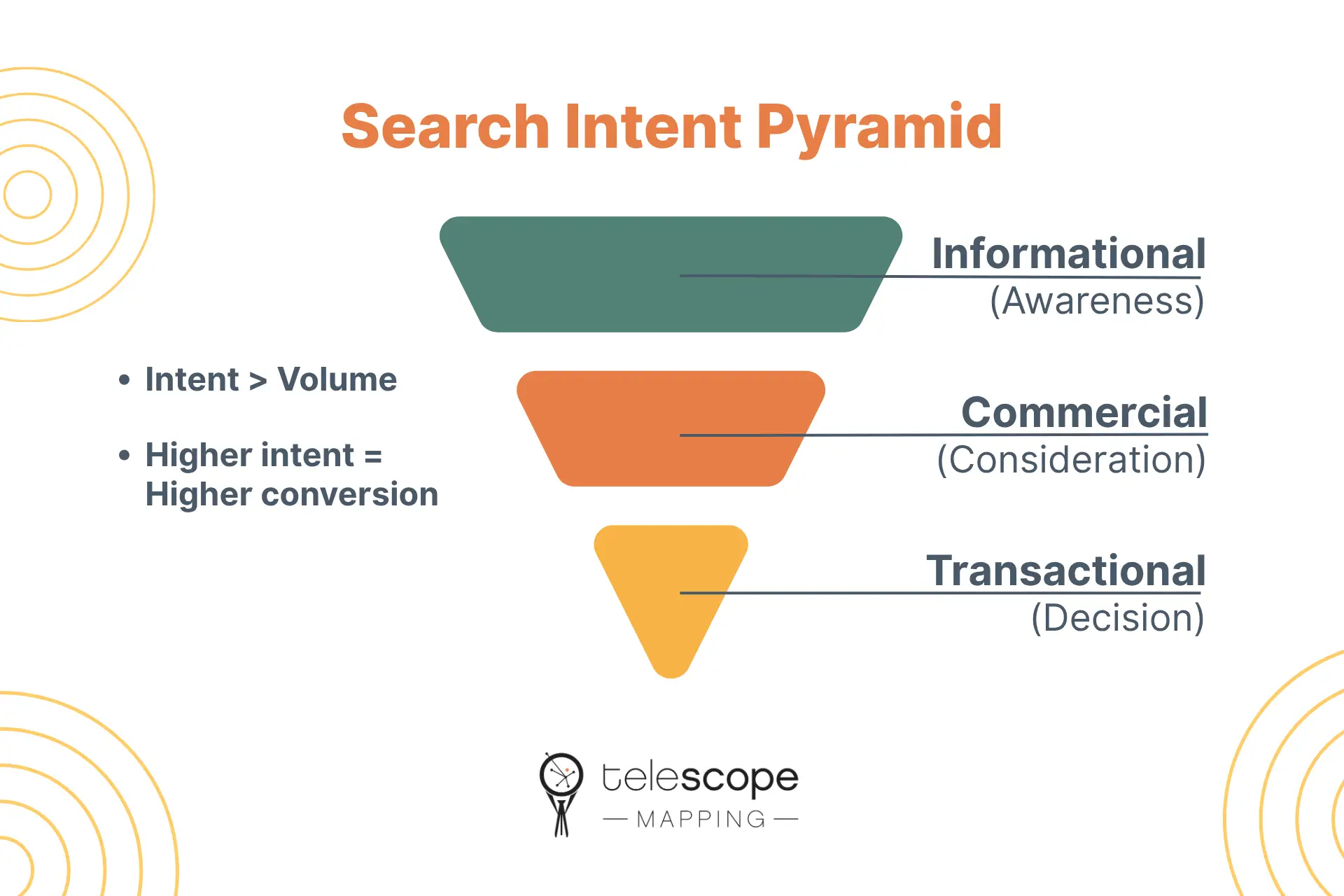
Our strategic approach prioritizes intent over volume. By analyzing whether users are seeking information, evaluating solutions, or ready to transact, your business can focus on niche keywords that drive qualified engagement. Competitive gap analysis further strengthens this phase by identifying underserved opportunities where your business can establish authority and outperform competitors.
Phase 3: Strategic Content & Keyword Targeting Framework
With a validated keyword universe in place, the focus shifts to execution through structured SEO content planning. This phase involves building content clusters and pillar pages, mapping keywords to specific assets aligned with each stage of the buyer journey.
Without this structured approach, businesses often create disconnected content that fails to guide users toward conversion. The result is fragmented engagement and underutilized traffic. A strategic framework ensures that each piece of content serves a clear role, moving prospects from awareness to consideration and ultimately to decision.
By aligning keyword targeting with content architecture, your business creates a cohesive ecosystem that maximizes both visibility and conversion potential.
Phase 4: Performance Monitoring, Iterative Optimization & Adaptation
A keyword strategy that isn’t continuously refined will inevitably lose effectiveness. Treating keyword planning as a one-time initiative is a critical oversight that leads to declining rankings, outdated content, and missed opportunities as search behavior evolves.
This phase establishes a dynamic, data-driven approach to performance monitoring. Key metrics such as keyword rankings, organic traffic, engagement, and conversion rates are tracked in relation to business outcomes. Continuous testing and analysis enable proactive adjustments in response to algorithm updates, competitive shifts, and emerging trends.
The strategic advantage lies in iteration. By continuously optimizing your keyword strategy, your business maintains relevance, improves ROI, and sustains long-term growth in an increasingly competitive digital landscape.
By integrating execution with strategic foresight, this framework ensures that your keyword strategy is not only comprehensive, but resilient. It aligns every effort with measurable business impact while systematically avoiding the common pitfalls that dilute performance and hinder growth.
Frequently Asked Questions
How often should we update our keyword strategy?
A robust keyword strategy requires continuous monitoring and quarterly reviews to adapt to market changes, competitive shifts, and algorithm updates. For comprehensive alignment with evolving business goals and emerging search trends, a thorough re-evaluation is recommended annually.
What’s the difference between short-tail and long-tail keywords for B2B?
Short-tail keywords are broad terms, such as “CRM software,” typically indicating early-stage research. Long-tail keywords are more specific phrases, for example, “best cloud CRM for small business sales teams,” which usually signal higher intent and engagement later in the buyer journey, making them crucial for B2B conversions.
How do we measure the ROI of our keyword strategy?
The ROI of a keyword strategy is effectively measured by tracking organic traffic growth, conversion rates from organic search (such as leads, sales, or demo requests), improvements in keyword rankings for high-value terms, and the resulting revenue generated. Connecting these metrics directly to your sales funnel is key for accurate assessment.
Can we build a strong keyword strategy without expensive tools?
While advanced tools significantly enhance the efficiency and depth of keyword analysis, a foundational keyword strategy can certainly be initiated using free tools like the Google Search Console. These can be combined with deep audience understanding, competitive analysis, and strategic thinking. However, for scalable, high-impact results, professional tools and SEO services are invaluable for uncovering nuanced opportunities.
Unlock Your Organic Revenue Potential
A sophisticated keyword strategy is far more than a mere SEO tactic, it’s a critical, strategic investment in your business’s future. It directly impacts your organic visibility, the generation of qualified leads, and your capacity for sustained revenue growth. By adopting a structured methodology and consciously avoiding the common pitfalls detailed in this article, your business can fundamentally transform its online presence into a powerful, predictable revenue engine.
Discover how our strategic approach to keyword strategy can unlock new revenue streams for your business. Schedule a complimentary strategy session with one of our experts today.