In today’s fiercely competitive digital arena, stalled organic growth and an inability to identify untapped market demand represent critical challenges for business leaders. This article introduces keyword gap analysis as a potent strategic tool for discerning crucial SEO opportunities that your competitors are currently leveraging, but your business is not. You’ll gain a comprehensive understanding of how to systematically uncover high-value keywords, strategically prioritize them, and integrate these insights to unlock significant organic traffic and ultimately, revenue potential.
Spotting Hidden SEO Opportunities With Keyword Gap Analysis
In today’s hyper-competitive digital landscape, the quest for sustainable growth often feels like a zero-sum game. Business leaders frequently grapple with escalating customer acquisition costs, a plateauing organic search presence, and the unsettling realization that competitors are consistently capturing valuable market share within your target market. The traditional approach to SEO, often reactive or focused solely on high-volume terms, frequently overlooks the nuanced opportunities that define true competitive advantage. This article posits that merely being present in search is no longer sufficient: strategic dominance requires a proactive, data-driven approach that looks beyond the obvious. Keyword gap analysis emerges as the indispensable methodology for transcending this challenge, offering a clear path to identifying the critical search terms and topics where your competitors are thriving, and your business has yet to establish its commanding presence. It’s about moving from reacting to market shifts to proactively shaping your digital destiny.
Why Keyword Gap Analysis Matters
For business leaders focused on growth, the “why” behind any strategic investment must be crystal clear. Keyword gap analysis is not merely a technical SEO exercise, it’s a vital component of strategic market positioning and revenue expansion, particularly relevant in an era defined by evolving search algorithms and intense digital competition. The strategic imperative for your business to embrace keyword gap analysis stems from several critical factors.
Firstly, the search landscape itself has evolved. Google’s algorithms increasingly prioritize user intent, context, and semantic relevance over mere keyword density. This shift means that businesses must understand not just what their audience is searching for, but why. Competitor keyword analysis, as part of a comprehensive keyword gap analysis, reveals the sophisticated content strategies your rivals are employing to capture users at various stages of their buying journey. By identifying these overlooked niches and long-tail opportunities, your business can reduce reliance on expensive paid channels, directly impacting customer acquisition costs.
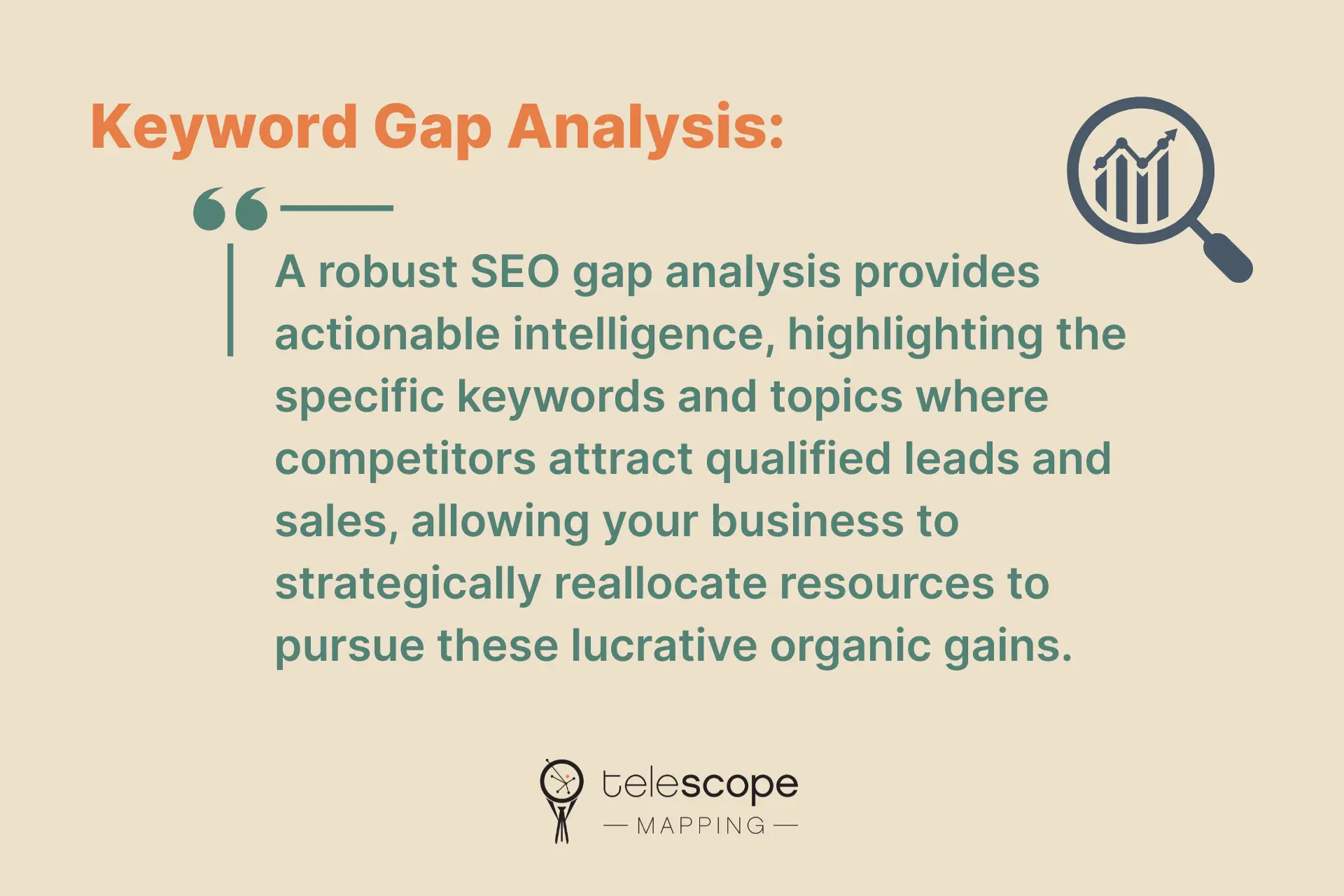
Secondly, competitive pressures are mounting across B2B and high-growth eCommerce sectors. Your rivals are constantly optimizing their digital footprints, and without a systematic approach to uncover their organic strengths and your corresponding weaknesses, you risk falling behind. A robust SEO gap analysis provides actionable intelligence, highlighting the specific keywords and topics where competitors attract qualified leads and sales, allowing your business to strategically reallocate resources to pursue these lucrative organic gains.
Finally, the direct impact on key financial metrics is undeniable. By attracting more relevant organic traffic through strategic keyword opportunity analysis, your business can significantly boost marketing ROI. This precision targeting translates into higher conversion rates, expanding your market share by capturing audiences previously missed, and ultimately enhancing customer lifetime value by attracting prospects who are actively searching for your solutions. Keyword gap analysis transforms your SEO strategy from a hopeful endeavor into a measurable growth engine, linking directly to your bottom line. It’s about securing market visibility where it matters most, driving sustainable growth, and achieving enduring competitive advantage.
Common Pitfalls, Strategic Oversights, & Our Approach to Keyword Gap Analysis
While the concept of keyword gap analysis is powerful, its execution is often fraught with missteps that can dilute its effectiveness and waste valuable resources. Business leaders must be aware of these common pitfalls to ensure their SEO gap analysis truly drives strategic advantage.
A frequent error is to limit competitor keyword analysis to immediate, obvious rivals in the same product or service category, a pitfall we term “narrowing focus to only direct competitors.” This myopic view overlooks a vast landscape of search opportunities. The consequence is that your business misses opportunities for top-of-funnel engagement, thought leadership, and capturing audiences earlier in their buying journey who might be researching problems or solutions, not specific brands.
The correct strategic approach that we take at Telescope Mapping involves expanding your analysis to include aspirational competitors who dominate broader industry terms, niche content publishers, and even related solution providers. This holistic view provides a richer understanding of where your target audience congregates online and what broader topics resonate with them, allowing for a more comprehensive keyword opportunity analysis.
Another significant oversight is overlooking search intent and conversion potential. Many businesses focus solely on keyword volume or perceived relevance without delving into the underlying user intent behind a search query or its position within the customer journey. The consequence of this is often attracting high volumes of irrelevant traffic that doesn’t convert, resulting in wasted resources on content that fails to generate business value.
Our strategic approach requires categorizing all identified keywords by their primary intent: informational, navigational, commercial, or transactional. We prioritize those that align with your business’s conversion goals or represent critical touchpoints in the customer journey. Understanding intent ensures that your content addresses specific user needs and moves them closer to a desired action.
Failure to prioritize opportunities based on business impact is a third common mistake. Treating all identified keyword gaps equally, regardless of their potential business impact or the effort required to rank for them, is a significant oversight. This leads to diluted efforts across too many fronts, slow ROI, and missed “quick win” opportunities that could build momentum.
To counteract this, we implement a robust prioritization matrix. This matrix should consider multiple factors: search volume, keyword difficulty, relevance to your core offerings, estimated conversion potential, and the relative cost or effort of content creation. Focusing on high-impact, achievable gains first ensures resources are allocated strategically for maximum ROI.
Finally, many organizations commit the error of treating keyword gap analysis as a one-time project, not an ongoing process. They view it as a periodic task, akin to an annual audit, rather than an integral, continuous component of their SEO and content strategy. The consequence is rapid obsolescence of insights, missing new competitive moves, emerging market trends, and shifts in search behavior.
The digital landscape is dynamic, and a static analysis quickly loses its relevance. Therefore, we establish a recurring cadence for keyword gap analysis, integrating it into quarterly or bi-annual strategic reviews. This continuous monitoring allows your business to adapt swiftly, maintain a dynamic competitive edge, and ensure that your organic strategy remains aligned with current market realities and your evolving business objectives.
Frequently Asked Questions
How often should our business conduct a keyword gap analysis?
To maintain a robust competitive edge and adapt effectively to the ever-evolving search landscapes and competitive movements, a comprehensive keyword gap analysis should be conducted at least annually. In rapidly changing industries, or during periods of significant product launches or market shifts, more focused, quarterly reviews are highly recommended to ensure your strategy remains agile and responsive.
Is keyword gap analysis only useful for generating new content ideas?
While keyword gap analysis is an excellent catalyst for generating new content ideas, its utility extends far beyond. It is equally powerful for optimizing existing content on your website. The analysis can reveal high-value keywords your competitors rank for with similar topics, providing actionable insights to enhance your current pages, expand their scope, or re-optimize them for stronger performance and increased organic visibility.
What specific tools are necessary for a robust keyword gap analysis?
An effective and comprehensive keyword gap analysis requires a combination of sophisticated SEO platforms. These tools are crucial for in-depth competitor keyword data, accurate traffic estimations, backlink profile analysis, and understanding the organic performance of both your domain and your competitors. Additionally, analytics tools are essential to understand your current performance, identify potential keyword cannibalization issues, and track the impact of your efforts. The specific suite of tools utilized will often depend on the scale, complexity, and specific needs of your business.
How quickly can we expect to see results from implementing a keyword gap analysis strategy?
The timeframe for realizing tangible results from implementing a keyword gap analysis strategy can vary based on several factors, including the competitive intensity of your industry, the scale and consistency of content creation, and your website’s existing domain authority. However, businesses typically begin to observe initial improvements in organic rankings and traffic within 3 to 6 months. More significant and measurable revenue impact, driven by targeted organic growth, is commonly observed within 6 to 12 months as new content gains authority and search engines recognize its relevance.
Conclusion & Next Steps
Keyword gap analysis is far more than a technical SEO exercise, it’s a strategic imperative for any business aiming for sustainable organic growth and market leadership. By systematically identifying and capitalizing on the keyword opportunities your competitors are already leveraging, and crucially, by avoiding the common pitfalls that plague less strategic approaches, your business can unlock significant untapped revenue potential.
The Telescope Mapping methodology transforms your SEO strategy from reactive to proactive, ensuring every content and optimization effort is aligned with genuine market demand and competitive advantage. Investing in a meticulous competitor keyword analysis and subsequent strategy is an investment in your long-term digital supremacy. Discover how our strategic approach to keyword gap analysis can unlock new revenue streams for your business, and schedule a complimentary strategy session with one of our experts today.