

You just launched the website for your new business: the design is clean, the copy is sharp, and… almost nobody can find it. There are no rankings, no links pointing in, and no data to learn from, while competitors with a decade of history sit above you in every result.
That’s the real starting point for many new businesses, and it’s actually more workable than it seems! A new site gets found by building trust signals in a deliberate order: measurement, a crawlable foundation, local presence, then earned links. Doing every tactic at once is how new businesses burn their first six months. This guide covers the SEO for new business basics: what to do, in what order, and what to ignore until it matters– plus a few free tools.
Why a New Website Starts at Zero (and What That Costs You)
A brand-new domain has no authority, no backlinks, no engagement history, and no performance data, leaving search engines with little reason to trust it yet. That gap has a price: paid media costs keep climbing, and if ads alone cover the invisible period, your customer acquisition cost stays high and your payback period stretches. Every lead you buy disappears when the budget stops, while organic visibility keeps working.
Additionally, two shifts are raising the stakes. AI-driven search summaries tend to favor sources with clear, verifiable signals: consistent business details, real reviews, and mentions elsewhere on the web. Privacy and consent changes also mean early data is harder to recover later, which makes measurement setup more urgent. Whether a formal sandbox for new sites exists is debated, but trust is earned slowly either way, so build it on purpose.
The Four-Phase Plan for a Site With No History
Treat these four phases as a sequence, not a menu. Each one makes the next more effective, and skipping ahead usually means redoing work.
1: Set Up Measurement Before You Launch
Picture a founder who gets a few calls in week two, and by month three, they cannot say where any came from. The first weeks of a new site are the most informative data you’ll have, and it exists only if tracking is in place.
Start with Google Analytics 4 (GA4), Google’s analytics platform, and verify the site in Google Search Console, the free tool that shows how Google crawls your pages, which queries surface them, and what errors it finds. Then, decide what success means before traffic arrives: phone calls, form fills, bookings, purchases. GA4 calls these ‘key events’ (previously labeled conversions), and each one should be tested end to end. If you serve visitors in regions where consent is required, set up a consent banner and configure consent mode, Google’s mechanism for adjusting how tags behave based on a visitor’s choices.
Then put numbers on success: what a customer is worth, what you can afford to pay to win one, and how many sales you need to break even. Telescope Mapping’s free business calculators cover each of these, along with conversion rate and return on ad spend.
And instead of adding analytics infrastructure once there’s traffic, configure tracking and test every conversion at launch, and keep the data in one place. Telescope Mapping’s data analytics & setup services covers clean tracking, event mapping, and dashboards your team can read.
2: Build a Crawlable Foundation
A new site often goes live with a leftover block from development. A ‘noindex’ tag or a staging rule in the robots file quietly tells search engines to stay away, and nobody notices for weeks. Check that the site is indexable before anything else.
From there, the essentials of SEO for new business are unglamorous. Submit an XML sitemap (a file listing the pages you want indexed) in Search Console. Keep the site structure clean and the mobile pages fast. Also, write unique title tags and page copy, so every page has its own job.
Keyword choice is where new sites win or stall. Start with specific, high-intent searches: a service plus a location, or a problem-specific query like emergency furnace repair in your city, rather than a broad head term like heating. Map one primary topic to each page so your pages support each other instead of competing. Chasing broad terms first usually means months of effort with no leads, so win specific, buyer-intent queries first and expand as authority builds.
Also, build the pages that close deals before the ones that educate: one page for each type of buyer and the problem they bring you, pricing or honest ranges with the process spelled out, and a FAQ that answers the objections you hear on sales calls. AI answers now handle many basic “what is” questions on the results page, so a blog of definitions brings in fewer visitors than it used to. Write explainers only when they lead to a page that sells. Telescope Mapping’s free Content Funnel Guide walks through what to write at each stage and where to start.
3: Establish Local Presence with Google Business Profile & Citations
For any business with a physical location or service area, Google Business Profile (GBP) setup is often the fastest route to being found, because it puts you in the local pack and on the map before your website has earned much on its own. Claim the profile and complete verification, choose an accurate primary category and relevant secondary ones, then fill in hours, services, and real photos. Start asking happy customers for reviews from the first week.
But before you claim anything, settle the basics of the business itself: use the same registered name on every listing, and if you operate under a trade name, use that “doing business as” name consistently. Two free Telescope Mapping guides can help here: How to Choose the Right Business Structure, and a state-by-state setup guide linking to official registration, tax, and licensing offices.
Next come local citations: listings of your business name, address, and phone number on directories and data aggregators. Their value is consistency. When your details match everywhere, search engines gain confidence that you are real and where you say you are.
Additionally, some situations need extra care. Multi-location brands need one naming and data standard for every location. Service-area businesses that travel to customers follow different address rules and may hide their street address. And in regulated categories such as cannabis retail, advertising and listing rules vary by platform and jurisdiction, so confirm specifics with counsel or official sources before publishing.
The usual trouble is inconsistent or duplicate details across listings, or listings the business isn’t eligible for, which leads to suppressed local visibility, suspended profiles, and customers at the wrong address. Set one canonical record, replicate it exactly, and audit it periodically. For multi-location or regulated brands, Telescope Mapping’s local visibility work covers profile management, location pages, and consistent listings as you grow.
4: Earn Your First Backlinks & Credibility Signals
A backlink is a link from another website to yours, and search engines treat it as a third-party vote of confidence. For a new domain, your first backlinks matter disproportionately because they are the first evidence that anyone else vouches for you.
The legitimate sources are usually closer than people think. Start with your local chamber of commerce or trade association, then supplier, manufacturer, and partner pages that list the businesses they work with. Local press, community events, and sponsorships often come with a link, and so do industry directories actually worth being in. A genuinely useful resource, such as original data or a free calculator, gives others something to cite. Relevance beats volume here: one link from a respected local organization is worth more than dozens from unrelated pages.
Buying bulk links or joining link schemes is the shortcut to avoid. It wastes budget and carries penalty risk under Google’s spam policies, a painful hole to climb out of on a young domain. Pursue a small number of relevant, earned links instead, and track which ones send referral traffic, since those signal real-world value.
Where to Start, Based on Your Type of Business
Not all SEO for new businesses should start in the same place. The graphic below highlights where the leverage usually sits for each type, and the trap that most often derails it.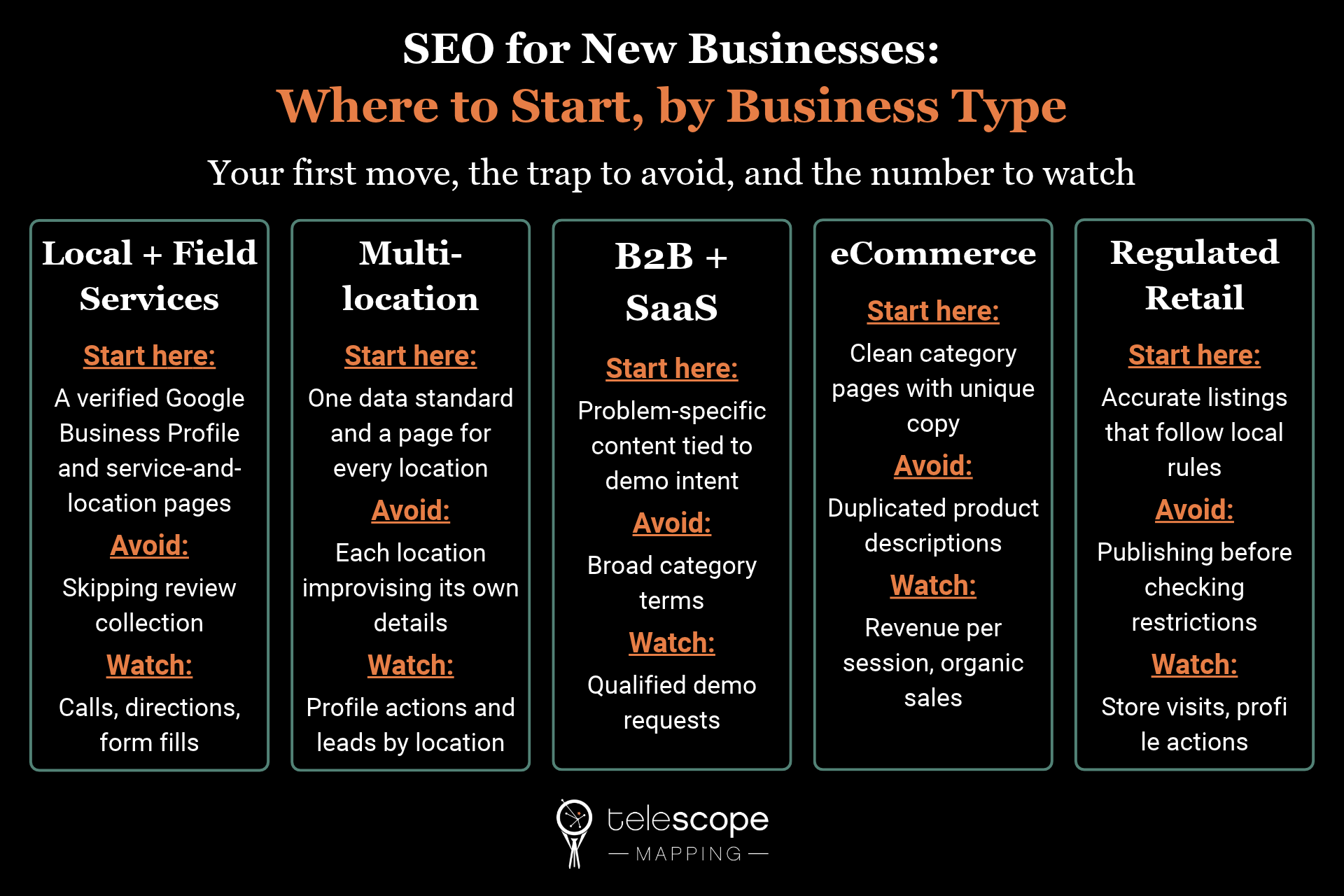
Common Questions About SEO for New Businesses
How long before a new site sees results?
Typically, specific local or low-competition queries start showing movement within a few months, while competitive terms can take considerably longer. Results are never guaranteed, and speed depends on competition, your local profile, and how quickly you earn credible links.
Should we run paid ads while organic visibility builds?
Often, yes, and not only for early leads. Paid campaigns show which queries and landing pages convert, so you can focus organic effort on terms that already prove their value. Track paid and organic separately, and check results against your cost ceiling with Telescope Mapping’s free return on ad spend and conversion rate calculators.
Do we need an agency, or can we handle this in-house?
Much of phases 1-3 is manageable in-house if someone owns it and follows a checklist. Outside help adds the most value in measurement architecture, technical issues that stay invisible without audit tools, and link building that requires outreach time. Decide based on who has the hours, not only the skills. If you’re unsure where you stand, our free preliminary website audit is a low-pressure place to start.
Start With What You Can Measure
A new site’s biggest advantage is a clean slate. There’s no broken tracking to untangle, no legacy structure to unwind, and no bad habits to reverse. Build tracking and structure correctly from day one, and every later decision about SEO for new business rests on evidence instead of guesswork.
If you want a second set of eyes before or just after launch, schedule a free consultation with Telescope Mapping today.