


The Marketing Lead opens your Monday meeting with good news: the new guide produced a record month of signups! But then your Sales person answers with the other half of the story. Many of those contacts never reply, and the ones who do aren’t buying.
The best lead magnet examples share two traits. Each solves one specific problem for one specific buyer at the right moment, and each is judged by lead quality, not form fills. This guide walks you through lead magnet examples by industry, so you can match the right offer to your buyer.
Why Generic Lead Magnets Fill a List but Not a Pipeline
The pattern is familiar: a team builds some sort of “ultimate offering” because it feels useful and broad enough to appeal to everyone, and it does, including students, competitors, and researchers who will never buy it. List growth and cost per lead look healthy until sales quietly stops working the list.
That’s why the number to judge a lead magnet by is cost per qualified opportunity, not cost per lead. A cheap lead who never buys costs more than a pricier one who does. Telescope Mapping’s full-funnel sales and marketing audits are built to surface this gap, showing which offers earn their budget and which only look busy. The scorecard below gives you a way to catch weak offers before you build them.
What Makes a Lead Magnet Convert? A Five-Question Scorecard
Before you build anything, run each idea through five questions. Strong lead magnet examples pass most of them. Filler fails the first two.
- Does it solve one narrow problem?
- A pricing worksheet for a procurement review beats a complete guide to buying software, because narrow offers attract people who actually have the problem.
- Is time-to-value fast?
- Time-to-value is the gap between someone handing over their details and getting something useful. Minutes is good. A 40-page PDF they have to dig through is not.
- Does it match the buyer’s stage?
- Researchers want education, comparers want side-by-side tools, and ready buyers want a quote or a demo.
- Does the gate fit the value?
- Asking for a phone number in exchange for a checklist feels like a bad trade. Asking for a work email in exchange for a personalized calculator does not.
- Does it lead naturally to what you sell?
- If the next step after the download isn’t obvious, the magnet is entertainment, not acquisition.
Before you invest in building, pressure-test the idea: describe it to five recent customers or sales contacts and ask whether they would trade an email address for it. A lukewarm answer can save you weeks of production.
Gated content works best when the asset is a tool, template, or personalized output. Top-of-funnel education is often better left open, because it earns trust and search visibility– a form in front of it filters out the people you most want to reach early.
Each answer also feeds lead qualification, the process of deciding whether a contact fits your ideal customer and shows real buying intent. A narrow offer attracts the right people, so your landing page should keep that promise: one clear headline, a preview of what’s inside, and only the form fields you will actually use. If building the asset is the bottleneck, Telescope Mapping’s content development services offer guides, whitepapers, and case studies, and helps you decide which pieces can be AI-assisted and which need a human writer.
Lead Magnet Examples by Industry
What works depends on how your buyers behave. A procurement committee, a homeowner with a broken furnace, and a shopper deciding on a first order all want different things. The lead magnet examples below are typical scenarios, not specific client cases.
B2B & SaaS
Long buying cycles with several stakeholders reward tools that help your champion (the person inside the buyer’s company pushing for you) build an internal case. ROI and pricing calculators do this well. So do benchmark-style templates, interactive product assessments, a sandbox or demo environment, and webinar replays tied to one use case.
Here’s a common scenario: a software company gates a calculator that returns a tailored savings estimate the champion can forward to finance. Contrast that with a gated whitepaper nobody on the buying committee wants to read. That is the pitfall: content that is easy to ignore and impossible to forward. The number to watch is cost per qualified opportunity.
eCommerce
Here the goal is easing the first purchase while learning something about the shopper. Strong options include first-order incentives, quizzes that lead to product recommendations, early access to drops, and buying guides or sizing and fit tools. The quiz is often the standout: it gives the shopper a useful answer and gives you zero-party data, meaning information customers volunteer about their preferences, which you can use to segment follow-up. The pitfall is relying on a discount alone, which trains customers to wait for the coupon. Watch revenue per subscriber, not just list growth.
Multi-Location, Local, & Field Services
Buyers in this category are often urgent and local, so speed and relevance beat depth. The best-performing formats tend to be instant or itemized quote tools, seasonal maintenance checklists, “what to expect and what it costs” guides, and service-area-specific offers.
Consider a typical business with a dozen locations: a homeowner searching for a repair wants a price range and an available slot, not a brand story. The pitfall is running one generic offer across every location with no way to see which location’s leads actually convert. Without that visibility, you can’t tell a weak offer from a weak local team, so track booked jobs by location.
Regulated & Cannabis Retail
When ad platforms restrict paid reach, owned channels matter more. Workable formats include loyalty or rewards sign-ups, product education guides, new-arrival or deal alerts, and in-store event invitations. Each gives customers a reason to opt in and gives you a direct line that doesn’t depend on a platform’s rules. That being said, treat compliance as part of the design, not a final check, because advertising, age-verification, and consent rules vary by jurisdiction.
Telescope Mapping has years of experience writing and marketing in regulated markets like cannabis, which is where this kind of careful, compliant offer design matters most. The metric that matters here is repeat purchases by sign-up source.
Also, notice that none of the metrics mentioned in the above sections are “downloads.” Every one sits closer to revenue, which is where the next section picks up.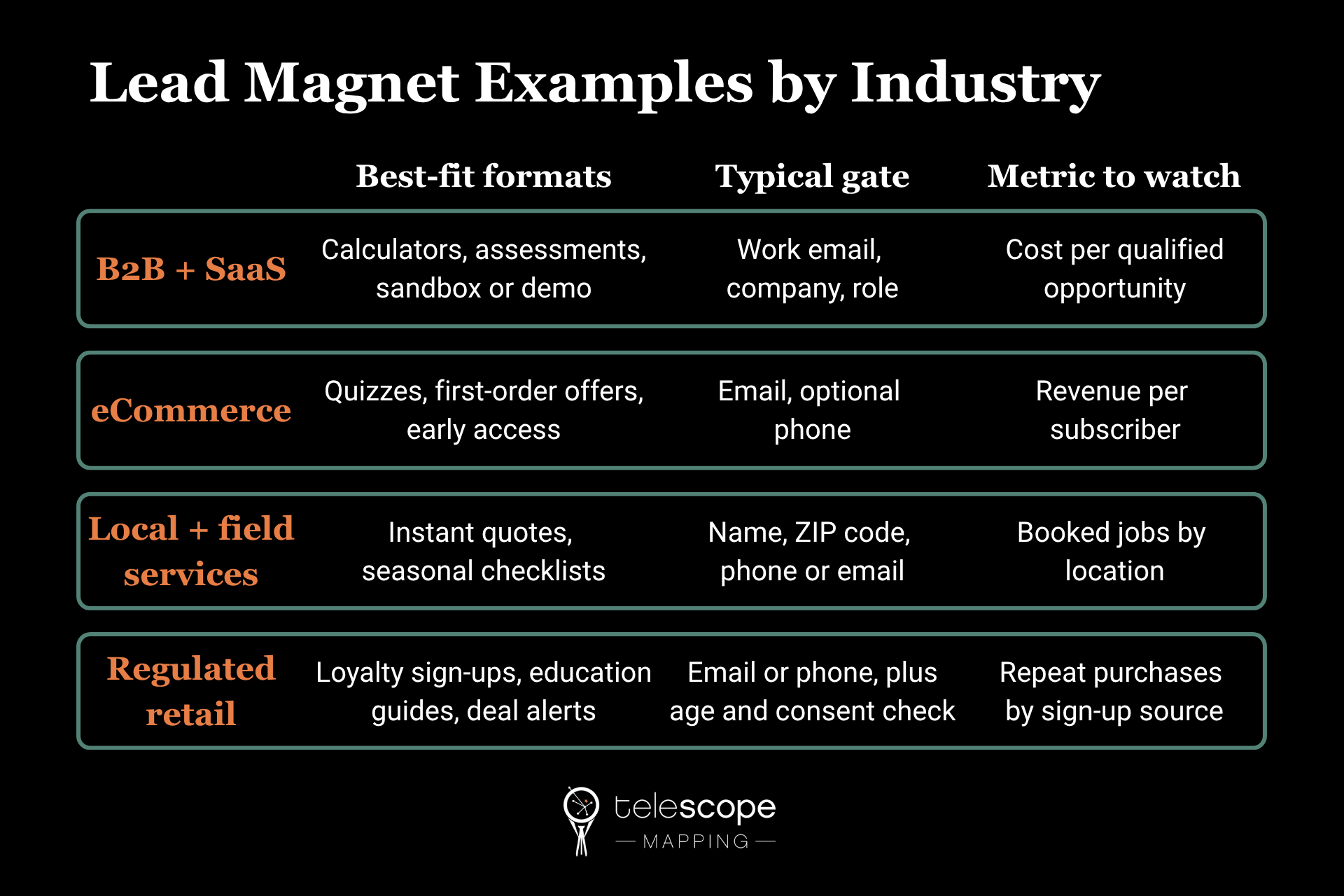
How to Track Whether a Lead Magnet Is Working
Measure before you optimize. A lead magnet you can’t trace to revenue is a guess, and clean data is the infrastructure that makes the trace possible.
Start by defining the conversion event. In GA4, a form submission should be set up as a key event (GA4’s term for a conversion, an action you’ve marked as valuable). Then pass UTM parameters, the tags added to URLs that identify source, medium, and campaign, into your CRM so each lead keeps its origin. Without that, every lead arrives as “direct” and the question of which offer worked has no answer.
Next, track downstream. Follow each lead from signup to qualified opportunity to revenue, by lead magnet. Two terms keep this data reliable as privacy limits erode browser-based tracking: consent mode is a Google setting that adjusts how tags behave based on a visitor’s consent choices, and server-side tracking sends event data from your own server rather than relying only on the visitor’s browser, which makes form-conversion data harder to lose. If you’d rather outsource, Telescope Mapping’s data analytics & setup services covers this ground, from tracking events mapped to the actions that matter, to CRM integration, attribution that goes beyond last-click, and dashboards your team can read at a glance.
The common pitfall here is judging a lead magnet by signup volume. Give each offer enough time and traffic to produce a readable result, because small samples swing wildly and a few lucky weeks prove very little. When it works, the result is a shared dashboard showing lead source, lead quality, and pipeline in one place, so marketing and sales argue about strategy instead of whose numbers are right.
Lead Magnet Example Questions Business Leaders Ask Before Launching
How much does it cost to build a lead magnet?
Cost depends on format, design, and development. A checklist or template costs far less than an interactive calculator or quiz, which needs build time, testing, and CRM integration. Start with the cheapest format that still meets your lead quality criteria, and invest further only once tracking shows the topic earns qualified leads.
How many lead magnets do we need?
Start with one per major buyer stage or segment, not one per blog topic. A small set tied to clear decision points is easier to measure and maintain. Expand based on which offers produce qualified opportunities, not on which ones are easiest to make.
Should we gate the content or leave it open?
Gate tools, templates, and personalized outputs, where the value is obvious before the download. Consider leaving top-of-funnel education open so it can build trust and be found in search. If you’re unsure, test an ungated version and compare how many readers later return and convert.
How should leads be followed up?
Speed-to-lead, the time between signup and first contact, matters most for high-intent offers like quotes and demos. Pair it with a short nurture sequence matched to the magnet’s topic, and keep every message within email rules such as the CAN-SPAM Act. Email list building only pays off if the messages after the download stay relevant to why the person signed up.
Start with One Offer You Can Measure to Revenue
You don’t need a dozen lead magnet examples running at once. Pick the one closest to a buying decision, wire its tracking all the way to your CRM, and let the quality data tell you what to build next.
If you’re not sure your forms and offers are measured end to end, schedule a free consultation with Telescope Mapping today. We’ll look at how your current lead magnets are captured, attributed, and tied to your pipeline, and show you where the gaps are.