A multi-location SEO strategy that works beautifully across three locations often falls apart at thirty. The tactics don’t change– optimized listings, consistent data, and local content still matter– but the way you execute them has to. What breaks most businesses isn’t a lack of SEO knowledge, it’s trying to manage growing complexity with a process built for a much smaller footprint. This article looks at why that breakdown happens and what actually makes a multi-location SEO strategy hold up as a business scales.
Why Multi-Location SEO Strategies Break Down at Scale
Most businesses don’t set out to build an unscalable local SEO process, it simply happens gradually: a strategy that made sense for the first handful of locations gets applied to the next batch, and the next, and then the next until someone’s manually updating dozens of listings, chasing down inconsistent data across markets, and wondering why rankings vary so wildly from one location to the next. The strategy wasn’t wrong at a smaller scale, it just was never built to grow.
The core challenge is that each additional location doesn’t just add work, it multiplies the coordination required to keep everything consistent. Managing a handful of locations by hand is manageable because one person can hold the whole picture in their head: which listings need updating, which reviews need a response, which pages are due for a refresh. That mental model stops working long before the workload technically becomes impossible: coordination overhead tends to grow faster than the location count itself, since every new location adds not just its own tasks but new dependencies on the ones already being managed.
This shows up in a few predictable ways. For one, data drifts out of sync as different people update different listings without a shared system. Some locations get real attention while others (often smaller or newer ones) quietly fall behind. On top of that, reporting can become fragmented, making it hard to tell which markets are actually performing and which are dragging the average down. There’s also a brand-trust cost that’s easy to overlook: when one location’s listing looks polished and current while another’s is outdated or inconsistent, customers researching the business notice, and that unevenness can quietly undermine confidence in the brand as a whole, not just in the weaker location. None of this is really an SEO problem in the traditional sense, it’s more so a process and systems problem that happens to show up in your search rankings.
The financial stakes are real, too. Every location that underperforms in local search is lost foot traffic, lost calls, and lost revenue in that specific market– and because local search intent is so immediate, a customer who doesn’t find you nearby usually just finds a competitor who did. A multi-location SEO strategy that only works when someone has the bandwidth to manage it by hand isn’t really a strategy, it’s a temporary workaround that will eventually need to be rebuilt anyway, usually at a less convenient moment than now.
Consider a regional service business that opens its eighth and ninth locations in the same quarter. The person managing local SEO wasn’t given more hours in the day to match the new workload, so something has to give quietly in the background: often it’s the newest locations, which take longer to get properly optimized because they’re competing for attention with everything already on someone’s plate, and problems tend to go unnoticed for months rather than being caught early. Nothing about the tactics changed between the seventh location and the ninth– what changed is that the person responsible ran out of capacity to catch problems as they happened.
What It Actually Means for a Strategy to Scale
A multi-location SEO strategy that scales isn’t one where every location gets identical treatment, it’s one built on a system that can expand without requiring proportionally more manual effort for each new location added. In practice that means the underlying process (not any single person’s judgment) carries most of the weight as the business grows.
The clearest test of whether a strategy scales is what happens when you add a location: does bringing a new one online take roughly the same effort as the last one, or does it get incrementally harder each time? A strategy that scales keeps that effort flat (or close to it) as the number of locations grows.
Yes, technology plays a real role here, but it’s worth being precise about what it actually solves. Tools that centralize listing management, aggregate reviews, and consolidate reporting across locations remove a huge amount of the manual coordination that causes strategies to buckle under growth. What they don’t do is replace the strategic decisions about what should stay consistent, what should flex locally, and where attention should go next. Those remain judgment calls that a multi-location SEO strategy can support, but not make on its own.
Businesses that treat technology as the entire solution, without the underlying strategic framework, often end up with faster access to the same disorganized data rather than a genuinely more scalable process. The four-phase framework in the following section breaks down what that SEO strategy actually needs to include.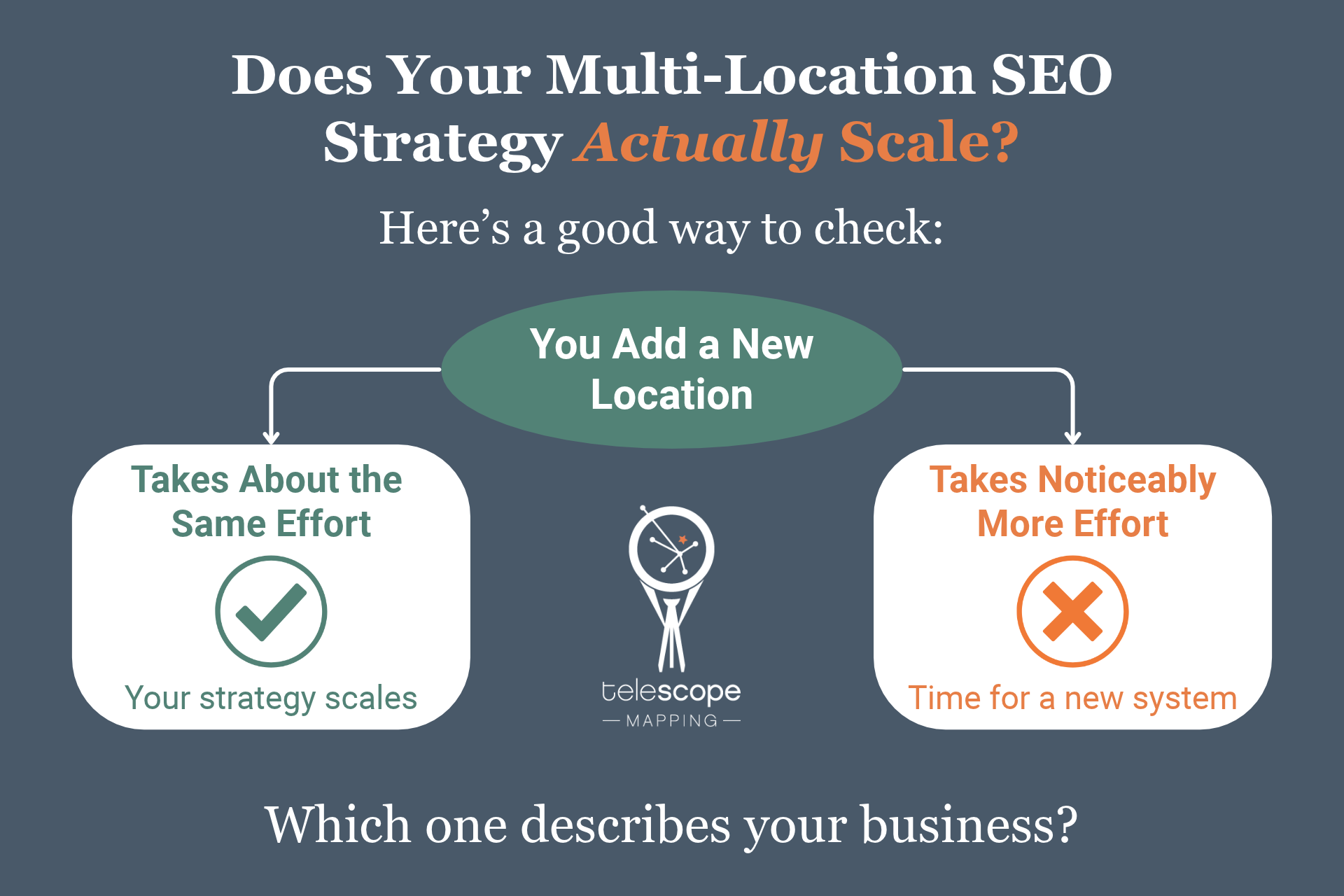
Building a Truly Scalable Multi-Location SEO Strategy
Telescope Mapping generally works through four phases when helping a growing, multi-location business build this kind of system. Each phase below is paired with the mistake most likely to undermine it, so you can sidestep it all together.
1. Standardizing the Foundation.
Before adding more locations to the mix, it’s worth establishing templates and systems for the elements that should stay consistent everywhere: how listings get structured, how location pages are built, and how citations get managed. This groundwork is what makes every future location faster to bring online rather than another one-off project.
The mistake to avoid: Treating every new location as a custom build instead of an instance of a repeatable system. Without a standardized foundation, each new location adds disproportionate manual work, and the gap between your best-managed and worst-managed locations tends to widen rather than narrow.
2. Building in Local Flexibility.
Standardization shouldn’t mean uniformity. Within that consistent foundation, each location still needs content, keywords, and messaging that reflect its actual community and search behavior: a template that produces identical location pages for every market usually underperforms because it reads as generic rather than genuinely local.
The mistake to avoid: Over-correcting toward rigid uniformity in an attempt to make things manageable. A system so standardized that every location page reads the same misses the local relevance that search engines and customers are actually looking for, trading one scaling problem for a different performance problem.
3. Centralizing Measurement and Reporting.
As the number of locations grows, so does the need for a single, reliable view of how each one is performing: rankings, traffic, conversions, and reviews, all trackable at the individual location level without requiring someone to check thirty separate dashboards by hand.
The mistake to avoid: Relying on fragmented, per-location reporting that makes it genuinely difficult to see the big picture. Without centralized measurement, underperforming locations can go unnoticed for months, and there’s no reliable way to know which parts of the strategy are actually working across the portfolio.
4. Prioritizing and Triaging as You Grow.
Not every location needs the same level of attention at the same time. A scalable multi-location SEO strategy includes a clear, consistent way to decide where to focus effort (new locations, underperforming ones, or high-opportunity markets), rather than spreading attention evenly regardless of actual need. In practice, this often means weighing a handful of concrete factors: how recently a location opened, how competitive its specific market is, and how large the gap is between its current performance and what comparable locations are achieving, rather than defaulting to whichever location happens to be top of mind that week.
The mistake to avoid: Treating all locations as equal priority by default, which in practice means flagship locations get disproportionate attention while smaller or newer ones are neglected simply because no one made a deliberate decision about where focus should go.
This is usually the point where internal teams hit a real ceiling. Not because any single phase is complicated on its own, but because building and maintaining all four simultaneously, across a growing number of markets, takes dedicated infrastructure most internal teams weren’t originally built to support. Telescope Mapping works directly with multi-location businesses to build exactly this kind of scalable system, so growth adds new locations to a working process instead of new strain to an already-stretched one.
Multi-Location SEO Strategy: Frequently Asked Questions
At what point does a business typically need a more scalable approach to multi-location SEO strategy?
There’s no fixed number, but the signal is usually process-based rather than location-count-based: when bringing a new location up to speed starts taking noticeably longer than it used to, or when someone on the team is regularly working reactively instead of staying ahead of updates, that’s a strong sign the current approach won’t hold up much longer.
Does a scalable strategy mean every location gets less individual attention?
Not necessarily. It means individual attention gets spent more deliberately. A scalable system handles the repeatable foundational work automatically, which frees up real attention for the local nuances and underperforming locations that genuinely need a closer look, rather than spreading limited time evenly across tasks that didn’t need a person in the first place.
How does this differ for franchise or multi-brand operations versus a single company with multiple locations?
The core principles hold either way, but franchise and multi-brand structures usually need clearer guardrails around what’s centrally controlled versus what individual owners or banners can adjust. Getting that balance right up front avoids both the chaos of total local autonomy and the flatness of forcing every location into an identical mold.
Here’s the Bottom Line
A multi-location SEO strategy that actually scales isn’t defined by having more sophisticated tactics than a smaller competitor, it’s defined by a system that gets more efficient, not more strained, with every location added. Standardizing what should be consistent, preserving what should be local, centralizing how you measure success, and being deliberate about where attention goes are what separate a strategy that grows with the business from one that quietly becomes its biggest operational bottleneck.
If your current approach to local SEO feels like it’s straining under the weight of your own growth, that’s exactly the kind of problem Telescope Mapping helps multi-location businesses solve. Schedule a complimentary strategy session with one of our experts today and find out what a genuinely scalable system could look like for your business.