


The modern business landscape demands a robust, integrated digital marketing infrastructure. Too often, organizations grapple with a fragmented array of marketing technologies and disjointed data, leading to operational inefficiencies, a lack of actionable insights, and ultimately, missed opportunities for scalable growth. This article illuminates the strategic importance of building a meticulously planned marketing tech stack as the essential foundation for superior customer experiences and predictable revenue growth. You’ll gain a clear understanding of the core components of an effective digital marketing infrastructure and a phased approach to building it, ensuring your marketing efforts are not just active, but truly impactful.
Marketing Operations Today
Business leaders today confront an increasingly complex marketing environment. The promise of digital engagement often dissolves into a labyrinth of disparate tools, inconsistent data, and a pervasive struggle to definitively link marketing spend to tangible return on investment. Marketing teams frequently find themselves bogged down by manual processes, struggling to gain a unified view of their customers or to personalize experiences at scale. This operational friction is not merely an inconvenience, it represents a significant barrier to achieving strategic objectives, from accelerating sales cycles in B2B sectors to optimizing conversion paths in high-growth eCommerce. The strategic solution lies not in adding more tools, but in establishing a foundational digital marketing infrastructure that transforms this chaos into clarity, enabling data-driven growth and truly intelligent marketing operations.
Digital Marketing Infrastructure’s Significance
In today’s hyper-competitive marketplace, a sophisticated digital marketing infrastructure is no longer a luxury, it’s a strategic imperative. The “why” behind this investment is deeply rooted in macro business trends and critical financial metrics. Your customers, whether B2B decision-makers or eCommerce consumers, expect seamless, personalized, and relevant interactions across every touchpoint. Without a cohesive marketing tech stack, delivering this experience consistently becomes virtually impossible, eroding trust and sending prospects to competitors who are better equipped.
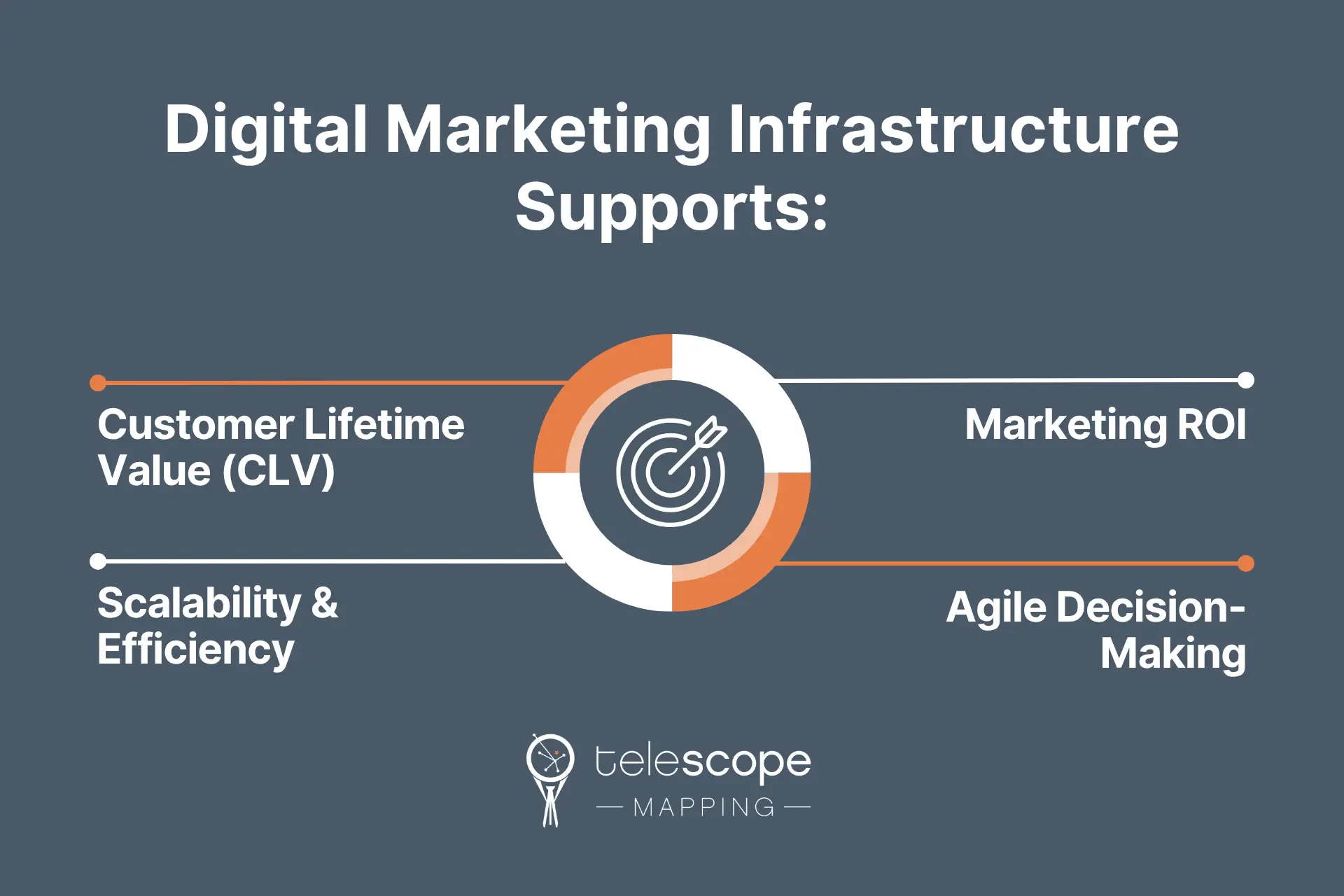
Furthermore, the pressure on marketing departments to demonstrate tangible return on investment has never been greater. Fragmented data and siloed systems obscure the true impact of campaigns, making it difficult to optimize spend, identify high-value channels, and accurately forecast results. A well-designed digital marketing infrastructure addresses this directly by creating a “single source of truth” for customer data. This unified data foundation allows your business to:
- Enhance Customer Lifetime Value (CLV):
- By providing a holistic view of customer interactions, you can tailor communications, anticipate needs, and deliver personalized experiences that foster loyalty and encourage repeat business.
- Boost Marketing ROI:
- Integrated attribution tracking provides clear insights into which channels and campaigns are driving revenue, enabling intelligent resource allocation and continuous optimization of your marketing spend.
- Achieve Scalability and Efficiency:
- Manual processes and data reconciliation consume valuable time and resources. A robust marketing automation setup streamlines repetitive tasks, allowing your marketing operations team to focus on strategic initiatives rather than administrative overhead. This efficiency is critical for high-growth businesses aiming to expand without proportionally increasing their operational costs.
- Enable Agile Decision-Making:
- With real-time access to accurate data and performance metrics, business leaders can make informed, rapid adjustments to marketing strategies, responding effectively to market shifts and competitive pressures.
Investing in a strategic digital marketing infrastructure isn’t merely a technology upgrade, it’s an investment in your business’s future growth, efficiency, and competitive advantage.
 Our Methodology & Your Marketing Tech Stack
Building a robust digital marketing infrastructure requires a systematic, phased approach. The Telescope Mapping methodology focuses on establishing foundational elements first, ensuring each subsequent layer builds upon a stable and integrated base. This strategic progression avoids common pitfalls and ensures maximum efficacy for your marketing operations.
CRM & Data Integrity
The cornerstone of any effective digital marketing infrastructure is a well-implemented Customer Relationship Management (CRM) system. Your CRM is not just a contact database, it’s the central repository for all customer and prospect data, serving as the “single source of truth” across your entire organization. Our approach to CRM setup emphasizes:
- Strategic Needs Assessment:
- Before selecting a platform, we meticulously define your business objectives, sales processes, and customer journey. This ensures the CRM is configured to support your unique operational workflows and data capture requirements.
- Data Governance and Standardization:
- Implementing strict protocols for data entry, categorization, and cleansing is paramount. Poor data hygiene contaminates downstream processes, leading to inaccurate insights and ineffective campaigns. We establish clear data models, field mapping, and validation rules to ensure data quality and consistency from day one.
- Scalable CRM Setup:
- We architect your CRM to scale with your growth, considering future integrations, expansion into new markets, and evolving customer segments. This involves thoughtful user role definition, security settings, and customization that enhances user adoption without over-complicating the system.
Without a clean, centralized, and accessible CRM, subsequent marketing efforts will be built on shaky ground. This phase ensures your data foundation is solid and reliable.
Engagement & Efficiency
Once your CRM is robust and populated with high-quality data, the next critical step is integrating a powerful email marketing platform. This layer transforms raw customer data into personalized, automated engagement sequences, driving efficiency and enhancing the customer experience. Key aspects of this phase include:
- Seamless CRM Integration:
- The marketing automation platform must integrate flawlessly with your CRM to ensure a continuous flow of data. This bidirectional sync enables personalized communication based on customer behavior, sales interactions, and demographic data housed in the CRM.
- Workflow Optimization and Lead Nurturing:
- We design and implement automated workflows for lead nurturing, onboarding, cross-sell/upsell opportunities, and customer retention. This streamlines repetitive tasks, ensuring prospects and customers receive timely, relevant communications without manual intervention from your marketing teams.
- Personalized Communication at Scale:
- Leveraging data from the CRM, the marketing automation setup enables dynamic content and segmentation, allowing for highly personalized emails, web content, and ad targeting. This level of personalization significantly improves engagement rates and moves prospects more efficiently through the sales funnel.
Insight & Optimization
The final layer of your core digital marketing infrastructure focuses on measuring impact, gaining insights, and driving continuous optimization. Robust attribution tracking and analytics tools are essential for understanding the true performance of your marketing spend and the efficacy of your marketing operations. In this phase, we focus on:
- Comprehensive Attribution Tracking:
- Implementing advanced attribution models (e.g., multi-touch, time decay, position-based) to accurately credit each touchpoint across the customer journey. This moves beyond last-click attribution, providing a more holistic view of which channels contribute most effectively to conversions and revenue.
- Integrated Analytics Dashboards:
- Connecting your marketing automation, CRM, website analytics, and advertising platforms into unified dashboards provides a real-time, 360-degree view of campaign performance and customer behavior. This facilitates data-driven decision-making and empowers your team to identify trends and opportunities.
- Customer Journey Mapping & Optimization:
- Using the data collected through attribution and analytics, we map the end-to-end customer journey, identifying bottlenecks, drop-off points, and areas for improvement. This iterative process of analysis and optimization ensures your digital marketing infrastructure continually evolves to meet and exceed business objectives.
By meticulously building these three core layers, your business creates a powerful, integrated marketing tech stack capable of driving sustainable growth and providing unparalleled clarity into your marketing performance.
Tech Stack FAQ
What’s the absolute first investment we should make in our digital marketing infrastructure?
The absolute first and most critical investment for any growing business, regardless of sector, should be a robust CRM system. It forms the foundational “single source of truth” for all customer and prospect data, enabling accurate segmentation, personalized communication, and consistent tracking. Without a solid CRM setup, subsequent investments in marketing automation or attribution tracking will lack the necessary data integrity and centralized customer view to be truly effective.
How can we measure the ROI of our digital infrastructure investment beyond direct campaign results?
Measuring the ROI of your digital marketing infrastructure extends far beyond direct campaign results. Key metrics include operational efficiency gains (e.g., reduced manual hours, faster campaign deployment), improved data accuracy and accessibility leading to more informed strategic decisions, enhanced customer experience and satisfaction, increased marketing team productivity, and better lead-to-customer conversion rates due to improved nurturing. Quantifying these efficiencies and improvements provides a holistic view of the infrastructure’s value.
Is it better to choose an all-in-one platform or best-of-breed solutions for our marketing tech stack?
The optimal choice between an all-in-one platform and a best-of-breed approach depends significantly on your specific business needs, existing technological ecosystem, budget, and the expertise of your marketing operations team. All-in-one platforms offer simplicity and native integrations but may lack deep functionality in specific areas. Best-of-breed solutions provide specialized features and flexibility but demand more effort in integration and management. A strategic assessment considering scalability, integration capabilities, feature depth, and total cost of ownership is crucial to determine the most effective path for your organization.
Next Steps for Your Digital Marketing Tech Stack
The journey to building a high-performing digital marketing infrastructure is a strategic endeavor that demands foresight, precision, and a commitment to continuous improvement. By adopting a phased methodology, beginning with a strong CRM setup and progressing through marketing automation and advanced attribution tracking, your business can transform fragmented data and disparate tools into a cohesive, powerful engine for growth. A well-architected digital marketing infrastructure is the bedrock for achieving unparalleled operational efficiency, gaining deep customer insights, and delivering superior, personalized customer experiences that drive predictable revenue. Discover how our strategic approach to digital marketing infrastructure can unlock new revenue streams and operational efficiencies for your business, and schedule a complimentary strategy session with one of our experts today.