


Ensuring that your critical web content is discovered, indexed, and ranked by search engines is a foundational challenge for any business aiming for digital growth. Strategic sitemap implementation is an often-underestimated cornerstone of effective SEO, crucial for driving organic visibility and, consequently, revenue. This article will provide business leaders with a comprehensive understanding of how a well-managed sitemap acts as a critical communication tool with search engines, ensuring optimal crawlability and indexing for your most business-critical pages.
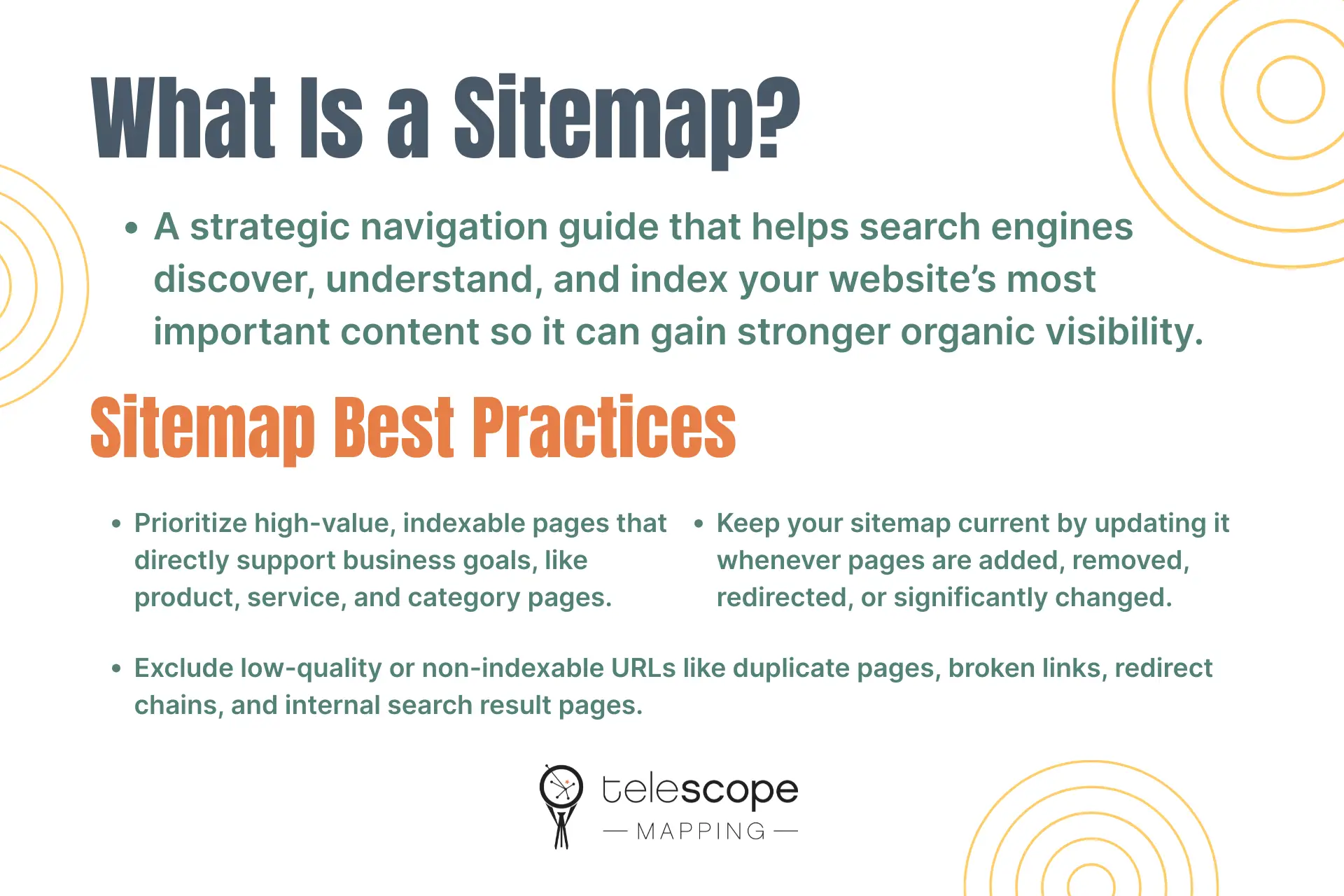
What Is a Sitemap?
In today’s vast and competitive digital landscape, merely having a website is insufficient: standing out and ensuring your valuable content is found is paramount. Business leaders are under constant pressure to maximize ROI from their digital assets amidst escalating customer acquisition costs, fierce competition, and continuously evolving search algorithms. This demands a nuanced approach to search engine optimization (SEO) that goes beyond surface-level tactics.
At its core, a sitemap is not merely a technical file, but a strategic tool that acts as your website’s navigation guide for search engines. Understanding what a sitemap is and its strategic implications directly impacts your SEO performance, market visibility, and ultimately, your bottom line.
Why Sitemaps Matter for SEO
For business leaders, the importance of a sitemap transcends technicality: it directly impacts key financial and growth metrics. In an era where digital visibility translates directly into market share, prioritizing sitemap SEO is a strategic imperative. Your sitemap serves as a comprehensive roadmap for search engine crawlers, guiding them through your site’s architecture and highlighting which pages are most important for indexing. This is critical for several reasons:
- Faster Content Indexing:
- For businesses constantly publishing new products, services, or B2B thought leadership, a well-structured XML sitemap accelerates the discovery and indexing of fresh content. This ensures your latest offerings and insights are visible to your target audience almost immediately, capturing timely interest and demand. Without it, search engines might take longer to discover new pages, delaying your market impact.
- Optimized Crawl Budget Utilization:
- Search engines allocate a “crawl budget” to each website, which is the number of pages they will crawl within a given timeframe. For large B2B platforms or high-growth eCommerce sites with thousands of pages, optimizing this budget is crucial. A strategic sitemap ensures that search engine bots prioritize your most valuable pages, such as high-converting product pages, key service descriptions, or essential whitepapers, rather than expending resources on less critical or deprecated content.
- Ensuring Comprehensive Discovery:
- Websites, especially complex ones, often have pages that are not easily discoverable through standard navigation or internal linking. These “orphan pages” might include campaign landing pages, detailed product specifications, or archived but still relevant content. An XML sitemap explicitly lists these URLs, guaranteeing that search engines are aware of their existence and can include them in their index, preventing valuable content from remaining unseen.
- Signaling Priority and Relevance:
- Beyond merely listing URLs, a sitemap can provide metadata about each page, such as its last modification date, frequency of changes, and relative importance. This information helps search engines understand the freshness and significance of your content, informing their indexing and ranking decisions. This strategic signaling is vital for maintaining competitive edge in industries with rapid content updates.
A strategically managed sitemap mitigates the risk of your most valuable content remaining undiscovered, directly impacting lead generation and revenue pipelines. In an increasingly crowded digital marketplace, where every organic click represents a potential customer, sitemaps provide a fundamental advantage, especially for large, complex, or frequently updated high-growth eCommerce and B2B platforms where efficient search engine communication is non-negotiable.
Our Methodology: How to Create a Sitemap + Sitemap Best Practices
Our consultancy approaches sitemap management not as a mere technical task, but as an integral component of a broader SEO and content strategy. A sitemap should do more than list URLs. It should help search engines understand which pages matter most, how your content is organized, and where your business wants organic visibility to concentrate. When implemented correctly, sitemap management improves crawl efficiency, supports faster indexing of priority content, strengthens technical SEO performance, and ensures your website architecture is aligned with revenue-generating objectives.
Comprehensive Site Audit and Content Prioritization
The first phase of optimal sitemap implementation begins with a comprehensive site audit and content prioritization process. This involves a deep examination of your website’s architecture, content landscape, and existing technical SEO signals. The goal is to identify every critical page that contributes to your business objectives, whether those are high-converting product pages, lead-generating service pages, strategic category pages, or thought leadership assets designed to build authority and support the buyer journey.
During this phase, canonicalization is also validated to prevent duplicate content issues, content hierarchies are reviewed to understand how pages relate to one another, and orphan pages are identified so valuable assets are not overlooked simply because they’re absent from standard navigation. This foundational analysis ensures that every URL included in the sitemap serves a strategic purpose and is aligned with business value, user intent, and overall SEO objectives.
Tailored XML and HTML Sitemap Structuring
From there, the second phase focuses on tailored sitemap generation and structuring. Rather than simply asking how to create a sitemap in the most basic technical sense, this phase considers how the sitemap should be structured to help search engines efficiently discover and evaluate the site’s most important content. Optimized XML sitemap files are generated to reflect the pages that deserve indexing priority. Depending on the nature of the business and its content ecosystem, this might include the strategic use of different XML sitemap types, such as image sitemaps for visual assets, video sitemaps for multimedia content, and news sitemaps for publishers or time-sensitive content operations. For very large websites, particularly enterprise platforms or high-growth eCommerce sites, XML sitemap index files can be implemented to break extensive URL inventories into smaller, more manageable segments. This makes the sitemap easier for search engines to process and improves crawl efficiency across complex site structures.
At the same time, effective sitemap strategy should not overlook the role of an HTML sitemap. While XML sitemaps are built primarily for search engines, an HTML sitemap provides a human-readable, categorized list of key pages that can improve navigation, accessibility, internal linking, and user discoverability. This can be especially valuable for complex B2B websites, large resource centers, or eCommerce platforms where users may need to find specific product categories, services, documentation, or educational content quickly. When deployed strategically, an HTML sitemap does more than assist users. It also strengthens internal link equity and reinforces the importance of key pages within the broader site architecture.
Ongoing Validation and Performance Monitoring
The third phase is ongoing validation and performance monitoring. Effective sitemap management is an iterative process, not a one-time setup. After sitemap generation, XML sitemaps should be submitted to relevant search engine webmaster tools, including Google Search Console and Bing Webmaster Tools. From there, sitemap performance should be monitored continuously through webmaster platforms and analytics systems. This includes tracking indexing status, identifying errors such as broken links or inaccessible URLs, reviewing how search engines are crawling the site, and ensuring that sitemap data remains accurate as content is added, updated, consolidated, or removed. This proactive approach keeps the sitemap current and aligned with evolving business priorities, SEO strategy, and content operations.
Turning Sitemap Management Into an SEO Growth Lever
Ultimately, sitemap best practices require both technical precision and strategic discipline. The sitemap should reflect what matters most to the business, guide search engines toward high-value content, support a better user experience, and evolve continuously as the website grows. By combining comprehensive auditing, tailored XML and HTML sitemap structuring, ongoing validation, and disciplined avoidance of common mistakes, businesses can turn sitemap management into a meaningful driver of organic visibility, crawl efficiency, and long-term SEO performance.
What Is a Sitemap? Frequently Asked Questions
Is an XML sitemap still necessary if my website structure is already excellent and easily crawlable?
Yes, absolutely. While an excellent website structure is crucial, an XML sitemap serves a distinct and vital purpose. It expedites the discovery of your content by search engines, helps manage your crawl budget more effectively by explicitly signaling important pages, and provides metadata that assists search engines in understanding the priority and freshness of your pages. For large sites, sitemaps are indispensable for ensuring comprehensive indexing and avoiding content becoming “lost” in the vastness of your domain, regardless of internal linking quality.
What’s the primary difference between an XML sitemap and an HTML sitemap, and do I need both?
The primary difference lies in their audience and purpose. An XML sitemap is a file primarily for search engines, containing a list of URLs you want crawled and indexed, along with optional metadata like last modified date or priority. An HTML sitemap, conversely, is a human-readable page on your website, designed to help users navigate and understand your site’s structure. For many businesses, particularly those with extensive content or complex hierarchies (like B2B sites or large eCommerce stores), having both is a strategic advantage. The XML sitemap optimizes search engine communication, while the HTML sitemap enhances user experience and can contribute to internal link equity.
How often should I update my sitemap, especially for a dynamic site?
For dynamic sites, such as high-growth eCommerce platforms with frequent product updates or B2B sites with regular content additions, your XML sitemap should be updated as often as your content changes. Ideally, this means having an automated system that regenerates or updates the sitemap whenever new pages are published, existing pages are significantly modified, or pages are removed. For less dynamic sites, a weekly or bi-weekly update might suffice, but the key is to ensure your sitemap always accurately reflects the current state of your website’s indexable content.
Can a poorly managed sitemap actually harm my SEO efforts?
Yes, a poorly managed sitemap can indeed be detrimental to your SEO strategy. Including incorrect URLs, broken links, or non-canonical versions of pages can confuse search engines, leading to indexing issues, wasted crawl budget, and potentially signaling low-quality content. A sitemap that lists pages blocked by robots.txt or containing redirect loops can also cause problems. These errors can result in important pages being overlooked, negatively impacting your organic visibility, rankings, and ultimately, your potential for lead generation and sales.
Next Steps for Your Sitemap SEO
A strategically managed sitemap is far more than a technical checklist item, it’s a foundational pillar of effective SEO that directly impacts your digital growth and revenue potential. By acting as a clear, comprehensive communication channel with search engines, sitemaps ensure your most valuable content is efficiently discovered, indexed, and visible to your target audience. Avoiding common pitfalls and adhering to sitemap best practices is not merely about preventing errors, but about proactively securing and enhancing your online presence. For business leaders striving for superior organic results and sustained market visibility, a holistic approach to sitemap management is non-negotiable.
Discover how our strategic approach to sitemap management can unlock new revenue streams for your business by ensuring optimal search engine communication and content visibility. Schedule a complimentary strategy session with one of our experts today.