

The current digital landscape presents a dual challenge for small businesses: how to gain meaningful online visibility and effectively compete against larger entities with seemingly endless resources. Navigating the distinctions between local SEO vs traditional SEO (national) is not merely a technical consideration, it’s a strategic imperative that directly impacts your revenue potential. This article provides business leaders with the clarity needed to make informed decisions, ensuring their digital efforts translate into tangible growth and sustained market presence, whether their focus is local, national, or a strategic blend of both.
National vs Local SEO Importance
For many small businesses, the quest for online visibility often feels like shouting into a void. The pressure of escalating customer acquisition costs, coupled with the struggle to convert online interest into genuine local customers or targeted national leads, is a constant operational challenge. In this environment, understanding the fundamental differences and strategic applications of local SEO vs traditional SEO becomes paramount. This distinction isn’t about choosing one over the other, but rather about discerning which approach, or combination thereof, is most critical for your business to not just survive, but thrive in its specific market.
The strategic imperative of a well-defined SEO approach for small businesses stems from profound shifts in consumer behavior and the competitive landscape. Consider the macro trends: the dominance of mobile devices means “near me” searches are at an all-time high, voice search queries often have strong local intent, and consumers increasingly expect hyper-localized results tailored to their immediate needs.
For businesses with a physical storefront or a defined service area, optimized local visibility directly translates into increased foot traffic, a surge in phone inquiries, and a boost in online orders for pickup or delivery. This localized attention significantly improves conversion rates and cultivates a stronger customer lifetime value through direct engagement. Your local search ranking determines whether you appear in Google’s coveted “local pack,” a prime piece of digital real estate that puts your business front and center for high-intent local searchers.
Conversely, a strategic, targeted application of traditional SEO principles remains crucial for small businesses that operate in niche national markets, offer scalable digital products, or provide services across broader geographical regions. While the competition for national keywords can be fierce, a focused approach can capture relevant broader intent, driving traffic that’s perhaps less geographically constrained but equally valuable. The necessity of a nuanced approach to national vs local SEO lies in recognizing that the right strategy is not a one-size-fits-all solution, but a carefully calibrated plan designed to meet specific business objectives and capitalize on unique market opportunities. Failing to adapt to these evolving search behaviors risks ceding market share to competitors who understand and leverage these powerful channels.
A Strategic Framework for Optimizing Small Business Visibility
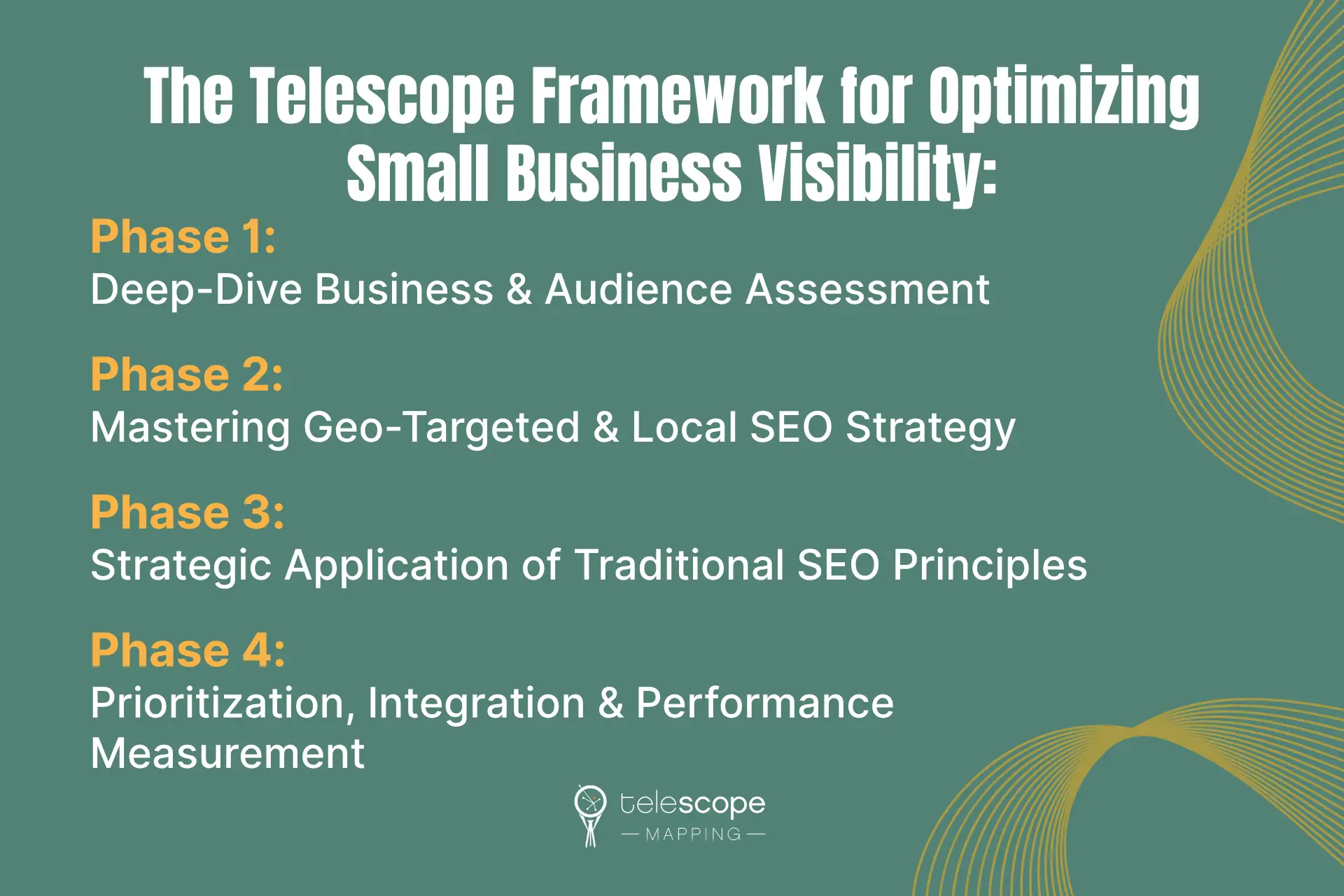
Our consultancy employs a comprehensive, phase-driven methodology designed to demystify the complexities of local SEO vs traditional SEO for small businesses. This integrated framework ensures a strategic, rather than reactive, approach to online visibility, while also proactively mitigating the common pitfalls that often undermine performance. The result is a clear, executable roadmap for achieving geo-targeted SEO success while intelligently leveraging broader search strategies where appropriate.
Phase 1: Deep-Dive Business & Audience Assessment (Understanding Search Intent)
The foundation of any effective SEO strategy is a precise understanding of your business’s operational footprint and target audience. This phase begins by defining your geographic service area or the specific market segments you serve. From there, customer personas are developed, mapping digital behaviors and analyzing search intent.
A critical distinction emerges at this stage: are customers searching for immediate, location-based solutions such as “plumber near me,” or are they exploring broader queries like “best eco-friendly plumbing solutions”? Misinterpreting this intent often leads to one of the most common strategic errors: over-investing in broad, non-local keywords that fail to convert.
By aligning SEO efforts with actual customer search behavior, your business avoids wasted resources and focuses on the highest-impact opportunities from the outset.
Phase 2: Mastering Geo-Targeted & Local SEO Strategy
With search intent clearly defined, the focus shifts to building a strong local SEO strategy. At the center of this effort is the optimization of your Google Business Profile (GBP). Simply claiming a listing is insufficient: it must be fully enriched with accurate information, compelling visuals, relevant categories, and consistent updates.
Neglecting GBP optimization is a critical oversight that can render your business effectively invisible in high-intent local searches. A well-optimized profile, combined with active engagement (such as posting updates and responding to reviews) positions your business prominently in local results.
Equally important is maintaining strict NAP (Name, Address, Phone) consistency across all directories. Inconsistent data creates confusion for both search engines and customers, eroding trust and negatively impacting rankings. A disciplined approach to citation management ensures uniformity across platforms.
This phase also includes building local citations, implementing a structured review generation strategy, and developing geo-specific content. Ignoring reviews is another frequent misstep: without a steady flow of positive, recent feedback, your business risks appearing less credible than competitors. Proactively encouraging and responding to reviews strengthens both rankings and customer trust.
Phase 3: Strategic Application of Traditional SEO Principles
While local visibility is often the primary driver for small businesses, traditional SEO remains a critical component when applied selectively and strategically.
This phase begins with targeted keyword research, emphasizing long-tail, intent-driven queries that align with your business model. A common mistake is pursuing broad national keywords without considering local relevance. For most small businesses, this approach delivers low ROI and diverts attention from more actionable opportunities. Instead, priority should be given to geo-modified and service-specific terms that capture qualified demand.
Technical SEO elements, such as site speed, mobile responsiveness, and local schema markup, are addressed to ensure a strong performance foundation. In parallel, high-quality content creation supports both local and broader visibility, positioning your business as an authority while answering key customer questions.
The emphasis here is disciplined execution. Every traditional SEO effort must directly support business objectives rather than dilute focus.
Phase 4: Prioritization, Integration & Performance Measurement
SEO for small businesses is rarely an either/or decision between local and traditional strategies. This final phase focuses on integrating both approaches in a way that maximizes impact while aligning with available resources.
Strategic prioritization is essential. Businesses that fail to balance these efforts often either overextend into low-value national competition or underinvest in broader visibility opportunities. A cohesive strategy ensures that local dominance reinforces brand credibility, while broader SEO efforts expand reach where it is commercially viable.
This phase also establishes clear performance metrics. Local SEO success is measured through indicators such as GBP insights, local map rankings, and review volume. Broader SEO performance is evaluated through organic traffic, keyword rankings, and lead generation.
A data-driven approach ensures continuous optimization, accountability, and sustained growth, transforming SEO from a fragmented set of tactics into a reliable engine for customer acquisition.
Frequently Asked Questions (FAQ)
As a small business, do I need both local SEO and traditional SEO, or is one sufficient?
The optimal approach is rarely an either/or decision, as it depends entirely on your business model and target audience. For brick-and-mortar stores or service-area businesses, a local SEO strategy is non-negotiable and often sufficient for immediate growth. However, if your business also offers online products or services with a broader appeal, a strategic blend incorporating targeted traditional SEO elements can significantly expand your reach and revenue streams. We recommend a phased approach that prioritizes based on your primary customer acquisition channels.
How quickly can I expect to see results from investing in local SEO?
While some local optimizations (such as a fully updated GBP and consistent NAP data) can yield quicker visibility improvements within weeks, sustained and dominant local search rankings require ongoing effort. Expect more significant, measurable results, like increased GBP calls, direction requests, and website clicks, within three to six months. SEO is a long-term strategic investment, with continuous refinement driving compounding returns over time.
My business operates service-area-only (no physical storefront). How does local SEO apply to me?
Local SEO is incredibly powerful for service-area businesses. Instead of relying on foot traffic, your strategy will focus on optimizing your GBP by setting clear service areas, not a physical address. You’ll leverage local content that speaks to specific neighborhoods you serve, generate customer reviews, and ensure your NAP data is consistent across online directories. The goal is to appear prominently for “service near me” searches, demonstrating your relevance within targeted geographic zones.
What are the most important metrics to track for small business SEO success?
For small businesses, key performance indicators should directly link to revenue generation. Important metrics include local search rankings, particularly your appearance in the Google local pack. Google My Business insights are crucial, tracking direct calls, requests for directions, and website visits originating from your listing. Additionally, monitor local citation strength, the volume and sentiment of customer reviews, organic traffic to geo-targeted pages, and ultimately, conversion rates from local search visitors. These metrics provide a holistic view of your return on SEO investment.
Conclusion & Next Steps
For small businesses striving for sustainable growth in a competitive digital landscape, clarity on the strategic importance of local SEO vs traditional SEO isn’t just an advantage, it’s a necessity. By understanding the core distinctions, embracing a structured methodology, and proactively avoiding common pitfalls, you can unlock unparalleled revenue potential. Your digital presence is too critical to leave up to chance or fragmented efforts. A tailored, strategic approach to SEO translates directly into competitive advantage, increased market share, and long-term business growth.
Discover how our strategic approach to SEO can unlock new revenue streams for your business. Schedule a complimentary strategy session with one of our experts today.