

Picture two buyers shopping for the same thing: a new accounting platform for a fast-growing company. One is at her desk, typing “accounting software for growing business.” The other is between meetings, riding in the back of a car, asking his phone, “What’s the best accounting software for a company with fifty employees?” Both are evaluating the same kind of product, yet the two searches look nothing alike– and the way a search engine answers each one is different too. This article compares traditional vs voice search SEO side by side, highlighting where they overlap and how to build one strategy that works for both.
A Simple Comparison of Traditional vs Voice Search SEO
It’s easy to read traditional vs voice search SEO as a choice between two separate strategies. But in practice, they’re two ways of asking the same search engines for the same information, and the work that earns visibility in one often supports the other.
Voice search SEO is the practice of making your content easy for a voice assistant, like the ones on phones, smart speakers, and in cars, to find, understand, and read aloud. When someone asks a question out loud, the assistant often speaks a single answer instead of showing a list of links, and it pulls that answer from a source it trusts. Voice search SEO is about making your business that source, which means writing clear answers to the questions your customers actually ask and keeping details like your hours and address accurate. Traditional SEO, by contrast, aims to place your pages high in a list of results that a person scans and clicks.
The main differences between traditional vs voice search SEO lie in emphasis: how a query is phrased, what the result looks like, and which parts of a page matter most. Once you can see those differences clearly, deciding where to focus becomes much simpler.
AI Overviews and Evolving Search Engines
Before going any further, we need to cover how AI fits into all of this. AI sits underneath both kinds of search, but it’s most visible in voice search. Voice assistants like Amazon’s Alexa or Google’s Gemini use AI to understand natural speech, and a growing number now use generative AI to compose answers from several sources instead of reading back a single web page.
For your business, that means two things: Clear, consistent information matters even more, because an AI system has to trust what it’s summarizing, and being cited as a source can matter alongside where you rank. How these features choose their sources is still evolving, so the safest approach is to publish accurate, well-organized answers and keep them current.
How the Searches Themselves Differ
The most visible difference between traditional vs voice search SEO is the query. Typed searches are compressed: people trim them to the few words they expect a search engine to understand, like “running shoes flat feet” or “best jogging sneakers 2026.” Spoken searches sound more like a conversation: “What are the best running shoes for flat feet?” or “What are the most-reviewed jogging sneakers this year?” They run longer, lean on question words, and often include context a typist would leave out, such as a location, a time period, or the situation behind the question. Assistants can also remember what was just asked, so a person might follow “what’s a good shoe store near me?” with “Are they open Saturday?” and the conversation carries on without restating the first question.
What the Results Look Like
The next difference between traditional vs voice search SEO is what comes back after the search. A typed search returns a page of results: ads, local listings, short answer boxes, and links, often topped by an AI-generated summary. The person scans it, compares a few options, and clicks the ones that look most useful, so several businesses can win a visit from the same search.
In contrast, a voice result gives the person nothing to scan. The assistant speaks an answer, and they either act on it or ask a follow-up.
Let’s circle back to our introductory example: the accounting software buyer in the car is unlikely to compare five vendors. He’ll hear a short answer, perhaps naming a product or two, which makes a spoken result feel more like a recommendation than a ranking. The gap is narrowing as typed results increasingly open with AI summaries that cite a handful of sources, but which sources get used still comes down to the page itself.
Which Parts of a Page Matter Most?
The last difference between traditional vs voice search SEO is which parts of a page do the work. In traditional SEO, a page is judged largely as a whole: the title and short description shown in the results influence the click, headings and keywords signal the topic, and the depth of the full page supports its ranking. Readers can skim, so overall coverage counts for a lot.
Voice search, along with AI-generated summaries, tends to reward something narrower: the individual passage. A voice assistant isn’t reading your whole page aloud, it’s looking for the one or two sentences that directly answer your question. That puts extra weight on headings written the way a customer would ask the question, a short, plain answer right beneath each one, and structured data (or schema), which is extra labeling in a page’s code that tells search engines what each piece of content is– like an address, a price, or a question and its answer.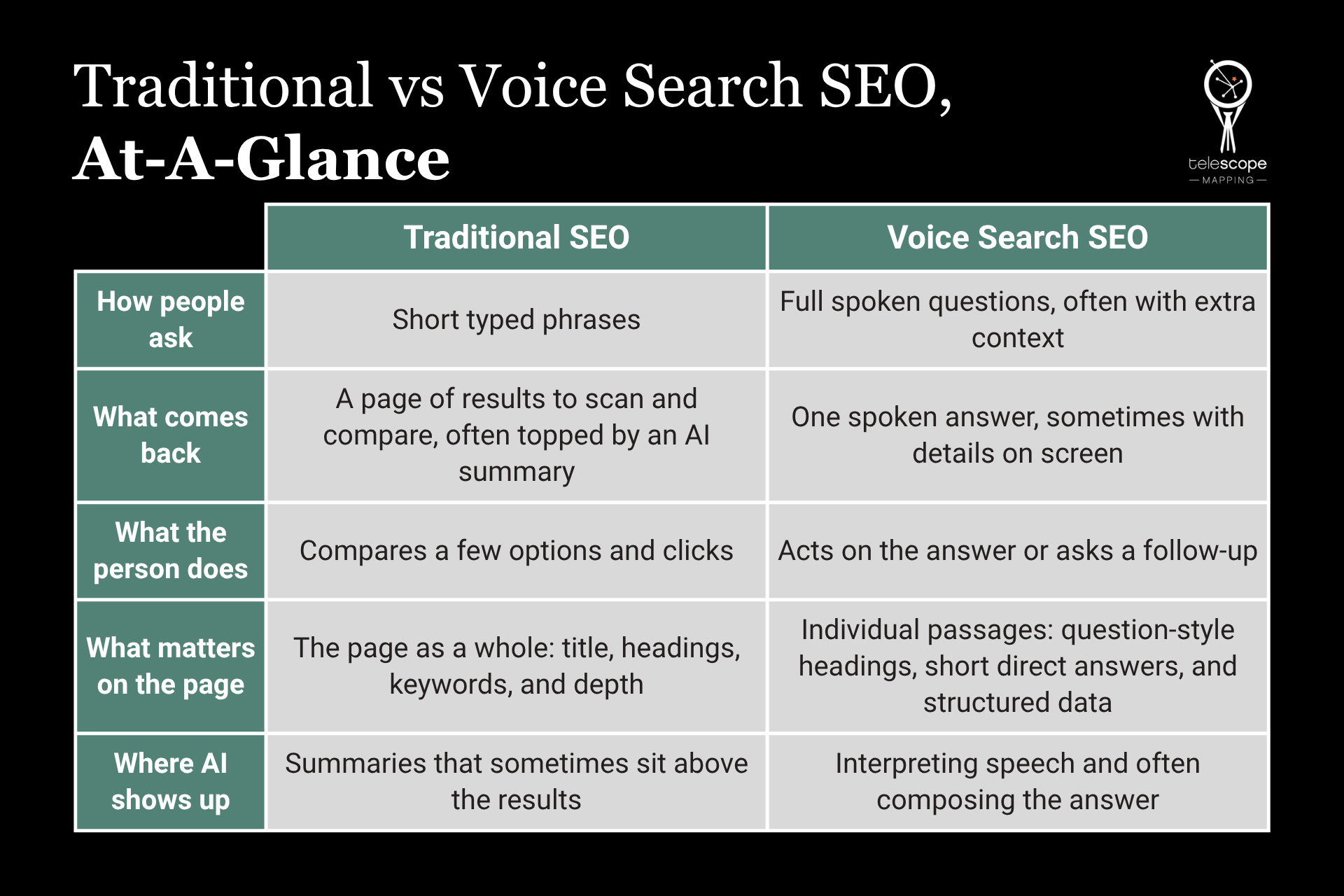
Where Traditional and Voice SEO Overlap
The encouraging news is how much carries over. Voice assistants and AI summaries generally draw on the same web that traditional search does, so the fundamentals that earn rankings also make you a candidate to be read aloud: expert content, technical health, and credible links from other sites.
Neither approach replaces the other, either. People still type when they want to compare options or read at length, and they speak when their hands or eyes are busy. Giving up typed-search optimization to chase voice would just trade one set of customers for another, so build voice into your existing SEO work instead of launching a separate project.
Building One Strategy for Both
A few adjustments take a traditional SEO program a long way toward voice readiness:
- Mine real questions.
- Customer emails, sales calls, support tickets, and your site’s own search data show how people phrase what they want to know. Turn the most common questions into headings with short answers, starting with your highest-traffic pages.
- Keep your information consistent.
- An assistant or AI summary has to trust what it repeats, and local details matter most because a voice search often ends in a call or a drive. If a business lists Saturday hours on its website but weekday-only hours in its Google Business Profile, the assistant has two conflicting answers and may skip the practice altogether. Make sure your business details match across your website, Google Business Profile, and major directories.
- Revisit your answers regularly.
- Prices, availability, and recommendations change, and an assistant will read an outdated answer aloud just as confidently as a current one.
- Test it yourself.
- Ask your phone or smart speaker the questions your customers would ask. If the answer you hear is thin or incomplete, that’s an opening for your page to take its place.
Where Telescope Mapping Fits In
For most businesses, the hard part isn’t understanding the difference between traditional vs voice search SEO, it’s deciding how much to invest in each. Telescope Mapping helps with that call. We look at how your customers actually search, check which of your pages are ready to be read aloud or summarized, and fold voice improvements into your broader SEO program so they’re tracked alongside your traditional rankings.
Traditional vs Voice Search SEO: FAQs
Which should we prioritize if resources are limited?
Start with the traditional SEO foundation if it has gaps, since it supports both: site speed, mobile experience, content quality, and accurate local listings. Then add voice-focused changes where they matter most, such as pages that answer common questions.
Can we measure how much traffic comes from voice search?
Not directly. Analytics tools and Google Search Console don’t separate spoken queries from typed ones, so measurement relies on proxies: growth in long, question-style queries, featured snippets (the short answer boxes at the top of results), and calls and direction requests from your Google Business Profile.
Does optimizing for voice also help with AI-generated summaries?
Often, yes. Both tend to draw on clear, well-organized, trustworthy passages, so the same work serves both. No one can guarantee which sources an AI feature will cite, though, so treat it as improving your odds rather than securing a spot. Check out our article on voice search optimization prep for more information.
How long does it take to see results?
Changes to page structure, direct answers, and listings can be picked up within weeks. Broader gains in rankings and traffic usually build over a few months.
One Strategy, Two Ways to Search
People want to make traditional vs voice search SEO into a rivalry, but in reality, they’re two expressions of the same goal: being the best answer to a customer’s question, whether it’s typed into a search bar or spoken from the back of a car. The differences in how people ask, what comes back, and which parts of a page matter show you where to adjust. The similarities mean much of your existing work already counts.
If you’d like a clearer picture of how your site performs for both, Telescope Mapping can walk you through it. Schedule a complimentary strategy session with one of our experts today to see where you stand and what to tackle first.