

A new business launch brings a strange kind of pressure. Everyone has advice, and every task feels urgent: a logo, a website, social accounts, ads, a newsletter, a Google listing. You have a small budget and no history to learn from, so every decision feels like a guess.
Marketing for new business owners works best when you build measurement and a small set of conversion-ready assets first, then add channels one at a time. The order matters more than the tactics: a modest plan you can measure will outperform an ambitious one you can’t, every time. This plan is measurement-first, but it isn’t slow. This article walks through a 90-day sequence including a practical method for judging what’s working, so you know where the next dollar should go.
Why the First 90 Days Set the Pattern for Everything After
Consider this common pattern: a founder launches on a Monday, sends paid traffic to a homepage with no conversion tracking, and checks the ad dashboard on Friday. Clicks are up, but sales are unclear. A few weeks and a few thousand dollars later, nobody can say which spend produced a customer, so the next decision gets made on instinct. That’s the core problem: new businesses often spend before they can measure.
This matters for a few reasons.
For one, customer acquisition cost (CAC), the total sales and marketing spend required to win one customer, determines how quickly a new business pays back its early investment. You can’t calculate it without tracking that connects spend to revenue.
Additionally, privacy changes and consent rules add pressure. Browsers limit tracking, and regulations require consent for many data uses, so tracking that is set up late or badly is harder to repair than tracking built correctly the first time.
Meanwhile, AI-driven and local search favor businesses that are consistently described and easy to find. Rising media costs punish guesswork on top of all this. The first 90 days are when you build habits that either prevent these problems or compound them.
Days 1-14: Define the Offer, Audience, & Success Metrics
Before you open an ad account, write down three things: what you sell, who it’s for, and what a win looks like. These notes become the foundation of your new business marketing plan, and everything later gets judged against them.
Start with a value proposition, one or two sentences on the problem you solve, and why a customer should choose you. Pair it with an ideal customer profile, a specific description of your best-fit buyer. “Small businesses” is not a profile. “Dental practices with three to ten staff opening a second location” is. Then turn both into a one-page messaging sheet: your one-sentence description, three proof points, and the words customers actually use to describe their problem. Every page, post, and email you write will draw from it, which keeps your message consistent as you add channels.
Next, sketch a customer journey map, a simple outline of the steps from first touch to purchase or booking. The graphic below includes two common examples:
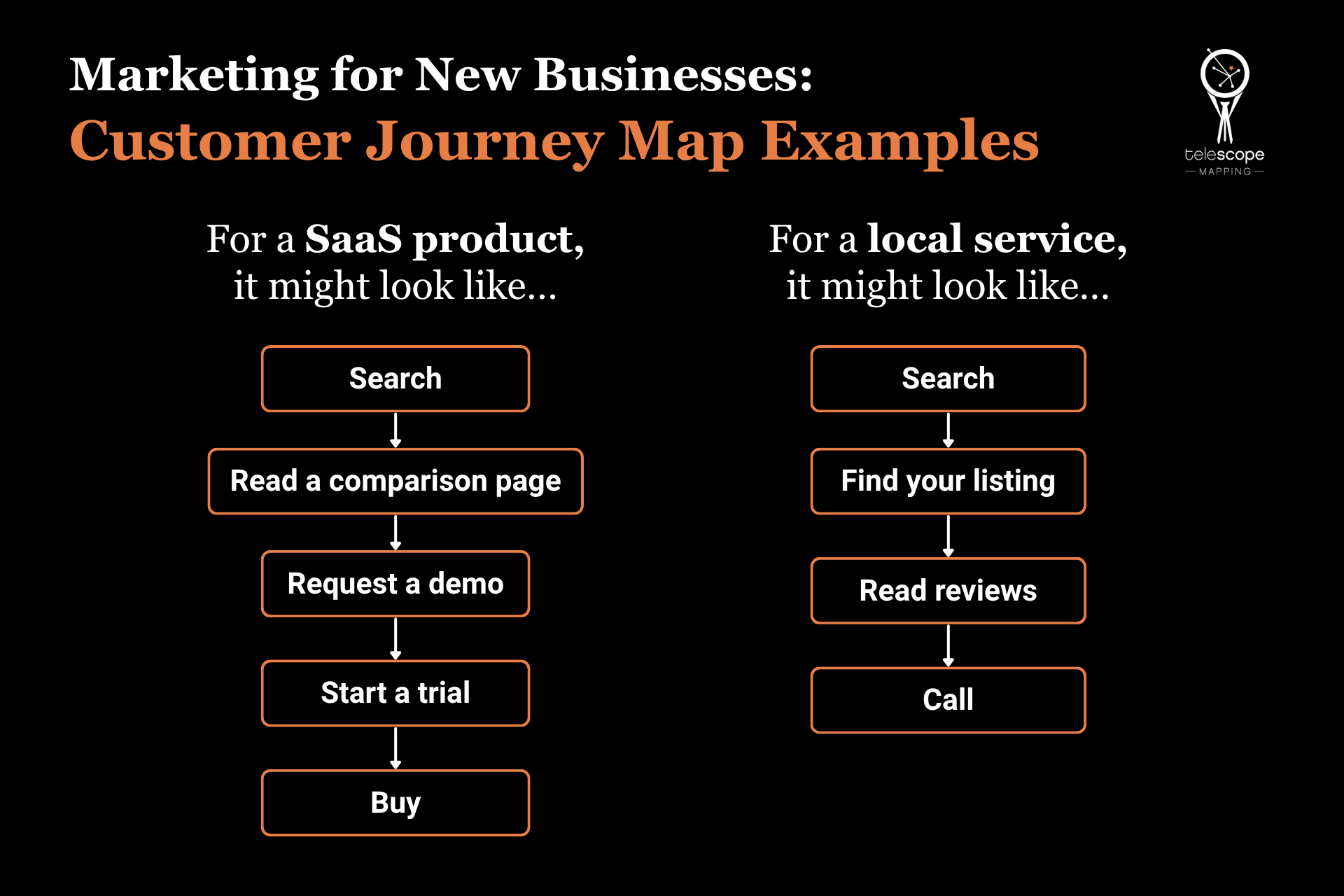 Each step is a place to measure and a place you can lose people.
Then choose two or three target metrics tied to revenue, such as qualified leads, booked calls, first orders, and a CAC ceiling, the most you can pay for a customer and still make the economics work. Finish with a scan of competitors and search demand: what they promise, how they price, and what people actually search for. Google Trends is a free place to start.
You don’t have to wait for tracking to start talking to people, either. The cheapest marketing out there is telling people. Make a list of 25 to 50 people in your network who fit your ideal customer or know someone who does, and start personal conversations: what you’re building, who it’s for, and whether they’d introduce you to anyone. Keep a simple lead log noting who you contacted and what came of it. It’s the first version of the tracking you’ll build in Phase 2.
The most common mistake at this stage is choosing channels before defining who the customer is and what a win looks like. The consequence is scattered activity and no basis for judging results. The correct approach is to write down the audience, offer, and numeric targets first, then pick channels that match them.
Days 15-30: Build the Data & Web Foundation
This is the heart of any small business launch checklist, and the least glamorous part. It’s also what makes every later dollar readable.
First, set up GA4 (Google Analytics 4) with defined conversion events: form fills, phone calls, purchases, bookings. Handle consent properly, using a consent banner and consent mode (Google’s mechanism for adjusting how tags behave based on a visitor’s choices) where your audience requires it. Adopt consistent naming and UTM conventions (the tags added to links that identify source, medium, and campaign) so “Facebook,” “facebook,” and “fb” don’t become three different channels. Then connect that data to a Customer Relationship Management (CRM) system, or, at minimum, a disciplined lead log, so revenue can be traced back to its source.
Treat your website as an acquisition asset, and let website design follow that goal: a clear call to action on every key page, fast load times, and a layout that works on a phone. If you serve a local area or multiple locations, claim and complete your Google Business Profile and key directory listings, with name, address, and phone details that match everywhere. Add early proof next to your calls to action: a testimonial from a pilot customer or beta user, a short case study, or a handful of reviews from the first people you’ve worked with. For a business with no track record, that proof does much of the persuading.
Once your conversion events are tested end to end, make your launch announcement. A short email or post to your network, pointing to a page with one clear call to action and an email sign-up, costs almost nothing. It also gives you your first conversions and lets you confirm that tracking works with real visitors before any money goes into ads. Set up only the social profiles you’ll actually maintain, and use them to point people back to that page.
The most common mistake here is launching traffic before conversions are tracked. The consequence is that the first and most expensive weeks of learning are lost, and the data can’t be backfilled. The correct approach is to test every conversion event end to end before any spend, and to connect analytics to the CRM so there is one source of truth.
Days 31-60: Launch Two Channels, Not Seven
With tracking in place and your launch behind you, you can now afford to learn. The discipline in this phase is restraint: one owned or organic channel and one paid test.
Your realistic options are…
- Search visibility fundamentals (pages that match what buyers search for, local listings, and reviews)
- A small paid search or paid social test with a capped budget
- Email capture with a basic nurture sequence (automated messages that guide a new contact toward a decision)
- Referral or partnership outreach, which you can expand now that your network has had its first look.
You won’t need all of them, and trying to run them all at once is how small budgets disappear.
Marketing for new businesses in the SaaS field usually leans toward search visibility and outbound, because buyers research carefully and several people weigh in. Local and field services lean toward local search and reviews, because customers search with urgency and choose on proof. eCommerce brands often lean toward paid social and email, which create demand and bring back visitors who didn’t buy the first time.
The most common mistake in this phase is spreading a small budget across too many channels. The consequence is that no channel gets enough volume to produce a readable result. The correct approach is to commit to one owned or organic channel plus one paid test, and run them long enough to compare.
Days 61-90: Measure, Learn, & Reallocate
By now you have a month of real channel data, plus whatever your launch and outreach produced, and the job changes from building to deciding.
Set up a shared dashboard that shows revenue, pipeline, and conversion, updated continuously rather than assembled once a month. Hold a short weekly check-in and a full review on day 90. In each one, ask what each channel cost per lead and per customer, what changed, why it changed, and what happens next. Every review should end in one of three decisions: scale it, fix it, or cut it.
The most common mistake at this stage is judging results by traffic or followers instead of revenue-linked metrics. The consequence is that spend follows activity rather than customers. The correct approach is to report on conversion, CAC, and pipeline first, and treat vanity metrics as supporting context.
Questions Founders Ask When Marketing for New Businesses (FAQs)
Can I do this plan in-house, or should I bring in outside help?
Many founders can handle the first phase and most of the channel work themselves. Outside help pays off most in the data foundation, where a mistake silently corrupts everything built on top of it. Additionally, a one-time review of your tracking can often have a better ROI than a full retainer– be sure to check out Telescope Mapping’s auditing services for more details.
How soon should I expect results, and what counts as early progress?
Timelines vary by business and channel, but your network outreach and launch can produce first conversations within days, paid tests and email tend to show signals within weeks, and organic search visibility usually takes longer. Typical early progress is a verified tracking setup, a measurable cost per lead, and one channel producing repeatable inquiries. Treat these as typical patterns, not guarantees.
Do I need social media accounts from day one?
Not necessarily. Choose the one platform where your customers already spend time, and treat it as a way to share your proof and point people to your website, not as a requirement to be everywhere. A few consistent posts on one platform will do more for you than six neglected profiles.
When Marketing for New Businesses, Start With What You Can Measure
The strongest asset a new business can own by day 90 is trustworthy data about what brings in customers. Logos, followers, and ad creative can all be replaced, but a clear record of which dollars produced revenue lets every later decision get cheaper and faster. Marketing for new business owners rewards the founder who can see clearly more than the one who simply spends more.
If you’d like a second opinion before your new marketing plan is set in motion, Telescope Mapping is here to help. Request a free consultation today, ask about auditing and data tracking review, and our team will check that your setup is capturing what matters.