

Ask three agencies how long a website redesign takes and you might hear “six weeks,” “six months,” and “it depends.” All three can be honest answers, because a website redesign timeline all depends on what’s being built, who’s involved, and how quickly decisions get made. This article gives you realistic ranges by project size, walks through where the time goes stage by stage, and shows what stretches a schedule and how to keep yours on track.
What’s a Realistic Website Redesign Timeline?
For most mid-size businesses, a realistic website redesign timeline runs about three to six months from kickoff to launch. Smaller sites can move in a couple of months, while larger or complex builds often take half a year or more. Those are typical ranges, though, not promises. The biggest swings often come from scope and from how quickly content and feedback arrive, not from how fast designers and developers work. Use the examples below as planning ranges:
- A small brochure-style site (roughly 10 to 30 pages with few integrations) typically takes 6 to 10 weeks.
- Content readiness and the number of revision rounds typically sets the pace, and many smaller and newer businesses fall here.
- A mid-size business site (roughly 30 to 100 pages, custom design, and CRM and analytics integrations) usually takes 3 to 6 months.
- This is often shaped by stakeholder approvals, content volume, and integrations.
- A large or complex site (eCommerce, multiple locations or languages, heavy migration) can run 6 to 12 months.
- Data migration, custom functionality, and testing are often the driving forces here.
Stage by Stage: Where the Time Goes
Stages overlap, so the total website redesign timeline is shorter than the sum of its parts. Below is what a well-run mid-size project should look like.
A professionally-run redesign (whether you’re partnering with an agency, freelancer, or handling the redesign in-house) should begin with planning and discovery, usually two to four weeks. Whoever is building your site should review your analytics, audit the current site, clarify goals, and talk with sales, marketing, and leadership before anything is designed. Skipping this stage rarely saves time– it just moves the questions to a point where the answers cost more.
Structure and content planning should follow for two to three weeks, producing a new sitemap, wireframes, and a messaging plan, along with a map of which old URLs connect to which new pages so your search visibility carries over. By the end of these first weeks, you should have agreed goals, an approved sitemap, and a content plan in hand.
Design and content creation then run side by side. Design should take three to six weeks, with concepts, structured feedback rounds, and mobile layouts leading to approved designs for the key page types. Revision rounds are one of the biggest influences on timing, so a good partner agrees on how many are included before design begins. Content creation runs four to eight weeks alongside design and development, covering writing, photography, product details, and approvals. A professional process plans for it from the start, since it’s the stage most likely to hold up a launch.
Development and integrations should take four to ten weeks. Templates, the content management system, forms, analytics, and connections to tools like your CRM get built and loaded with content, with performance and mobile behavior tuned along the way. The milestone is a working test version of the full site, kept on a private staging copy so everything can be checked without affecting visitors. Testing and launch preparation then takes two to three weeks: the site is checked across devices and browsers, redirects and tracking are verified, and a final content review happens before a launch date is locked.
Launch and early monitoring closes out the project, with about a week for go-live and 30 to 90 days of close watching afterward. The professional standard is to track rankings and traffic, look for errors, and fix issues as they appear, and some movement in search results right after launch is normal.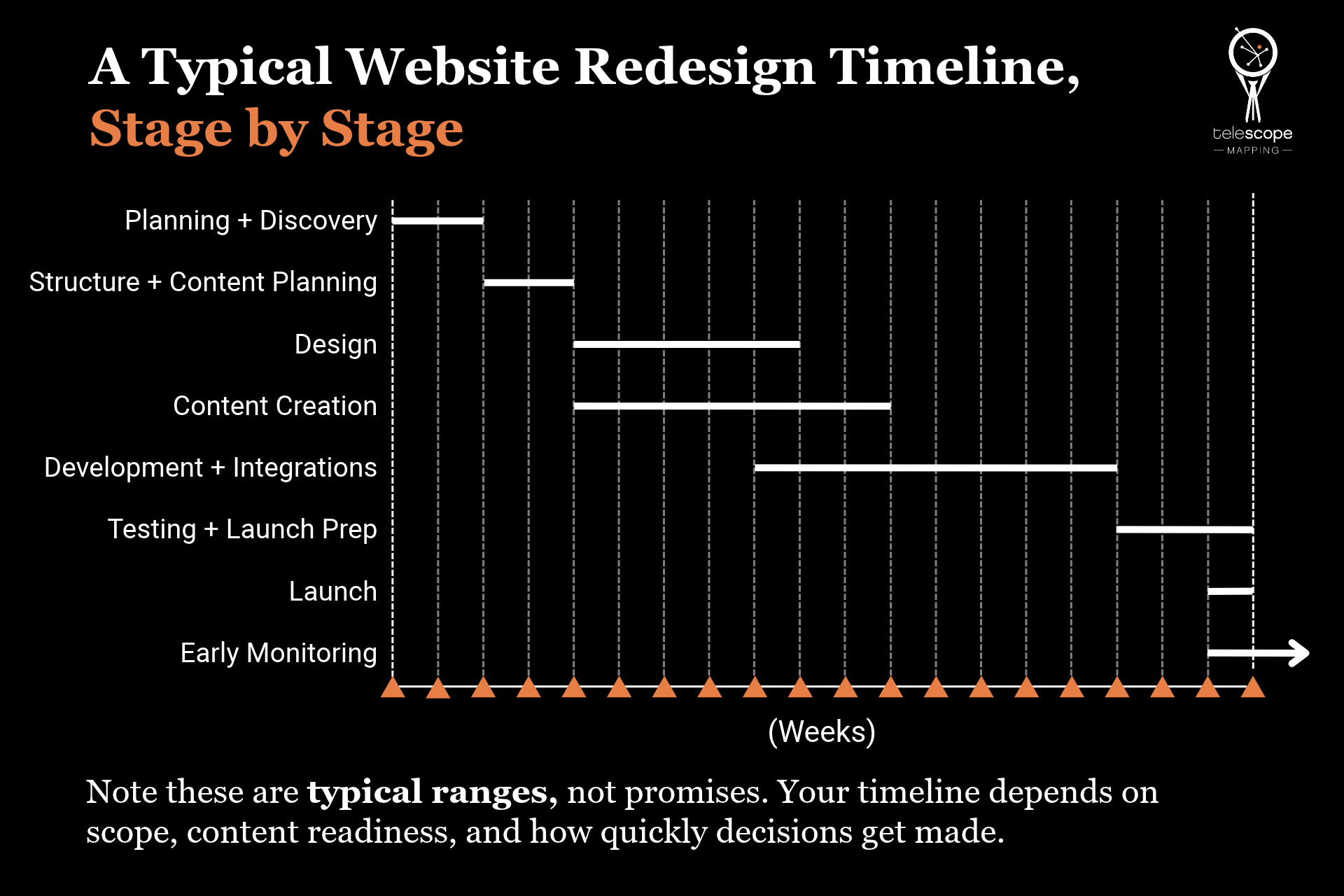
What Stretches a Timeline, and How to Keep It on Track
Most website redesign timeline delays trace back to the same handful of causes. Late content is the biggest: pages can’t be built or tested without real copy and images, so a week of delay in content often becomes a week of delay in launch. Too many decision-makers is a close second, since each approver adds feedback and conflicting feedback adds another round. Scope creep, integration surprises, and the migration of a large site with many URLs can each add time too, and so can unclear goals.
A few habits protect a schedule well:
- Name one final decision-maker who gathers input widely and then makes the call.
- Agree up front on how many revision rounds each stage includes and when feedback is due.
- Start drafting content during planning rather than after design is approved, and set up a simple process for weighing new ideas against their effect on cost and date.
- A phased launch can help, too: putting the most important pages live first and adding the rest later gets a better site in front of customers sooner and lets real data guide what comes next.
- Finally, leave a small buffer for the unexpected, especially around holidays and busy seasons.
Working Backward From Your Launch Date
It’s worth noting that if you have a firm deadline, such as a product launch, a trade show, or a seasonal peak, count backward from it. A mid-size project that needs to be live by October 1, for example, should kick off around the start of May or June, depending on its complexity. Count the weeks before kickoff, too: choosing an agency, signing an agreement, and gathering access and assets can easily take several weeks of their own. It’s also usually wise to avoid launching right before your busiest period, since a new site deserves a few quiet weeks of monitoring and fixes.
A Note for Smaller and Newer Businesses
If you’re a smaller or newer business, much of this website redesign timeline works in your favor. With fewer approvers, decisions often move faster than they do at larger companies, and an owner or founder who can make the final call keeps feedback rounds short. That makes a phased launch especially natural: a focused site with the pages customers need most can go live in a couple of months and grow from there.
The most common slowdown for smaller teams is content. When the same few people run the business and write the copy, gathering photos, testimonials, service details, and approvals can take longer than the build itself, so starting early pays off. Newer businesses may not have analytics history to review, which makes conversations with early customers and a look at competitors’ sites a good substitute during discovery. Even a trade show eight weeks away is workable for a small site, as long as the content is ready before the project starts.
After Launch: What Comes Next?
Launch isn’t the end of the schedule. Once the early monitoring window has passed, a steady rhythm of testing and content updates keeps the site improving, and many businesses revisit major design decisions every few years.
In between, the site needs everyday care, and that’s where Telescope Mapping’s hosting and website management service comes in. Updates are tested and backed up automatically, daily backups and real-time uptime monitoring run in the background, and contact forms and checkout are tested regularly, so problems get caught before visitors find them.
We take a proactive approach: security is active around the clock, page speed is tested and tuned continuously rather than only at launch, and a clear monthly report covers performance, traffic, updates, and security. A dedicated technical contact who knows your site is also there whenever questions come up.
Additionally, if your redesign includes a move to new hosting, we handle the migration for free, with no downtime for visitors. And because sites differ, we offer one plan designed for brochure and content sites, which suits many smaller businesses, and a second plan that adds extra checkout testing for eCommerce businesses.
Website Redesign Timeline FAQs
Can a redesign be done in 30 days?
For a very small site built on a template, or a phased launch of just the key pages, it’s possible. The tradeoff is less time for content, review, and testing, so the faster the schedule, the more you’ll want clear priorities and quick decisions on your side.
Why do agencies quote different website redesign timelines for the same project?
Usually because they’re assuming different things: whether content writing is included, how many revision rounds are allowed, how many integrations are needed, and how fast your team will respond.
Will a redesign hurt our search rankings, and how long does recovery take?
A well-planned migration, with old URLs redirected to the right new pages and tracking in place, helps limit the risk. Some ranking movement in the first weeks after launch is normal, and carefully handled sites often settle within a few months. Problems are more likely when redirects, content, or page structure change without a plan.
Does an eCommerce redesign take longer?
Often, yes. Product data has to be migrated and checked, and the connections for payments, shipping, inventory, and tax all need testing, especially the full purchase path. Plan extra time for that testing, and agree on who owns each integration at kickoff.
Setting Realistic Expectations for Your Timeline
All of this brings us back to the question at the heart of this guide. A realistic website redesign timeline isn’t a single number, it’s a range shaped by the size of your site, the readiness of your content, and the speed of your decisions. Plan in stages, protect the parts that depend on your team, and decide early whether a phased launch makes sense, and you’ll have a schedule you can actually keep. For smaller and newer businesses, that often means a focused launch followed by steady growth, with someone watching over the site along the way.
If you’d like a second opinion on a timeline, or help building one around your launch date, Telescope Mapping is happy to talk it through. Schedule a complimentary strategy session with one of our experts today to map out what a realistic plan looks like for your site.