Most businesses don’t decide to redesign their website all at once. They typically notice a slow accumulation of small frustrations first: maybe it’s a bounce rate that keeps creeping up, a sales team that stops sending prospects to the site, a design that suddenly looks dated next to a competitor’s. But by the time those signs add up to an obvious problem, leads have often already been lost. This article walks you through the concrete signs you need a website redesign, what a genuinely strategic redesign process looks like, and the mistakes that derail otherwise promising projects.
Why These Signs Are So Important
Your website isn’t just a digital brochure, it’s your primary sales engine. It’s a key touchpoint for customer engagement, and a direct reflection of how current your business feels to a prospect evaluating you for the first time. When it stops performing that role well, the cost shows up quietly: in traffic that doesn’t convert and sales cycles that stretch longer than they should (long before anyone flags it as a “redesign problem”).
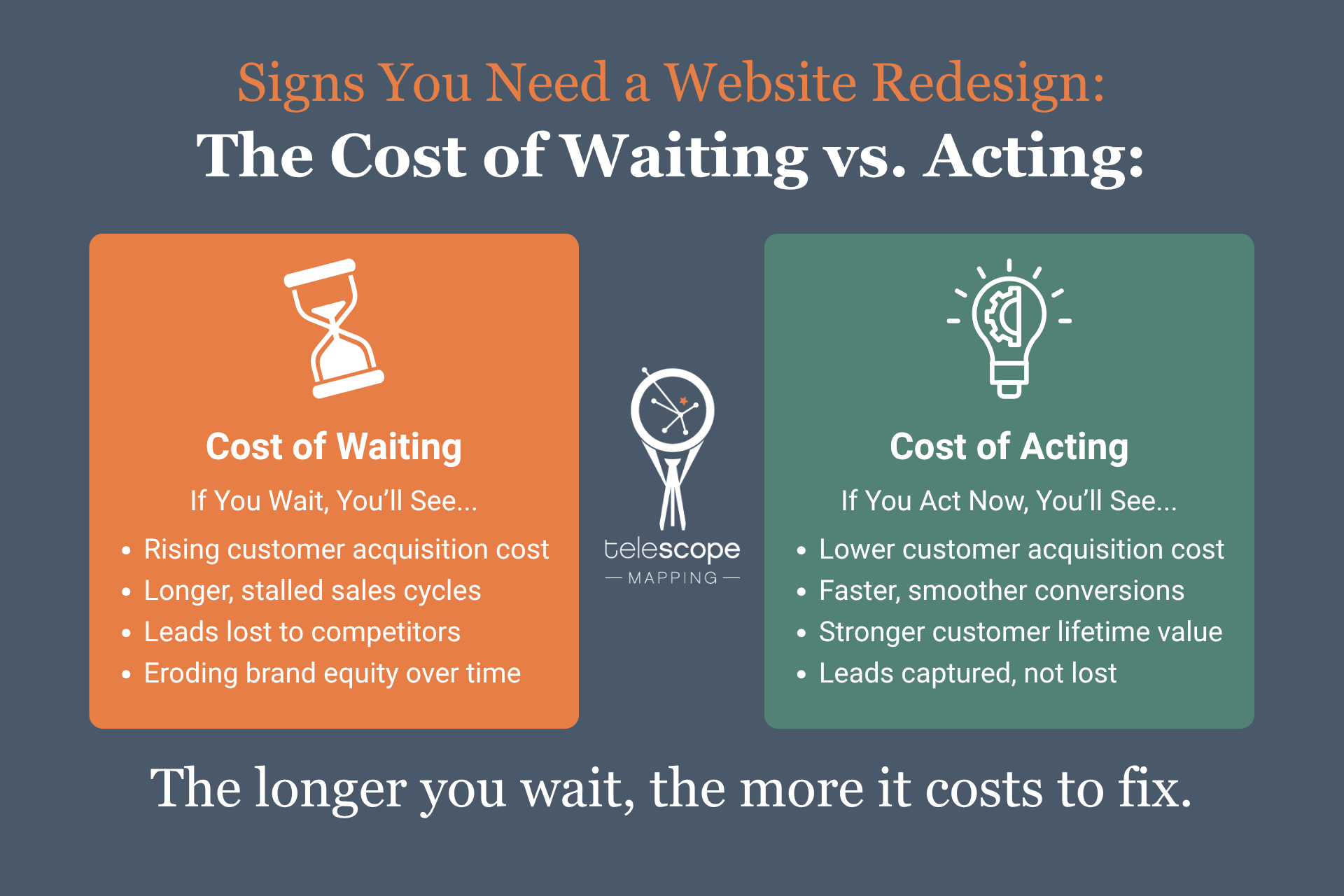
Businesses tend to defer a redesign until the problems become undeniable, treating it as a significant expense to put off rather than a strategic investment to make proactively. But the cost of that delay, in terms of lost leads, diminished brand equity, and operational drag, typically outweighs the cost of the redesign itself.
Today’s buyers, whether B2B or eCommerce, expect a seamless, intuitive experience close to the best consumer platforms they use elsewhere. A site that feels sluggish, looks dated, or is hard to navigate quietly signals that the business behind it might be behind the curve too, even when that’s not actually true. Meanwhile, competitors who are investing in stronger digital experiences make it progressively harder to differentiate and compete for the same attention. An aging platform also tends to carry real technical debt: missing modern functionality, weaker security, and friction when trying to integrate the marketing and sales tools a growing team actually needs.
All of this adds up on the balance sheet: an underperforming site increases customer acquisition cost by failing to convert the traffic it already has, and it lengthens sales cycles by failing to give prospects what they need to move forward. A modern site, by contrast, supports better analytics and faster, more informed decisions– and is built to scale as the business grows rather than becoming the thing holding growth back.
 None of this requires an executive to become a design expert. What it requires is recognizing the specific, observable signals that a site has crossed from “needs some attention” into “actively costing the business leads,” which is exactly what the next section lays out.
The Actual Signs You Need a Website Redesign
A handful of concrete signals tend to show up well before a website’s underperformance becomes an obvious crisis. If several of these sound familiar, that’s a strong indication it’s time to take a redesign seriously.
Your Bounce Rate Is Climbing and Conversion Rates Are Falling.
If visitors are arriving but leaving quickly without taking action, that’s often a sign the site isn’t communicating value clearly or isn’t built around a genuine conversion path. A slow, steady rise in bounce rate over several months is easy to miss without regularly checking analytics, which is exactly why it tends to go unaddressed until the trend is well established.
The Design Looks Noticeably Dated Next to Competitors.
A site that hasn’t meaningfully changed in several years starts to read as a proxy for the business itself. Whether it’s “fair” judgment or not, prospects associate visual datedness with being behind the curve, and that impression forms in the first few seconds of a visit well before anyone reads a word of your content.
Mobile Performance Is an Afterthought.
If the mobile experience feels like a compressed version of the desktop site rather than something genuinely built for how people browse on their phones, you’re likely losing a meaningful share of visitors, particularly given how much B2B research and eCommerce browsing now happens on mobile devices first.
Your Sales Team Has Stopped Relying on It.
When a sales team routes prospects around the website instead of through it (like sending decks and PDFs instead of pointing to pages), that’s a clear signal the site isn’t doing its job in the funnel. It’s often one of the clearest internal signs available, since the sales team feels the gap directly every day.
Updating Content Is a Technical Ordeal.
If publishing a new page or updating a service description requires a developer every time, the platform is actively slowing down your marketing team’s ability to respond to the market, test new messaging, or capitalize on timely opportunities.
It Can’t Talk to Your Other Systems.
An inability to cleanly integrate with your CRM, marketing automation, or analytics stack means valuable data is falling through the cracks. Your team is likely doing manual work to compensate (work that a modern platform would eliminate entirely).
You’re Not Confident It’s Secure.
Older platforms often carry real security vulnerabilities, and the reputational and financial risk of a breach is far more expensive than a redesign. This is a fact that becomes obvious in hindsight but is easy to deprioritize until something actually goes wrong.
Growth Plans Keep Running Into the Site’s Limitations.
A new product line, a new market, or a new campaign type that the current site structure simply can’t support is one of the clearest signs the platform has become a ceiling rather than a foundation. It tends to surface at exactly the wrong moment: right when the business is trying to move quickly.
How a Strategic Redesign Actually Works
With the signs you need a website redesign covered, let’s now discuss what the process actually looks like. A redesign done well is a business growth initiative, not just a visual refresh. Telescope Mapping generally approaches this in four phases, each building directly on the last.
1. Discovery + Strategic Blueprint
This starts with a genuine understanding of the business: objectives, buyer personas, competitive landscape, current analytics, and a technical audit of the existing site. Stakeholder interviews (including sales, not just marketing) help align everyone on what the redesign actually needs to accomplish, resulting in a clear brief with defined KPIs and scope before any design work begins.
2. Experience Design + Content Architecture
With that blueprint in place, the focus shifts to a genuinely intuitive, conversion-oriented user journey: wireframes, prototypes, and real user testing, paired with an information architecture and content strategy that addresses actual buyer pain points and builds in SEO from the start (rather than retrofitting it later).
3. Development + SEO Integration
This is where the site gets built: mobile-first, fast-loading, and integrated cleanly with the CRM and marketing tools your business already relies on. Technical SEO, keyword strategy, site structure, and proper redirects get built in from the ground up here, which is what protects existing search visibility through the transition rather than losing it.
4. Launch + Ongoing Optimization
Launch is the start of the next phase, not the finish line. Careful pre-launch testing followed by close post-launch monitoring against the KPIs set in discovery lets the team catch issues early, and ongoing A/B testing and conversion rate optimization keep the site improving well after it goes live.
This is often the stage where internal teams run out of bandwidth: not because the individual steps are unclear, but because doing all four well, on top of everything else a marketing team is already juggling, is genuinely difficult without dedicated support. Telescope Mapping works directly with businesses through this exact process, from the initial audit through post-launch optimization, so the redesign is treated as a growth investment rather than a one-time design refresh.
Common Pitfalls to Avoid During a Redesign
Even if you notice the signs you need a website redesign, well-intentioned redesigns can still miss the mark. Here are the mistakes we see most often, and how to steer clear of them:
- Focusing on aesthetics over business objectives.
- A beautiful site that doesn’t convert visitors or support sales goals hasn’t actually solved the problem. Every design decision should trace back to a measurable objective, not just visual preference.
- Neglecting SEO during the redesign.
- Many businesses discover, too late, that their new site quietly lost organic traffic and rankings after launch. Building SEO in from the discovery phase (like keyword research, URL mapping, redirects) protects that visibility through the transition instead of rebuilding it from scratch afterward.
- Skipping user research in favor of internal assumptions.
- Designing around what your team believes users want, rather than what the data actually shows, tends to produce a site that misses real user behavior and pain points.
- Treating launch as the finish line.
- A redesign that stops improving once it’s live leaves real performance on the table. Planning for ongoing testing and optimization after launch is what turns a one-time investment into a compounding one.
Avoid these four missteps, and you’re already ahead of most redesign projects.
Signs You Need a Website Redesign: FAQs
How long does a strategic website redesign typically take?
It varies with scope and complexity, but a comprehensive redesign (discovery, design, development, and testing) typically takes 3 to 6 months. A phased approach helps keep that timeline efficient without cutting corners on strategic alignment.
Should we rebuild the whole site, or just refresh specific elements?
That depends on what the initial assessment turns up. Fundamental architectural issues, real security risk, or a platform that can’t scale with your growth plans usually point toward a full rebuild. A lighter refresh tends to make more sense when the underlying platform is sound and the issues are more cosmetic or content-related– an honest discovery phase is what clarifies which situation you’re actually in.
How do we make sure the new site actually supports our sales team?
Involving sales leadership in the discovery and planning phases (not just marketing), is the biggest factor. From there, clean CRM integration, clear calls-to-action that guide prospects toward sales-ready content, and dedicated resource sections built for sales enablement turn the site into something the sales team actively uses rather than works around.
Next Steps for Your Redesign
Recognizing the signs you need a website redesign isn’t about chasing a “fresher look,” it’s a proactive move to protect your revenue and market position before an underperforming site quietly erodes them further. A site that’s showing several of the signs above isn’t just a cosmetic concern, it’s a growing bottleneck in your funnel. The longer it goes unaddressed, the more expensive it typically becomes to fix.
If you’re not sure whether what you’re seeing on your own site adds up to “time for a redesign,” that’s exactly the kind of question Telescope Mapping helps businesses answer. Schedule a complimentary strategy session with one of our experts today to find out where your site stands, and what a genuinely strategic redesign could recover.