

A customer searches for your business, clicks a result that promises one thing, and lands on a social profile that sounds like a completely different company. Then a promotional email arrives in a third voice, with an offer that contradicts both. None of these moments is a disaster alone, but together, they tell the customer that nobody’s in charge.
A digital brand consistency plan closes that gap. It’s a documented, measurable system of standards, ownership, and review that keeps your identity and messaging aligned wherever customers meet you. By the end of this article, you’ll know what that plan should contain, how to build one effectively, and how to verify it works with data rather than opinion.
Inconsistent Branding Costs You More Than You Think.
Customers feel it before they can name it. A search result promises same-day service, the social page lists different hours, and the email footer shows an old address. Trust erodes quietly, then surfaces as lower conversion rates, higher customer acquisition cost, and weaker repeat purchasing, which drags down lifetime value.
Three shifts raise the stakes. AI-driven search now summarizes brands from scattered sources, so contradictory profiles produce muddled summaries. Privacy and consent changes limit tracking, which makes owned channels like email more valuable. And rising media costs make every confusing impression more expensive.
What a Digital Brand Consistency Plan Actually Includes
A plan turns those risks into something you can manage. It separates what must never change from what can flex. The fixed list is short: business name, logo usage, core promise, approved claims, compliance language, and contact and location data. The flexible list covers format, length, and cadence, because a search description, a social reply, and a subject line each work under different constraints.
It also clears up a distinction that often gets blurred: digital brand strategy defines who you are and what you promise. Brand consistency is how that promise gets executed day to day. An effective digital brand consistency plan covers both brand voice (how you sound) and visual identity (how you look), because customers experience them together.
When to Build a Digital Brand Consistency Plan
The best time to build your digital consistency plan is before drift starts, but most teams act when something forces the question. Four triggers come up most often.
The first is a change that touches everything at once, such as a rebrand, a website redesign, or a platform migration. Everything is already being revisited, so it’s the cheapest moment to set standards and roll them out across every channel together. Protect existing equity as part of the move: rankings, inbound links, and tracking should survive it.
The second is growth. A new location, an acquisition, a new channel, or a new agency or freelancer all multiply the number of people shaping your brand, and each one is another place for drift. A sturdy digital brand consistency plan in place before onboarding means newcomers start from the standards instead of guessing.
The third is noticing drift yourself. Warning signs include a business described differently on your website, social profiles, and listings; email templates that don’t match your current look or tone; and no single person who owns approvals. If two of those are true, drift is already happening. Asking an AI search tool to describe your business is a quick test, too: if the summary is outdated or contradictory, your sources are.
The fourth is an outside prompt: a compliance update, a complaint about conflicting offers, or a customer confused by mismatched information. These are easy to dismiss as one-offs, but each one means there’s no single standard to answer the question “which version is right?”
Whichever trigger applies to you, you don’t need a finished plan to begin. A one-page fixed list, a named owner, and an audit of your busiest channels make a workable first step, and the phases below fill in the rest.
How to Build Your Digital Brand Consistency Plan in Four Phases
Whatever your trigger, the order matters. Each phase builds on the one before it, and each comes with the pitfall that most often undermines it.
Phase 1: Audit Every Place Your Brand Appears
Start by seeing what customers see. Inventory your search listings and metadata (the titles and descriptions that appear in results), social profiles, email templates and sender names, and business listings. Score each against your current standard: name, description, tone, visuals, claims, and contact data.
This is the measure-before-you-optimize principle applied to brand: baseline how it appears before you change anything. Review your tracking naming conventions too, such as UTM parameters (tags added to links that tell analytics where a visit came from) and campaign names. Inconsistent naming makes channel comparisons unreliable later, which is where a broader marketing audit, like the one Telescope Mapping offers, earns its keep.
Teams often audit only the channels with the most activity. The result is that orphaned profiles and old templates keep contradicting the brand, and they often feed the very summaries AI search produces about you. Audit everything customers can find, then prioritize fixes by traffic and revenue influence.
Phase 2: Define Standards by Channel, Not Just Guidelines
Now turn the brand book into operating rules. Brand voice needs a tone spectrum, do and don’t examples, and approved vocabulary. Add a messaging hierarchy, visual rules, and claims language, then show how each rule adapts to the channel it lives in. If your foundation isn’t documented yet, Telescope Mapping’s brand development support can help.
For search, that means titles, descriptions, structured data (code that helps search engines understand your content), and page copy. For social, it means formats, replies, and community tone. For email, it means sender name, subject lines, templates, footers, and the preference center. For business listings, it means a name, address, phone number, and hours that match everywhere. The table below shows how the same standard holds across channels while the execution changes.
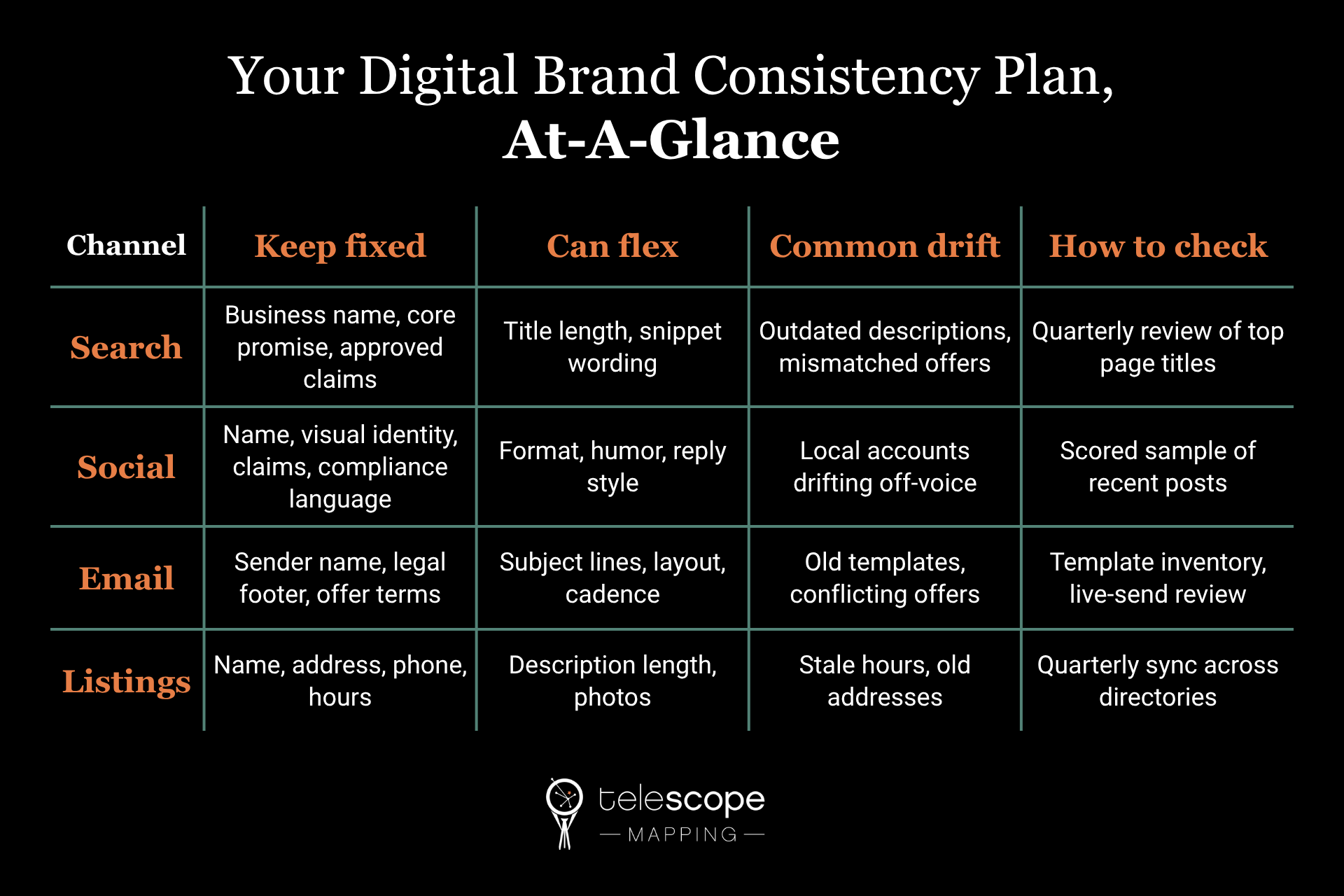 Notice that the keep-fixed column is short on purpose. The shorter the fixed list, the more likely people are to follow it. For the same reason, resist handing every channel the same 40-page PDF, because nobody uses it. Short, channel-specific playbooks with real examples of what good looks like get used.
Phase 3: Build Ownership, Workflow, and Compliance Into the System
Standards without owners decay. Assign one brand owner with final say, and name a channel owner for search, social, and email. Then set approval tiers: what needs sign-off, and what doesn’t. A routine social reply shouldn’t wait in the same queue as a new product claim. And don’t forget that agencies and freelancers need the same onboarding as employees, including the playbooks, the approval tiers, and a named contact.
Build reusable assets so the right choice is also the easy one: templates, snippet libraries for approved descriptions and disclaimers, and location-level fill-in fields for multi-location brands. Local teams can personalize hours, staff, and promotions without rewriting the brand.
Also, compliance belongs inside the workflow, not at the end of it. For regulated content, put required language into templates and add a checkpoint before publishing. For email, that includes footer elements required by laws such as CAN-SPAM in the United States.
Lastly, be wary of centralizing every approval. It creates bottlenecks that push teams to bypass the process, which is exactly when off-brand content ships. The tiered approval approach described above, with strict review reserved for high-risk claims and regulated content, keeps things moving.
Phase 4: Measure Consistency and Report on It Continuously
Consistency feels subjective until you give it a score. Define key performance indicators (KPIs) that connect to business outcomes: periodic brand-compliance scoring across channels, accuracy of listings and metadata, email engagement and unsubscribe trends, branded search demand (people searching for your name directly), and conversion consistency from each channel into your site.
But these only work if the data underneath them is clean. Consolidated sources and consistent campaign naming, supported by sound analytics infrastructure, let you compare channels without arguing about whose numbers are right. Telescope Mapping’s data analytics services can help set that up.
Then, put the results on a shared dashboard with plain-language readouts: what changed, why it changed, and what happens next. An accessible dashboard beats a monthly PDF nobody opens. Then set a quarterly review cadence so the plan gets maintained instead of admired.
The common trap in this final phase is treating brand consistency as a feeling (“it seems on brand”), which means the plan loses budget and attention the first time priorities compete. Pair a scored checklist with performance metrics instead, and attribute results carefully. Better consistency may coincide with better performance, but correlation is not causation– so compare against your baseline and watch for other changes.
Digital Brand Consistency Questions Leaders Ask (FAQs)
How long does it take to build a digital brand consistency plan and see results?
Typically, the audit and first playbooks take a few weeks for a single-location brand and a few months for a multi-location brand with many legacy assets. Channel count, number of locations, and the volume of old templates and profiles drive the range. Leading indicators such as listing accuracy and compliance scores move first, while conversion and retention effects take longer and aren’t guaranteed.
Who should own this internally, and what if we use multiple agencies?
Give ownership to one person with authority over standards, usually in marketing leadership, and make agencies accountable to that person. Share the same playbooks with every partner and build them into contracts. The goal is one standard with many contributors, not one standard per vendor.
Can a small team do this without a big budget?
It’s definitely possible. Start with the fixed list, one named owner, and an audit of the channels customers see most. A scored checklist in a shared spreadsheet is enough to begin, and you can add playbooks and dashboards as the brand grows. For additional resources for smaller teams, check out Telescope Mapping’s online business tools.
Make Your Digital Brand Consistency Plan Something You Can Measure
A style guide in a shared drive describes your brand. A digital brand consistency plan with named owners, scored standards, and a review cadence runs it. The difference is whether someone can answer, in any given quarter, how closely your search results, social channels, and emails match the promise you’re making.
If you’re not sure how your brand actually appears across those channels, or what the data says about it, schedule a free marketing audit with Telescope Mapping today. We’ll review how your brand shows up and performs across search, social, and email, and walk you through where the biggest gaps are.