

Link building has changed a lot over the past few years, but the core idea hasn’t: links from credible sites remain one of the clearest signals that your content deserves attention. What has changed is which tactics earn those links and which ones quietly stopped working. This article explains why links still matter, which link building strategies are delivering results in 2026, and a practical framework for building a backlink profile that grows steadily without relying on shortcuts.
Link Building Strategies in 2026: What Still Works?
If you’ve been doing SEO for a while, you’ve probably noticed that the old playbook of volume-based outreach and templated guest posts doesn’t deliver the way it once did. The encouraging part is that the strategies working today are actually more rewarding: they build real authority, support the rest of your marketing, and tend to hold up through algorithm updates rather than being undone by them.
Yes, Links Still Matter in 2026
Search engines still depend on signals of trust and authority, and a backlink from a credible source is one of the most direct ways to earn them. Each one works as a third-party endorsement, reinforcing the experience, expertise, authoritativeness, and trustworthiness (E-E-A-T) that Google’s quality guidelines describe. As AI-generated content makes the web more crowded, links earned from real publications and real people become harder to imitate, which makes them more valuable as a way to stand out.
The business case is just as strong. A solid backlink profile supports higher organic rankings, which brings in qualified traffic without the per-click cost of paid channels, helping to lower customer acquisition cost over time. Authority also builds trust before a prospect ever speaks to your sales team, which supports conversion. And beyond rankings, a link from a respected publication introduces your brand to an audience that already trusts the source. Plus, unlike a paid campaign that stops delivering when the budget does, earned links keep working long after they’re won.
Link Building Strategies in 2026 That Still Work
The common thread across today’s effective tactics is that each gives another site a genuine reason to link to you. Here are the approaches that continue to earn results.
- Original Research and Proprietary Data.
- Surveys, benchmark reports, and analyses built on your own data give journalists and bloggers something they can’t get elsewhere: a statistic worth citing. Few assets earn links as reliably, because the reason to link is built into the content itself.
- Digital PR and Expert Commentary.
- Positioning your team’s experts as sources for journalists and industry publications, whether by responding to relevant queries or offering informed takes on news in your field, earns links alongside brand visibility that a standard outreach email rarely does. Speed matters here, since journalists often work to tight deadlines.
- Linkable Tools and Definitive Resources.
- Calculators, templates, and genuinely comprehensive guides can become the go-to reference on a topic. Once they’re established, they keep attracting links without a separate pitch for each one.
- Broken Link Building and Resource Page Outreach.
- Finding dead links on relevant sites and offering your content as a replacement, or suggesting your resource to a curated resource page, still works because it solves a real problem for the site owner rather than simply asking for something.
- Reclaiming Unlinked Brand Mentions.
- When a publication already mentions your brand without linking to it, a friendly request often turns that mention into a link. The relationship already exists, which is why this tends to be one of the easiest wins available.
- Selective Guest Contributions.
- Writing for authoritative, relevant publications still pays off when the piece genuinely serves that publication’s audience and showcases your expertise. The link is a byproduct of the contribution, not its purpose.
By contrast, tactics built on volume have faded: mass templated outreach, link-count targets, paid link schemes, and low-quality directory submissions. The businesses seeing the strongest results are the ones that put relevance and quality ahead of quantity.
What Makes a Link Worth Pursuing?
Not every link carries the same weight, so it helps to have a filter before you invest time in a pitch. Four questions do most of the work:
- Is the site relevant to your industry or audience?
- Is the link placed editorially, within content a person chose to write, rather than in a sidebar, footer, or sponsored block?
- Does the site have a genuine readership and a reputation of its own?
- Does the link point to a page on your site that deserves the attention?
Links that pass all four tend to deliver ranking value and a steady stream of interested visitors, while those that fail most of them rarely justify the effort.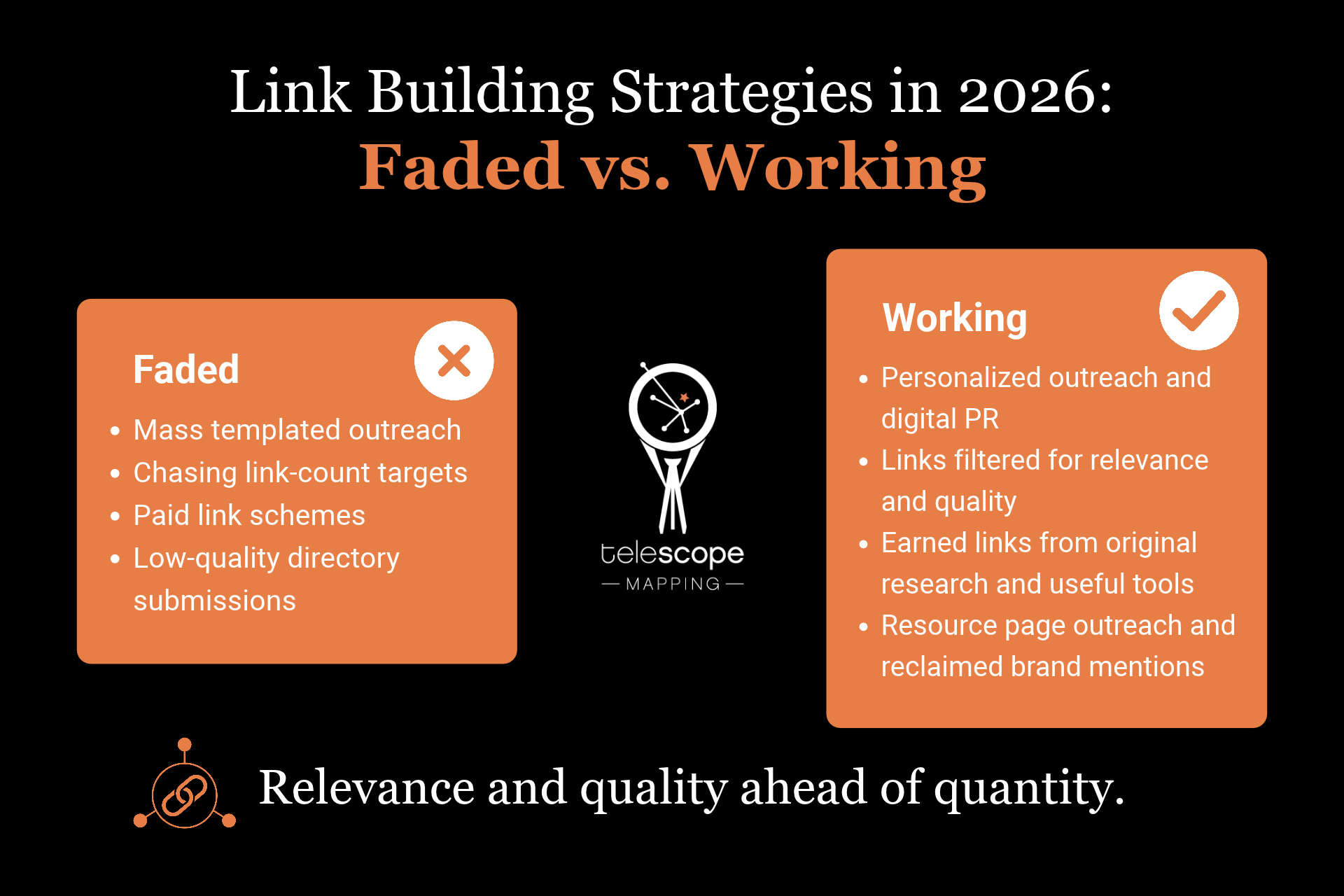
Choosing Where to Start
You don’t need to run every tactic at once, and the best starting point for your 2026 link building strategy depends on what your business already has. For example, a company sitting on years of customer or industry data is well placed to lead with original research. A business with recognized subject-matter experts may see faster returns from digital PR and expert commentary. Teams with limited bandwidth often do well beginning with brand mention reclamation and resource page outreach, since both require little new content. Starting with the approach that matches your existing strengths builds momentum faster than forcing a tactic that doesn’t fit.
Our Framework for Building Links That Last
Knowing what works is one thing, running it consistently is another. Telescope Mapping generally approaches link building in four phases, laid out in the sections below– each paired with the mistake most likely to undercut it, so you can sidestep if you choose your own approach.
Auditing Your Assets and the Competitive Landscape.
We start by taking stock of what you already have that’s worth linking to: content, data, tools, and in-house expertise. We then look at where your competitors’ links come from and where the gaps are, and review your own profile for low-quality or harmful links that need attention. This groundwork sets the direction for everything that follows.
The mistake to avoid: Rushing into outreach before you know what you have to offer. Without that clarity, pitches end up generic, targets end up irrelevant, and the links that do come in rarely move rankings in a meaningful way.
Creating Assets Worth Linking To.
With a clear picture of your business’s strengths, we then invest in the assets that will anchor your outreach, whether that’s original research, a useful tool, or a definitive guide. The standard we aim for is content that other sites would reference without being asked.
Keeping those assets current matters, too: a well-regarded study or guide that gets refreshed can keep earning links for years, while an outdated one slowly stops being cited.
The mistake to avoid: Producing generic content and hoping links follow. Material that repeats what everyone else already says gives nobody a reason to cite it, no matter how widely it’s promoted.
Building Relationships, Not Just Sending Requests.
Effective outreach starts with understanding what a publication’s audience needs and offering something of value before asking for anything. These relationships compound: an editor or journalist who finds you useful once is far more likely to come back to you later.
The mistake to avoid: Sending mass, impersonal outreach. It produces high rejection rates and can quietly damage your standing with the very publications you most want to work with.
Monitoring and Refining.
We then track what each link actually delivers, including ranking changes, referral traffic, and the leads that follow, and review your backlink profile regularly so low-quality links don’t linger.
A quarterly check is a good rhythm for most businesses, and we do this by confirming which links are still live, which pages attract them, and whether anything questionable has appeared. We then use what we learn to shape the next round of assets and outreach.
The mistake to avoid: Treating link building as a one-time project. Search evolves and competitors keep earning links, so a profile that isn’t maintained gradually loses ground.
The tactics above aren’t complicated, but they are time-intensive, and the results depend on doing them well and doing them consistently. At Telescope Mapping, we handle the research, outreach, and relationship-building for clients, and we tie every link back to the rankings, traffic, and leads it produces.
Link Building Strategies in 2026: Frequently Asked Questions
How quickly can we expect results from a new link building strategy?
Individual links can influence rankings within weeks, but meaningful, sustainable gains usually build over several months. The timeline depends on your industry’s competitiveness, your site’s current authority, and the quality of the links you earn.
How do we measure the ROI of link building strategies in 2026?
Look beyond link count. Track changes in organic rankings and traffic (especially to your most valuable pages), along with referral traffic from the linking sites and the leads or revenue attributed to organic search. Together, these show whether links are translating into business results.
How many links do we actually need?
There’s no universal number. A useful benchmark is the backlink profile of the competitors ranking where you want to be: comparing the quality and relevance of their links to yours shows how much ground there is to cover.
Is it worth paying for links?
Paying for placements solely to pass link equity goes against Google’s spam policies and puts your site at risk. Investing in the assets and outreach that earn links naturally, such as research, tools, and genuine PR, is the safer and more durable use of budget.
Will AI-driven search change how much links matter?
How AI features surface sources continues to evolve, so it’s wise not to build a strategy around any single platform. What stays constant is that credible, widely cited sources are easier for both search engines and AI systems to trust. Focusing on becoming a genuinely authoritative source is a durable approach regardless of how search interfaces change.
Parting Thoughts
Link building strategies in 2026 reward the businesses willing to earn links through real value, with original data, useful resources, and relationships with the people who cover their industry. That approach takes more thought than volume-based outreach, but it also builds something lasting: an authority that compounds over time and supports every other part of your marketing.
If you’d like help building a link strategy that fits your business and holds up over time, Telescope Mapping would be glad to help. Schedule a complimentary strategy session with one of our experts today to see where your biggest link opportunities are.