The digital landscape is unforgiving. What this means for business leaders is that every touchpoint matters. This article illuminates the critical, yet often overlooked, strategic importance of 404 error management. You’ll gain a clear understanding of how these seemingly minor technical glitches can profoundly erode your search engine optimization (SEO) performance, degrade user experience, and directly impact your bottom line, alongside our robust framework for identifying, prioritizing, and resolving these issues to unlock significant revenue potential.
Why 404 Error Code SEO Services are Gaining Popularity
In today’s fiercely competitive digital arena, business leaders grapple with escalating customer acquisition costs, stagnating organic traffic, and the persistent challenge of maximizing marketing return on investment. The aspiration for a seamless, high-converting online presence often clashes with the intricate realities of website management. Many overlook the insidious impact of technical SEO oversights, particularly the prevalence of 404 errors, which silently sabotage even the most ambitious growth strategies. Strategic 404 error management isn’t just one of the many technical SEO fixes, it’s an indispensable solution for enhancing search engine performance, reinforcing user trust, and establishing a robust foundation for sustainable business growth.
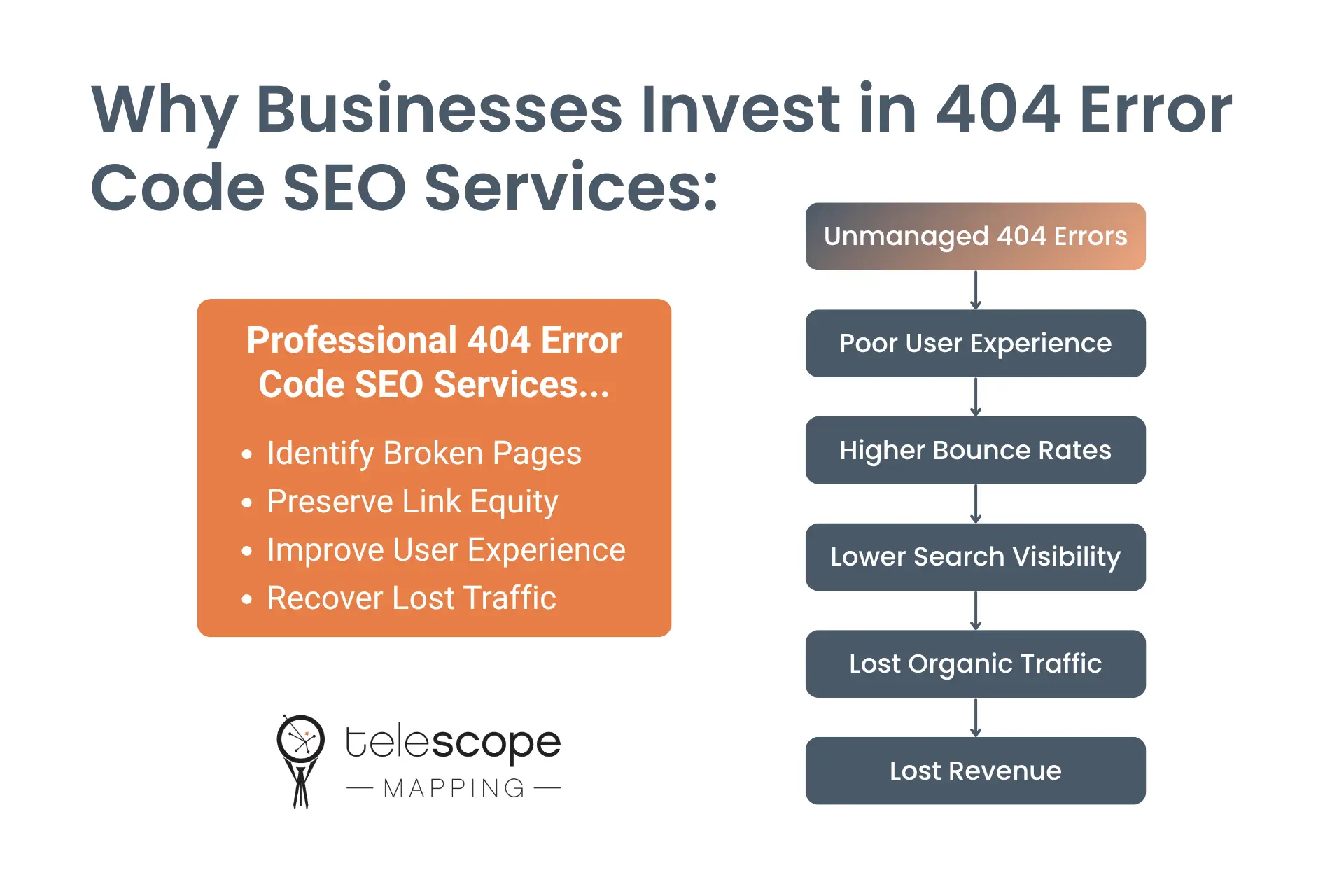
The strategic imperative of addressing 404 errors cannot be overstated. For business leaders, “page not found” notifications are more than inconveniences, they represent tangible threats to your brand’s digital authority and revenue streams. Search engine algorithms, such as Google’s Core Web Vitals, increasingly prioritize user experience (UX) and overall site quality. A proliferation of 404 errors signals to search engines that your site could be poorly maintained, leading to diminished crawl budget, reduced indexation of valuable content, and ultimately, lower organic search rankings. This translates to lost search visibility, critical for B2B enterprises seeking qualified leads and high-growth eCommerce businesses striving for direct consumer engagement.
Competitive pressures further amplify the need for proactive 404 management. While your competitors meticulously optimize every facet of their digital presence, unaddressed 404 errors create digital dead ends that frustrate potential customers and divert them elsewhere. This competitive disadvantage directly impacts your marketing ROI: consider the effort and expense invested in content creation, link building, and paid advertising to drive traffic to your site. Each 404 error represents a failed journey, a potential conversion lost, and an immediate erosion of that investment.
Furthermore, 404 errors directly affect critical financial metrics. They lead to increased bounce rates as users quickly abandon broken pages, impacting perceived site quality. This decline in user engagement can signal to search engines that your content is irrelevant or inaccessible, further harming rankings. More critically, every instance of a user encountering a missing page translates to lost conversion opportunities, be it a lead form submission, product purchase, or service inquiry. Over time, these missed opportunities chip away at your Customer Lifetime Value (CLV), preventing the nurturing of long-term customer relationships. Effectively managing 404 errors through diligent technical SEO fixes protects existing SEO equity, actively contributing to a healthier sales pipeline and sustained revenue growth. Neglecting these seemingly minor issues is akin to leaving money on the table, allowing your digital foundation to silently crumble.
Common Strategic Oversights in 404 Error Code Management
While the strategic importance of managing 404 errors is clear, many businesses inadvertently undermine their efforts through common pitfalls and strategic oversights. Recognizing these mistakes is the first step toward implementing a truly effective and revenue-generating approach.
- Pitfall 1: Using Generic 404 Pages
- Default 404 pages offer little value beyond notifying users that a page is missing. Without clear next steps, visitors often leave the site, increasing abandonment rates.
- Consider creating custom 404 pages that help users continue their journey. Include site search, links to key content or services, and relevant calls to action to turn dead ends into engagement opportunities.
- Pitfall 2: Redirecting Everything to the Homepage
- Sending broken URLs to the homepage creates a poor user experience and weakens SEO signals. Search engines might view irrelevant redirects as soft 404s (page found but content sparse or irrelevant, often returning a 200 status code), reducing their effectiveness.
- Instead, think about employing targeted 301 redirects to the most relevant replacement page. This preserves link equity, maintains user intent, and supports a smoother navigation experience. If no suitable page exists, a well-designed 404 page is often the better choice.
- Pitfall 3: Overlooking Internal Broken Links
- Internal broken links disrupt site navigation, hinder content discovery, and weaken the flow of authority across your website. They can also increase bounce rates and reduce engagement.
- Conducting regular internal link audits and fixing broken links promptly is paramount. Maintaining a healthy internal linking structure improves both user experience and search engine crawlability.
By consciously avoiding these common pitfalls and adopting a strategic, nuanced approach to 404 errors, your business can protect its digital assets, enhance its search performance, and ultimately drive greater revenue.
Our Firm’s Approach to 404 Error Code SEO Services
Effective 404 error management demands a systematic and strategic approach, moving beyond reactive fixes to proactive optimization. Our methodology provides a comprehensive framework designed to not only identify and rectify existing 404 errors but also to establish a resilient digital infrastructure that supports continuous growth. This approach transforms a technical challenge into a strategic advantage, ensuring your website remains a powerful revenue-generating asset.
Our process is broken down into four distinct phases:
- Phase 1: Comprehensive Site Audit & Discovery:
- The initial step involves a deep-dive analysis to uncover the full scope of 404 errors and broken links across your domain. This phase utilizes advanced crawling tools combined with critical insights from Google Search Console, meticulously examining crawl errors, indexing issues, and user-reported problems. We go beyond surface-level checks, analyzing server logs, backlink profiles, and internal linking structures to pinpoint the root causes of errors. This comprehensive discovery ensures a complete picture of your site’s technical health and identifies all instances of 404 error codes.
- Phase 2: Strategic Assessment & Prioritization:
- Not all 404 errors are created equal. This phase focuses on intelligent prioritization based on business impact. We differentiate between various “not found” issues, such as true 404s (page genuinely deleted), soft 404s, and temporary server issues. Errors from high-traffic pages, those with significant inbound links (link equity), or those critical to conversion funnels receive immediate attention. Our assessment quantifies the potential loss in traffic, link value, and user experience for each error, guiding a data-driven prioritization strategy that aligns with your specific business objectives.
- Phase 3: Implementation of Targeted Solutions:
- With a clear understanding of the errors and their priority, this phase executes precise, strategic remediation. The primary tool for addressing moved or deleted content is the 301 redirect, a permanent server-side instruction that tells search engines and users that a page has moved to a new URL. Crucially, these redirects must target the most relevant existing page to preserve link equity and ensure a seamless user experience. For truly obsolete content with no direct equivalent, or where a user might mistype a URL, we focus on developing custom, user-centric 404 pages. These pages are branded, helpful, include internal search functionality, links to popular content or categories, and clear calls to action, transforming a potential dead end into an opportunity for re-engagement. Where appropriate and strategically beneficial, content restoration may also be recommended.
- Phase 4: Continuous Monitoring & Refinement:
- The digital landscape is dynamic, and new 404 errors can emerge. Our methodology includes establishing a regime of ongoing surveillance and regular re-audits. We continuously monitor your website using advanced tools and Google Search Console to detect new crawl errors and track the performance of implemented fixes. This iterative process allows for prompt identification and resolution of any emerging issues, ensuring long-term site health, sustained SEO performance, and preventing recurrence. This continuous refinement ensures your technical SEO fixes remain robust and effective.
By following this rigorous, phased approach, we move beyond simple problem-solving to deliver a robust and sustainable solution that fortifies your digital presence, recaptures lost traffic, and significantly enhances your overall SEO performance.
404 Error Code SEO Services: FAQs
How do 404 error codes and broken links truly impact my search rankings and organic traffic?
While a single isolated 404 won’t critically harm your site, a proliferation of unmanaged 404 errors signals to search engines that your website is poorly maintained or unreliable. This can lead to wasted crawl budget, where search engine bots spend resources on non-existent pages instead of valuable content. More significantly, 404s prevent the flow of valuable link equity from external backlinks, effectively neutralizing their SEO benefit. Over time, this cumulative effect can result in diminished organic search rankings for relevant keywords, directly impacting your organic traffic potential and visibility.
Should I fix every single 404 error identified immediately?
Not necessarily. Strategic prioritization is paramount. It’s crucial to first identify and address 404 errors stemming from high-traffic pages, pages that historically received significant backlinks, or those integral to your primary conversion funnels. These errors have the highest potential for negative impact on user experience and SEO performance. True external 404s on insignificant or long-deleted pages with no traffic could be lower priority, though a systematic approach ensures all issues are eventually addressed to maintain overall site health and prevent the accumulation of problems.
This prioritization can be difficult– keep in mind that employing professional 404 error code SEO services can be a simple way to sidestep any added stress or burden.
What’s the practical difference between a 404 error and a “soft 404”?
A true 404 (or 410 Gone) is an HTTP status code that explicitly tells search engines and users that a requested page does not exist on the server. This is a clear signal. A “soft 404,” however, is a more insidious problem: the server returns a 200 OK status code (meaning “page found”), but the content displayed is actually a “page not found” message, an extremely thin page, or content irrelevant to the original request. This confuses search engines, wastes crawl budget as they try to index non-existent content, and can lead to indexing issues, making it harder for your valuable pages to rank.
Can a well-designed custom 404 page mitigate all the negative SEO impact?
A well-designed custom 404 page significantly improves the user experience and can reduce bounce rates by guiding visitors back to valuable content or encouraging them to explore other parts of your site. However, it does not fully solve the underlying problem of a missing page or lost link equity. While it helps retain users, it doesn’t automatically recover the SEO value of a missing page that once had backlinks. For pages that once existed and held SEO authority, proper 301 redirects to the most relevant equivalent page are essential for recapturing lost SEO value and preserving organic traffic. To put it simply, a custom 404 page is a user-centric solution, and a 301 redirect is an SEO-centric solution.
Navigating 404 Error Code SEO Services & Next Steps
This article has underscored that managing 404 errors isn’t merely a technical chore but a strategic imperative for maintaining robust SEO, delivering superior user experience, and ultimately, unlocking your business’s revenue potential. By understanding the direct impact of 404 errors on your search rankings, organic traffic, and conversion rates, and by proactively addressing them through a structured methodology or by employing professional 404 error code SEO services, your business can fortify its digital presence against common pitfalls. Avoiding oversights like ignoring these errors, using generic 404 pages, or implementing indiscriminate redirects is crucial for optimizing your digital performance.
Discover how our strategic approach to technical SEO and 404 error management can transform these potential liabilities into powerful assets, ensuring your digital foundation is solid, future-proof, and continuously drives growth. Schedule a complimentary strategy session with one of our experts today to unlock new revenue streams for your business.