Scaling a small business in 2026 presents unique challenges, often exacerbated by limited resources. While the promise of marketing automation offers a compelling solution for efficiency and growth, its true power is unlocked not by mere tool adoption, but through strategic foresight and meticulous planning. This article delineates how a strategic approach to marketing automation for small businesses can transform operational bottlenecks into pathways for sustainable revenue growth, positioning you to leverage technology as a decisive competitive advantage.
Marketing Automation for Small Businesses is Gaining Popularity
For many business leaders, the imperative to grow, acquire new customers, and retain existing ones remains paramount, often against a backdrop of constrained budgets and lean teams. In this environment, the concept of “marketing automation” often emerges as a tantalizing prospect: a digital magic bullet promising to streamline operations and multiply outreach without multiplying headcount.
Yet, the reality for many small businesses falls short of this ideal. They invest in platforms, but the anticipated surge in efficiency or revenue never fully materializes. This common disconnect arises because true success in marketing automation extends far beyond simply acquiring a tool. It demands a well-defined, overarching marketing strategy that dictates how and why technology is deployed. The distinction between merely automating a task and strategically automating an entire customer journey is crucial for turning potential into profit.
Unlocking Growth with Strategic Automation
The current market landscape makes strategic marketing automation not just beneficial, but essential for small businesses aiming for sustainable growth. Business leaders face escalating customer expectations, intensified competition, and the constant pressure to optimize every dollar spent.
Marketing automation for small businesses directly addresses these challenges by offering solutions that directly impact critical business objectives, including enabling scalability by handling increased lead volumes and customer interactions without a proportional increase in manual labor. It also enhances customer experience by allowing your business to deliver personalized, timely, and relevant communications at scale, nurturing leads and retaining customers through tailored engagement. According to recent studies, modern customers expect personalization, driving the need for automated solutions.
Moreover, marketing automation for small businesses drives operational efficiency and productivity, freeing up your team from repetitive tasks like email sequences, social media posting, and data entry to refocus on high-value, strategic initiatives. Implementing strategic business automations provides a competitive edge, allowing smaller businesses to contend effectively with larger enterprises through sophisticated, personalized marketing campaigns that would otherwise be resource-intensive.
Finally, integrated marketing automation tools offer invaluable insights into campaign performance, customer behavior, and conversion funnels, empowering data-driven decisions that optimize marketing spend and significantly improve marketing ROI.
In a market where efficiency and personalization dictate success, simply doing manual marketing is no longer sustainable. More critically, haphazard or unstrategized automation can be even more damaging, leading to wasted investment, alienated customers, and a frustrated team. The urgent need, therefore, is not just for automation, but for a clear, strategic roadmap that ensures every automated action contributes to your overarching business goals.
How to Maximize Marketing Automation ROI (And the Pitfalls That Undermine It)
Getting real value from marketing automation for small businesses isn’t just about deploying the right tools, it’s about pairing each stage of implementation with an awareness of where similar efforts commonly go wrong. Small businesses in particular tend to feel the cost of these missteps more acutely than larger organizations, since there’s less budget and bandwidth to absorb a failed rollout or a platform that never gets fully adopted. Below, each phase of a strategy-first approach is presented alongside the pitfall it’s designed to help you avoid, so the framework and its risks are addressed as a single strategic effort rather than two separate conversations.
Phase 1: Strategic Discovery & Goal Alignment
Our journey begins with a deep dive into your business: defining clear objectives, whether that’s accelerated lead generation, improved retention, or a shortened sales cycle. This means auditing existing marketing and sales processes, mapping the customer journey, and assessing your current technology stack and data integrity so automation efforts are built on a solid foundation rather than guesswork.
The pitfall to avoid: Automating a broken process. Many businesses try to automate inefficient, manual workflows without first optimizing them. But automation doesn’t fix a broken process, it magnifies its inefficiencies, frustrating leads and customers while wasting resources. If manual lead nurturing isn’t working, automating it only makes the ineffectiveness faster and more consistent, not more effective.
The fix is straightforward, if often skipped: audit and streamline your processes manually first, and only introduce automation once the underlying process is genuinely efficient and worth scaling.
Phase 2: Customer Journey Optimization & Automation Blueprint
With objectives defined, the next step is designing automated workflows that align precisely with your customer journeys and business goals. This includes developing segmentation strategies for personalized communication (useful for initiatives like email automation for small businesses) and selecting tools based on the right blend of functionality, scalability, and cost-effectiveness rather than sheer feature count.
Establishing KPIs at this stage ensures every effort remains measurable from the start, rather than something you try to reverse-engineer once campaigns are already live.
The pitfall to avoid: Letting tool features drive strategy instead of the other way around. An overwhelming focus on a platform’s bells and whistles, rather than alignment with business goals, often leads to overspending on unused features or campaigns that fail to move the needle on the objectives that actually matter.
The fix is to let your business goals and customer journey define your requirements first, then choose tools that meet those specific needs, resisting the temptation to buy the most feature-rich option available simply because it looks impressive on paper.
Phase 3: Implementation, Integration & Launch
This phase focuses on executing the blueprint: configuring automation platforms, integrating with your existing CRM and business systems, and developing compelling content for automated sequences across email, social, and SMS. Rigorous testing and a soft launch before full deployment help catch issues early and optimize performance from day one.
The pitfall to avoid: Treating every lead and customer as a homogenous group, even within an automated system. Generic, one-size-fits-all messaging alienates prospects and customers, driving low engagement and high unsubscribe rates in a market that expects relevance from every brand it interacts with. The fix is robust segmentation based on demographics, behavior, and purchase history, paired with dynamic, personalized content so every message resonates with where the recipient actually is in their journey, rather than treating a first-time visitor the same as a repeat customer nearing renewal.
Phase 4: Continuous Optimization & Scalable Growth
Marketing automation for small businesses is never a set-it-and-forget-it solution. This phase emphasizes ongoing monitoring: tracking performance against established KPIs, analyzing data patterns, and running A/B tests on subject lines, send times, and offers to refine engagement and conversion over time.
The pitfall to avoid: Treating automation as a one-time setup rather than an iterative process. Without continuous data analysis and adjustment, campaigns quickly grow stagnant and ROI becomes difficult to demonstrate to stakeholders who are asking what the investment is actually producing. The fix is committing to the same discipline this phase describes: clear KPIs, continuous monitoring, and a habit of iterative refinement, so your automation evolves alongside your business rather than calcifying into something that quietly stops working.
Taken together, these phases and pitfalls reflect a single principle: marketing automation for small businesses only amplifies what’s already there. It amplifies a broken process, generic messaging, or a set-and-forget mindset just as readily as it amplifies a sound strategy, which is exactly why strategic discipline has to come first.
Marketing Automation for Small Businesses: FAQs
When is the “right time” for a small business to invest in marketing automation?
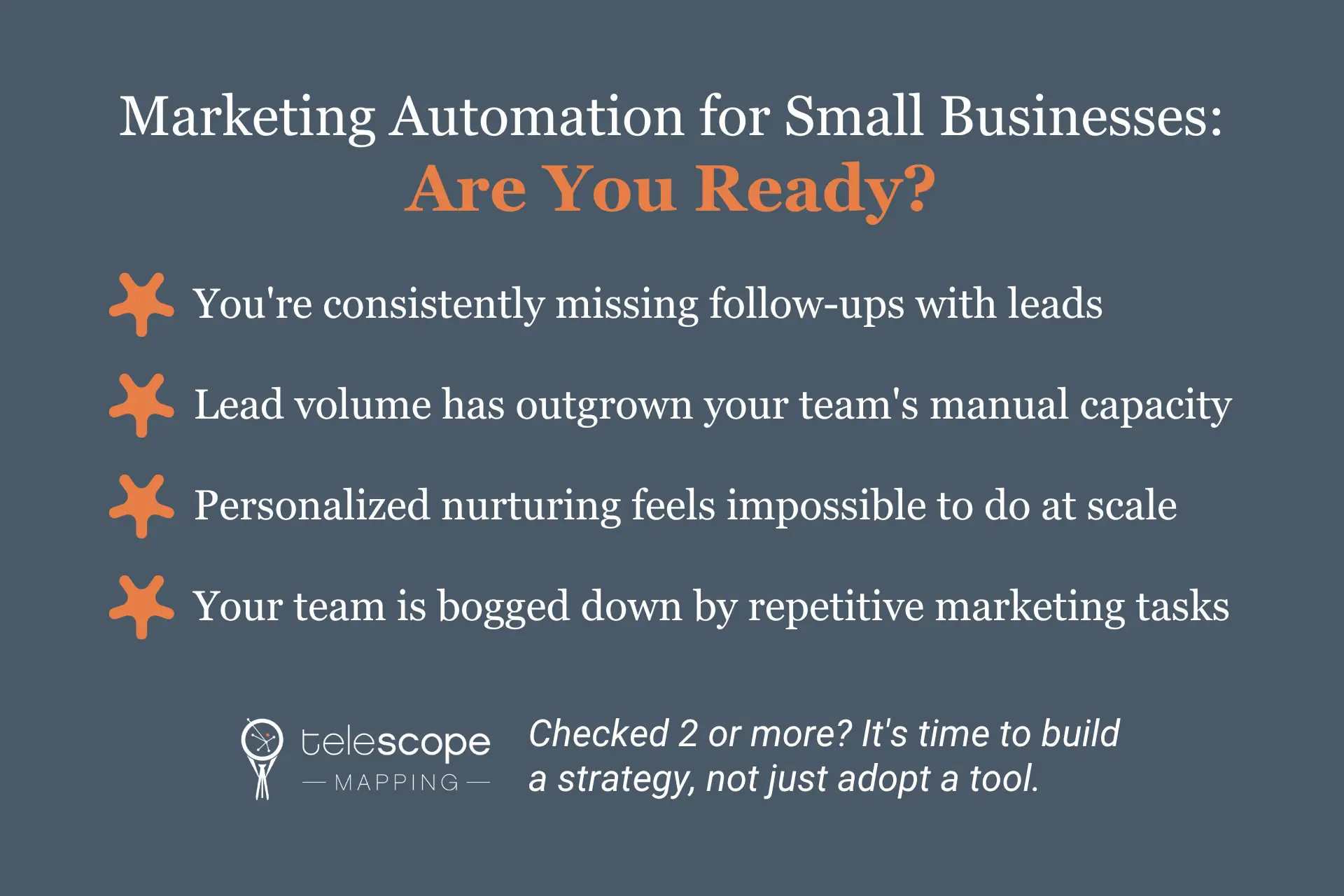
The optimal time isn’t determined by size alone, but by operational readiness and strategic need. It’s time when manual marketing processes become bottlenecks, when lead volume outstrips your capacity for manual follow-up, or when personalized customer journeys become critical for nurturing, retention, and upsell opportunities. If you’re consistently missing follow-ups or your team is bogged down by repetitive tasks, you’re ready.
Can my internal team handle marketing automation setup and strategy?
The technical setup is often within reach for a capable internal team, but the strategic layer (integrating automation into broader business objectives, optimizing complex workflows, and maximizing marketing ROI) frequently benefits from specialized expertise. An external strategist brings an objective perspective and the experience to design systems aligned with long-term growth, which internal teams focused on daily operations may struggle to prioritize.
How do I choose the best marketing automation tools for my small business?
Let your strategic objectives drive the decision, not the feature list. Focus on platforms that meet your current needs while allowing room to scale, and avoid overpaying for capabilities you won’t use. Prioritize easy CRM integration, cost-effectiveness within your budget, and reporting robust enough to actually measure your automation’s effectiveness.
How can I measure the actual ROI of my small business automation efforts?
Look beyond surface metrics like open and click-through rates. Track lead quality improvements, conversion rates at each funnel stage, average deal size, and the customer lifetime value of automated segments. Also quantify efficiency gains: the time and resources saved by your sales and marketing teams that can now be redirected toward strategic work rather than repetitive follow-up. Taken together, these figures give a far more accurate picture of ROI than vanity metrics alone.
From Automation to Accelerated Growth
Marketing automation for small businesses is far more than a technological upgrade. It’s a strategic imperative for sustainable growth. By following a well-defined methodology and consciously avoiding the pitfalls that undermine it, your business can turn repetitive tasks into engines of lead generation, customer engagement, and revenue growth. The distinction between simply automating and strategically automating is the difference between incremental improvement and genuine, compounding growth– and it’s a distinction that becomes more apparent with every quarter a business sticks with the strategic approach rather than reverting to guesswork.
Discover how our firm’s strategic approach to marketing automation can transform your small business operations into a powerful growth engine and schedule a complimentary strategy session with one of our experts today.