

An effective SEO audit checklist in 2026 needs to evaluate more than rankings, metadata, and traffic fluctuations. Search performance now depends on technical health, content quality, user experience, structured data, brand authority, and whether organic visitors are converting into meaningful business outcomes. For business leaders, a modern website SEO audit is not simply a way to find errors. It’s a strategic process for identifying the barriers that limit visibility, qualified leads, and revenue growth. This article outlines the core SEO audit steps your business should use to diagnose performance issues, prioritize improvements, and fix SEO errors that weaken organic results.
Why Your 2026 SEO Audit Needs to Be More Strategic
Organic search remains one of the most valuable channels for sustainable growth, but it’s become harder to compete. Many businesses are investing in content, paid media, and website redesigns, yet still see inconsistent organic performance. Traffic may rise without producing qualified leads. Important service or product pages may fail to rank. Competitors may capture demand even when their offering isn’t stronger.
A disciplined website SEO audit helps leadership move from assumption to evidence. It shows whether search engines can crawl and index the right pages, whether content aligns with buyer intent, whether the website provides a strong user experience, and whether organic visibility is contributing to pipeline or revenue.
In 2026, SEO should not be measured only by impressions or keyword movement. It should support demand generation, reduce overdependence on paid acquisition, strengthen brand authority, and create a reliable source of qualified traffic. The following checklist is built to help your team evaluate the full organic ecosystem and prioritize the improvements that matter most.
Our 2026 SEO Audit Checklist: Key Steps to Identify and Fix SEO Errors
Search engines are increasingly sophisticated at evaluating intent, usefulness, technical performance, and trust. Buyers are also more selective. They expect fast websites, clear answers, proof of expertise, and a logical path from research to action. That makes your website a revenue infrastructure asset, not just a marketing channel.
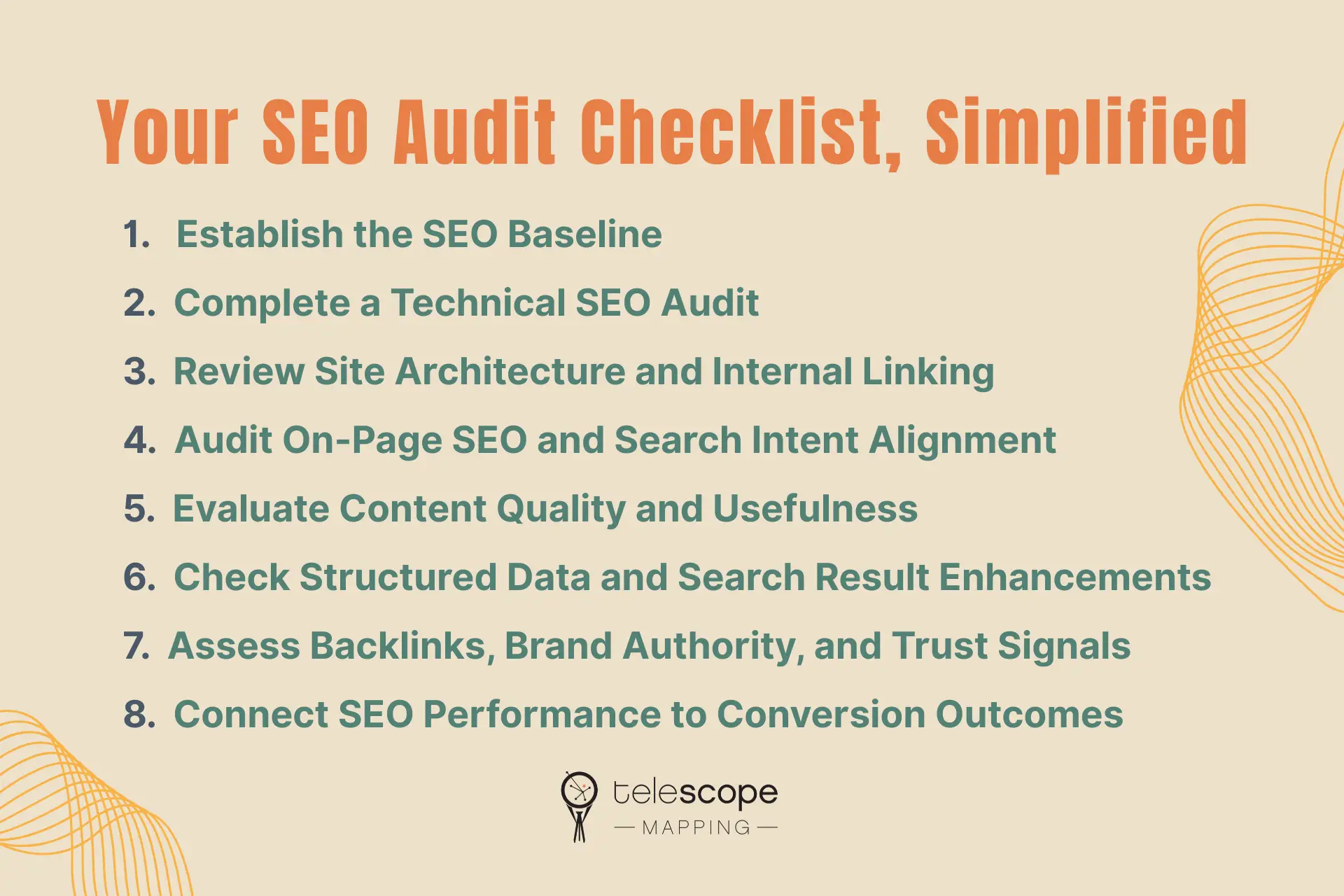
A useful SEO audit checklist should be practical enough for marketing teams to apply, but strategic enough for leadership to act on. The strongest audits evaluate performance baseline, technical health, site structure, on-page SEO, content quality, authority, and conversion alignment. The following section lays out our firm’s SEO audit steps for website success.
1. Establish the SEO Baseline
Before making changes, define your current organic performance. This prevents random optimization and gives the business a clear way to measure progress.
Review organic traffic trends over the past 12 to 24 months. Separate branded and non-branded traffic. Identify top organic landing pages, ranking distribution, organic conversions, assisted conversions, and revenue or pipeline influenced by organic search.
Then identify which pages currently drive business value. These may include product pages, service pages, industry pages, comparison pages, category pages, case studies, or high-intent educational content.
The key question is whether your visibility, engagement, and conversion pages overlap. If the website attracts traffic but that traffic doesn’t support qualified demand, your SEO strategy may need to be refocused around commercial intent.
2. Complete a Technical SEO Audit
A technical SEO audit is the foundation of the process. If search engines cannot efficiently crawl, render, index, and understand your website, even strong content can underperform.
Start with crawlability. Review your sitemap, crawl errors, redirects, broken links, etc. Your most important pages should be easy for search engines to discover and access.
Next, review indexation. Confirm that priority pages are indexed and that low-value pages are not creating unnecessary index bloat. Common issues include duplicate pages, outdated parameter URLs, and legacy content that no longer serves the business.
Then evaluate performance. Slow loading times, layout shifts, heavy scripts, oversized images, and poor mobile usability can reduce engagement and weaken search performance. Page speed should be treated as both an SEO issue and a conversion issue.
The technical checkpoint is simple: your website should be easy to crawl, efficient to index, fast to load, secure to use, and stable across devices.
3. Review Site Architecture and Internal Linking
Strong SEO depends on how well your website organizes information and distributes authority. Site architecture tells search engines which pages matter most. Internal linking helps users and crawlers move through the site logically.
Start by mapping your key page types. For a B2B company, this might include service pages, solution pages, industry pages, blog articles, and resource pages. For an eCommerce business, this may include category pages, product pages, buying guides, comparison pages, and collection pages.
Each important page should have a clear purpose and be accessible from relevant areas of the website. High-value pages should not be buried several clicks deep or left without supporting internal links.
One common SEO error is allowing strong blog content to exist in isolation. A post might attract qualified visitors, but if it doesn’t guide readers to a related service page, product category, or consultation offer, your business can lose valuable demand.
As part of this review, determine whether commercial pages are supported by relevant educational content, whether top-performing articles guide users towards next steps, whether similar pages compete for the same intent, and whether anchor text is clear and descriptive.
4. Audit On-Page SEO and Search Intent Alignment
On-page SEO connects keyword targeting with buyer psychology. A page can be technically sound and still fail if it doesn’t match what the searcher wants.
Review title tags and meta descriptions first. Each priority page should have a unique title that includes the target keyword naturally while communicating clear value. Meta descriptions should encourage qualified clicks by explaining why the page is relevant.
Next, review headings. They should clearly describe the page topic. Supporting headings should organize the page around the user’s questions, needs, and decision criteria.
Keyword use still matters, but repetition isn’t a strategy. The larger objective is intent coverage. For example, a page targeting “technical SEO audits” should address crawlability, indexation, site speed, Core Web Vitals, redirects, structured data, and implementation priorities.
This step of the SEO audit checklist should answer one question: does each important page fully satisfy the intent behind the search query? If the page is too thin, too vague, too promotional, or disconnected from the buyer’s real question, it needs improvement.
5. Evaluate Content Quality and Usefulness
Content remains central to SEO, but generic content is no longer enough. Search engines and buyers reward specificity, credibility, and usefulness.
A strong content audit should classify pages by purpose. Some pages educate early-stage buyers. Others compare solutions, address objections, support evaluation, or convert demand. Once the purpose is clear, evaluate whether the page fulfills that purpose better than competing results.
Look for thin content, outdated information, duplicate themes, unsupported claims, weak introductions, missing examples, etc. Also assess whether the content demonstrates genuine expertise. For service-based businesses, this might include methodology, examples, frameworks, implementation considerations, and strategic tradeoffs. For eCommerce brands, it may include product guidance, comparison support, fit recommendations, and confidence-building details.
Keep in mind that not every underperforming page needs more words. Some just need clearer positioning. Some just need sharper keyword focus. Others should be redirected or retired because they no longer serve a strategic purpose.
Each audited page should receive a clear action: keep, optimize, consolidate, redirect, rewrite, or remove.
6. Check Structured Data and Search Result Enhancements
Structured data helps search engines understand your content and may improve how pages appear in search results. It doesn’t replace strong content, but it can support clarity, eligibility for enhanced results, and stronger click-through performance. Review whether your website uses appropriate schema for its business model and page types.
Accuracy matters. Structured data should reflect what’s actually visible on the page. Misleading schema creates risk and does not help users. Important pages should use valid, relevant markup where it helps search engines interpret the page and improves the search experience.
7. Assess Backlinks, Brand Authority, and Trust Signals
A website can have strong technical health and useful content, but still struggle if it lacks authority. Off-page signals remain an important part of organic performance.
Review backlink quality rather than only backlink quantity. Links from relevant, credible websites are more valuable than large volumes of weak or unrelated links. Evaluate referring domains, link relevance, anchor text patterns, and lost backlinks.
Brand mentions should also be considered. Mentions in industry publications, partner websites, associations, directories, review platforms, and credible third-party resources can strengthen perceived authority.
The stronger question isn’t, “How many backlinks do we have?” it’s, “Does the market see this brand as a credible authority in the categories where it needs to rank?”
8. Connect SEO Performance to Conversion Outcomes
Finally, an SEO audit that stops at traffic is incomplete. Organic visibility only matters commercially when it supports qualified engagement and business outcomes.
Review the conversion paths from high-traffic organic landing pages. Are calls to action clear? Does the page guide users to a logical next step? Are forms easy to complete? Are product or service pages persuasive? Are proof points, case studies, comparison resources, or consultation offers placed where they are useful?
For B2B businesses, organic visitors might not convert immediately. They may read several pieces of content, return through branded search, and later engage with sales. Your audit should evaluate assisted conversions, content engagement, CRM attribution where available, and how SEO supports the broader buyer journey. For eCommerce businesses, review category page performance, product page conversion rates, internal search behavior, cart abandonment, and whether organic landing pages help users make confident purchase decisions.
Every high-value SEO page should have a business purpose. If a page ranks but doesn’t help the user move forward, the audit should recommend a conversion-focused improvement.
SEO Audit Frequently Asked Questions
How often should a business complete a website SEO audit?
Most businesses should complete a comprehensive website SEO audit at least once per year. Companies in competitive markets, businesses undergoing a redesign, or organizations experiencing traffic declines should audit more frequently. A lighter quarterly review can help identify issues before they become larger problems.
How long does it take to see results after fixing SEO errors?
The timeline depends on issue severity, market competitiveness, and implementation speed. Technical fixes may produce faster improvements when they resolve major crawl or indexation barriers. Content and authority improvements usually take longer because search engines need time to reassess relevance and trust.
Can an internal marketing team complete this SEO audit checklist?
An internal team can complete many important SEO audit steps, especially with the right tools and analytics. However, complex technical issues, competitive analysis, content strategy decisions, and prioritization often benefit from an outside perspective. The most valuable audit isn’t the one that identifies the most issues. It is the one that identifies the right issues and turns them into a focused growth plan.
Conclusion and Next Steps
A strong SEO audit checklist gives your business more than just a list of technical tasks. It shows whether your website can be crawled and indexed, whether your content satisfies buyer intent, whether your brand has authority, and whether organic traffic is contributing to meaningful outcomes.
In 2026, SEO success requires precision. Businesses need to understand where visibility is being lost, where user experience creates friction, where content fails to meet intent, and where technical issues limit performance. The companies that win organic search will be the ones that build technically sound, strategically organized, highly useful websites that serve both search engines and buyers.
Discover how Telescope Mapping’s strategic approach to SEO can help your business uncover hidden growth opportunities, fix performance-limiting SEO errors, and turn organic search into a more reliable revenue channel. Schedule a complimentary strategy session with one of our experts today.