

Right now, your brand is being built by whoever is making the next ad, slide, or landing page. The founder picks one blue, a freelancer picks another, and a new sales rep pastes an old logo into a deck. None of them is wrong on their own, but together they make your company look like three different companies.
Brand guidelines for small businesses are the fix: a short, usable rulebook covering how your brand looks, sounds, and shows up in real work. Small teams need them most because there’s no brand manager to catch inconsistencies before they go live. This article covers what belongs in a guide, what you can safely leave out, and how to keep the document in use after the initial effort fades.
What Are Brand Guidelines and Brand Style Guides?
Brand guidelines are the documented rules for how a brand looks, sounds, and behaves. A brand style guide is usually the visual and verbal subset: logo, colour, typography, imagery, and writing style. Many teams use the two terms interchangeably, which is fine as long as the document covers both appearance and voice.
Guidelines also differ from their neighbours. A brand strategy answers who you serve and why you’re different, and a logo folder holds files but says nothing about how to use them. Guidelines sit between strategy and execution, turning positioning into choices a designer, writer, or location manager can make without calling you.
And scope matters as much as content here: a working document of roughly 10 to 20 pages serves a small team far better than a 100-page corporate manual that nobody opens.
Why Small Teams Need Brand Guidelines More Than Large Ones
Large companies have brand managers, design systems, and approval layers. Small teams have many hands and no gatekeeper, so nobody owns consistency– and the result is mismatched websites, ads, decks, and local pages.
Picture this common situation: a business with three locations, two freelancers, and a website redesign on the calendar. Each location uses a different version of the logo. One freelancer writes warm, casual copy and the other writes formal copy. When the redesign begins, the designer has to guess which version is the real one, and every wrong guess costs a revision round.
From a leader’s perspective, the cost shows up as rework. Consistency shortens production time and revision cycles, speeds onboarding for new hires and contractors, and makes paid and organic content feel like one company. Ask your team how many hours last quarter went to fixing things that were off-brand, or run a quick marketing audit of your live channels to see how far they have drifted apart.
A few shifts raise the stakes, too. You publish in more channels than you did a few years ago, more of the work is outsourced, and AI-assisted drafting tools will happily produce copy in a generic voice unless you’ve defined yours. Each one adds another place for your brand to drift.
If you run locations in more than one jurisdiction or sell in a regulated category (such as cannabis retail), there’s one more reason. The rules can differ from place to place, and the guide is where approved wording and claims can live, so they’re part of the work from the start instead of something checked at the end.
What Brand Guidelines for Small Businesses Should Include
Seven elements cover what most brand guidelines for small businesses need. Each answers a question people would otherwise ask you in a chat message, and each one signals a specific problem when it is missing.
1. Brand Foundation: Mission, Audience, & Positioning
This is a single page that anchors everything else. State who you serve, what you promise, and three or four brand attributes (for example, practical, direct, and warm). Without it, later rules have no reason behind them and get ignored the first time they’re inconvenient.
2. Logo Usage Rules
A clear logo usage rules page should list the approved versions (primary, stacked, and icon), clear-space and minimum-size requirements, and acceptable backgrounds. Add a short list of don’ts: stretching, recolouring, and adding effects. Note the file formats and where to find them. If people keep asking you to send “the logo,” this section is either missing or buried.
3. Brand Colour Palette
Define your brand’s primary and secondary colours with HEX, RGB, and CMYK values. If you want to go the extra mile, include rough usage ratios so one accent colour doesn’t take over. Add accessibility guidance, too: enough contrast for text and buttons, in line with the W3C’s Web Content Accessibility Guidelines (WCAG), and a rule for how colour is used on calls to action. A palette without this guidance tends to look good in a presentation and fail on a phone screen.
4. Typography
Name the typefaces for headings, body copy, and web, plus fallback fonts, sizes, and hierarchy. Mention licensing, because a font licensed for print might not be licensed for your website. Open-source libraries such as Google Fonts ease much of that worry, though you should still read the terms for any typeface you choose.
5. Brand Voice Guidelines
Brand voice guidelines should show, not just describe. Give each voice attribute a “we sound like / we don’t sound like” example, then explain how tone shifts between a sales email, a support reply, and a social post. List vocabulary to use and avoid, and add a short note on AI-assisted drafting (if applicable): what context to give the tool and what a human must edit before publishing. Teams that produce articles and campaigns at volume often pair this with a content development process. In regulated categories, include approved and restricted claims.
6. Imagery & Graphic Elements
Describe the photography style, iconography, illustration, and data visualization rules, so charts and graphics look like they came from the same company. Include image sourcing and consent rules, such as permission to photograph staff and customers. If you use free image libraries, read their terms first, and note what’s allowed.
7. Applications & Templates
Show the rules at work: website and landing pages, email signatures, social templates, decks, signage, and location-level assets. Name who approves exceptions. This is where a document becomes a tool.
Keep in mind, though, that not every element listed above carries equal weight on day one. The table below separates what a small team needs immediately from what can follow.
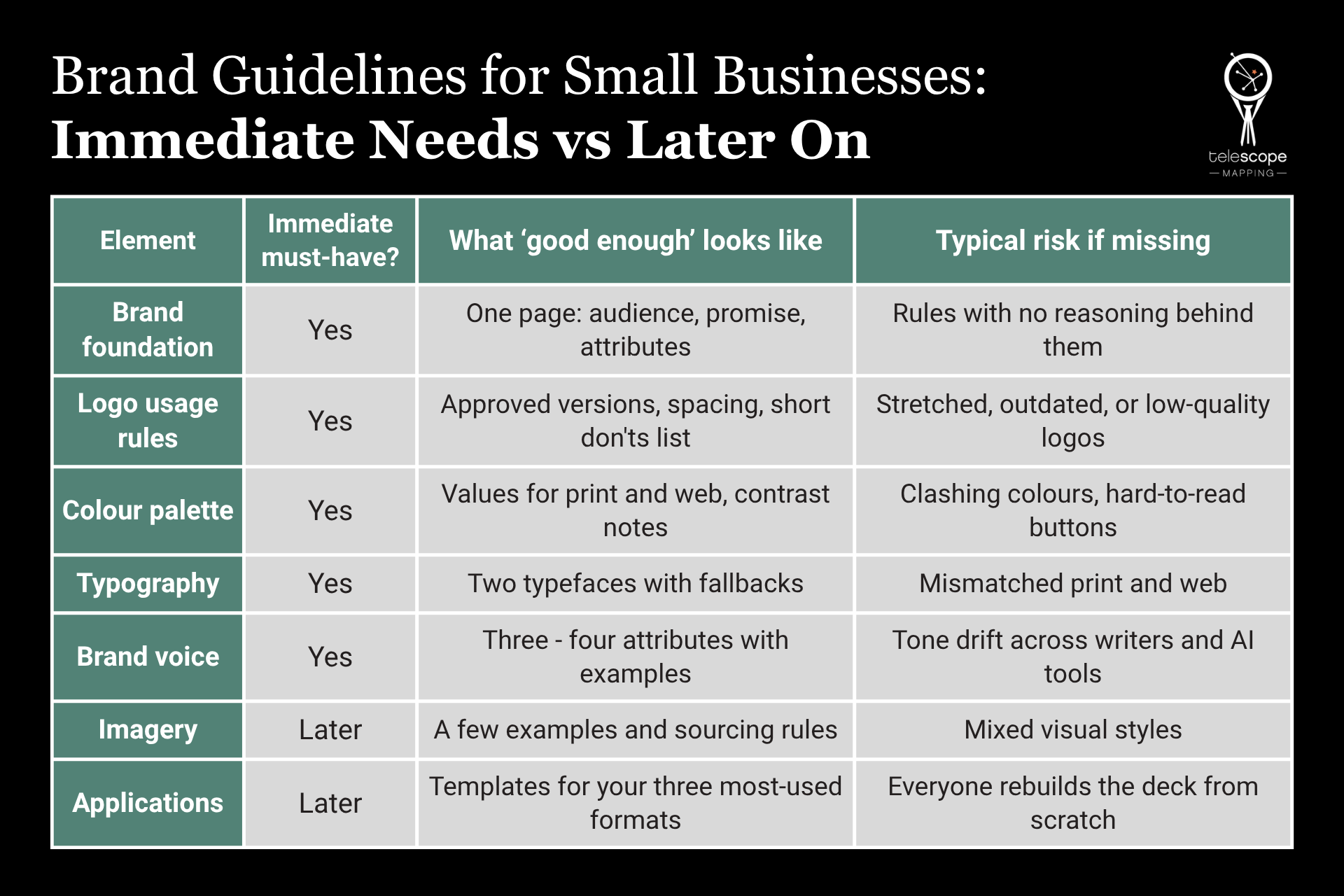 If you’re starting from nothing, begin with the first five rows. Add imagery and templates as the gaps show up in real work.
How to Present & Maintain Your Guidelines So They’re Actually Used
A guide stored as an email attachment is a guide nobody follows. Put it in one shared location, create a one-page quick-reference version for everyday use, and build templates in the tools your team already uses, whether that’s Google Slides, Canva, or your website’s content management system.
Assign a named owner and a light review cadence: once a year, plus whenever you redesign or migrate your website. A redesign is the moment to apply the rules and protect the brand equity you’ve already built, and Google’s guidance on site moves explains how to keep search visibility intact when URLs change. A good website redesign process starts from the guide instead of improvising around it.
The most common pitfall is treating the guide as a one-time design project. Channels, products, and people change, and a guide that doesn’t change with them is obsolete within a year.
To test whether yours works, answer these six questions with a plain yes or no:
- Could a new freelancer produce an on-brand asset without asking you anything?
- Can anyone find the latest logo file in under a minute?
- Are your colours and fonts saved as styles in your design and web tools?
- Could two people write about the same product and sound like one company?
- Does a named person own updates and approve exceptions?
- Do your website, ads, and location pages look like they belong together?
As a rule of thumb, five or six yeses mean the guide is doing its job. Three or four mean it needs targeted fixes. Two or fewer mean it exists on paper but not in practice.
Brand Guidelines for Small Business: FAQs
How long should a small-business brand guide be?
Long enough that every rule settles a real question, and short enough that people actually read it. If a rule has never resolved a disagreement or prevented a mistake, cut it. A five-person team with one location needs less than a multi-location brand with franchise partners.
How much does it cost, and how long does it take?
Typical ranges vary widely, and none are guaranteed. The main cost drivers are whether a brand identity already exists, how many applications you need documented, and how many stakeholder review rounds you go through. Documenting an existing identity is usually much faster than building one from scratch.
Can we build one in-house, or do we need an agency?
In-house works when your identity is settled and someone has the time to document it carefully. Outside help makes sense when your assets are already inconsistent, you’re rebranding, or you’re rolling out across many locations. An outside view is also useful when no one on the team feels able to say no to the founder’s favourite logo.
How do we know the guidelines are working?
Look for operational signals: fewer “which logo is current?” messages, contractors delivering usable first drafts, and consistent assets across locations. Also check that your website, ads, and reporting dashboards present the brand the same way. If you only spot problems after something has been published, the guide is not yet being used upstream.
Make Your Brand Easier to Get Right Than Wrong
The best brand guidelines for small businesses aren’t the most thorough ones. They’re the ones your team opens on a Tuesday afternoon while building something real. Start with the elements people get wrong most often (logo, colour, and voice) and document them in a form your team will use this month, not a perfect manual next year.
If you’re unsure how consistently your brand shows up across your website, campaigns, and locations, book a free consultation with Telescope Mapping today. We’ll look at what’s live today and help you decide what to formalize first.